
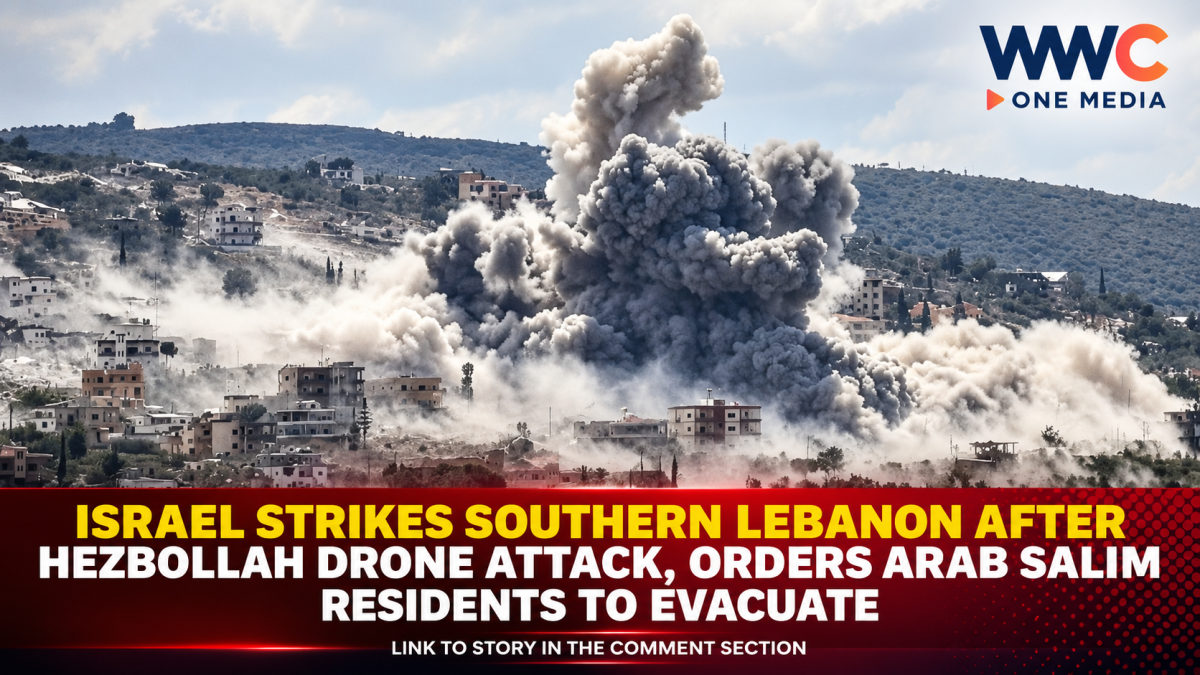
BEIRUT — Israel launched fresh strikes in southern Lebanon on Sunday after the Israeli military said Hezbollah had launched two drones toward Israeli soldiers operating inside an Israeli-declared security zone, sharply raising tensions despite ongoing efforts to maintain a ceasefire.
The Israel Defense Forces (IDF) said the drones were directed at its troops in southern Lebanon but reported no Israeli soldiers wounded. Israel subsequently announced that it was conducting strikes against what it described as Hezbollah targets in the area.
The Israeli military also issued an evacuation warning to residents of Arab Salim, urging them to leave the area ahead of planned military action. The warning adds another layer of concern for civilians already affected by months of fighting and displacement.
The latest escalation follows a series of Israeli strikes across southern and eastern Lebanon in recent days.
Casualties reported as strikes continue
Lebanon’s Health Ministry reported that Israeli strikes on Friday killed at least three people and wounded 23 others across several locations in the south and the western Bekaa region. The ministry said the strikes hit areas in the Tyre and Nabatieh districts as well as the Bekaa.
The reported toll has varied as Lebanese authorities continued updating casualty figures. Other reports said the number of people killed later rose to four. The figures also did not initially distinguish between civilians and combatants.
Israel said its earlier strikes were aimed at Hezbollah personnel and infrastructure, including weapons-storage facilities, and were carried out in response to what it described as attacks against its forces. Hezbollah has disputed or not immediately claimed some of the incidents cited by Israel.
Strategic ridge becomes a new flashpoint
The latest violence comes days after Israel announced that its forces had taken “operational control” of the Ali al-Taher ridge, a strategically important high point overlooking parts of southern Lebanon.
Israel says Hezbollah had underground infrastructure in the area and that its forces intend to consolidate their position and prevent the group from rebuilding there. Hezbollah, however, has questioned Israel’s claim of full control of the ridge.
The development has intensified fears that the security situation in southern Lebanon could deteriorate further.
Reuters reported that Iran had previously warned the United States against a major Israeli offensive targeting Hezbollah positions around the ridge, underscoring the potential for the confrontation to expand beyond the immediate Israel-Hezbollah battlefield.
Ceasefire efforts under growing pressure
The renewed attacks are particularly significant because they come despite ceasefire and diplomatic arrangements involving Israel and Lebanon.
According to reporting by Al Jazeera and other outlets, agreements reached in June were intended to halt fighting and establish conditions involving Hezbollah’s weapons and the presence of Israeli forces in southern Lebanon. However, Israeli strikes and Hezbollah-related incidents have continued.
The continuing violence is also creating a major humanitarian problem.
Reuters reported that more than 340,000 people remain displaced in southern Lebanon, while dozens of public schools are being used as shelters. Thousands of children remain out of their homes as Lebanon prepares for the new academic year.
The United Nations has previously warned that displacement orders and continuing hostilities are placing civilians under severe pressure, particularly in communities south of the Zahrani River.
What happens next?
The immediate focus is now on whether Sunday’s Israeli strikes and evacuation order remain limited to a specific Hezbollah-related target or become part of a broader military escalation in southern Lebanon.
For residents of Arab Salim and surrounding communities, the latest warning means another round of uncertainty in an area that has already endured repeated attacks, displacement and destruction.
With Israel maintaining military positions in parts of southern Lebanon, Hezbollah continuing to oppose Israeli actions and diplomatic efforts still struggling to produce a lasting settlement, the latest exchange threatens to further test the fragile calm.
For now, the warning to evacuate Arab Salim signals that the fighting in southern Lebanon is far from over — and the next Israeli move could determine whether the latest escalation remains localized or opens another, much wider chapter in the conflict.
WWC ONE MEDIA J.M.S

Leave a Reply