
Hyundai Motor Group is turning steel into the foundation of a much bigger U.S. manufacturing strategy—one that reaches beyond cars and into robotics, energy infrastructure and potentially aerospace.
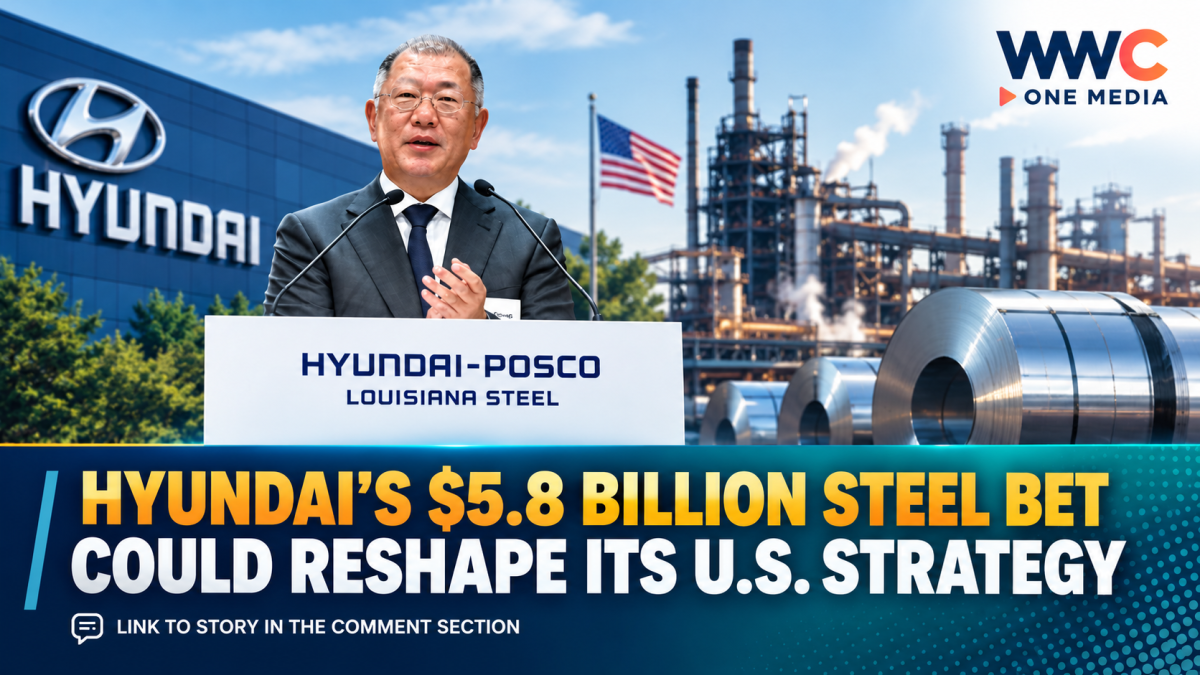
Hyundai Motor Group is making a massive bet on American steel, breaking ground on a $5.8 billion electric-arc-furnace steel mill in Louisiana as the South Korean industrial giant moves to build a more localized manufacturing supply chain in the United States.
The Hyundai-POSCO Louisiana Steel project in Donaldsonville is expected to begin production in early 2029, with annual capacity of about 2.7 million metric tons. About 1.8 million tons is expected to be automotive steel, while another 900,000 tons will be available for other industrial applications.
But the bigger story is what Hyundai says it wants to do with that steel.
From cars to robots, data centers and aerospace
At the groundbreaking ceremony, Hyundai Motor Group Executive Chair Euisun Chung described the facility as more than an automotive supply project.
The company expects the mill to produce high-grade, lower-carbon steel for Hyundai and Kia vehicles, while also targeting potential demand from humanoid robots, AI data centers, power-generation facilities and aerospace applications.
Chung specifically said Hyundai’s high-value steel could eventually be used in its Atlas humanoid robot and expressed hopes that the company could one day supply steel for the U.S. space industry. Those comments indicate that Hyundai sees the mill as part of a much wider industrial ecosystem rather than simply a factory supplying its vehicle plants.
That strategy could give Hyundai an important advantage as the United States pushes companies to manufacture more of their products and components domestically.
The tariff problem is a major part of the equation
The timing is hardly accidental.
The United States has imposed a 50% tariff on imported steel, creating a powerful incentive for manufacturers that consume large amounts of steel to establish domestic supply.
SBS News reported that the Louisiana project is designed to help Hyundai overcome that tariff barrier by creating a supply chain in which steel and automobiles can be produced locally in the United States. The steel is expected to supply Hyundai’s Alabama operation and Kia’s Georgia facility, among other potential customers.
But the investment also gives Hyundai greater control over a critical input.
Instead of depending as heavily on steel shipped from South Korea, the group can increasingly connect its American vehicle production with steel manufactured inside the United States.
That could make its North American operations more resilient to tariffs, shipping disruptions and changes in trade policy.
Hyundai and POSCO are building more than a steel mill
The ownership structure underscores the project’s strategic importance.
Hyundai Motor Group companies will collectively control 80% of the Louisiana venture: Hyundai Steel holds 50%, Hyundai Motor 15% and Kia 15%. POSCO holds the remaining 20%. Reuters reported earlier this year that the project would be financed through $2.9 billion in equity and $2.9 billion in external borrowing, bringing total planned investment to $5.8 billion.
The technology is also significant.
The facility will use an electric arc furnace, combined with direct-reduced-iron technology, to produce steel with substantially lower emissions than traditional blast-furnace production.
Louisiana Economic Development says the facility is expected to produce 2.7 million metric tons annually and could generate approximately 1,300 direct jobs and more than 4,100 indirect jobs. The state also says the project is expected to have roughly 70% of its contracts with Louisiana companies, potentially creating opportunities for local suppliers and contractors.
The project is only one piece of Hyundai’s U.S. expansion
The steel mill is part of a much larger Hyundai Motor Group commitment.
The group announced a $26 billion U.S. investment plan for 2025 through 2028, covering steel, automobiles and robotics. Hyundai said the investment is intended to strengthen local supply chains while expanding U.S. vehicle production and establishing a robotics manufacturing hub.
The company previously said the broader plan could create approximately 25,000 direct U.S. jobs by 2028.
That means the Louisiana steel project should not be viewed in isolation. It is one component of Hyundai’s attempt to create a deeper manufacturing network inside the United States—from raw materials to vehicles and emerging technologies.
Why this matters for Hyundai
For Hyundai, the Louisiana mill could solve several problems at once.
It can provide a domestic source of automotive steel, reduce exposure to imported-steel tariffs, strengthen supply-chain control and potentially create a new source of materials for businesses outside the traditional auto sector.
It also gives Hyundai a stronger argument for expanding manufacturing in the United States at a time when Washington is increasingly emphasizing domestic production.
And there is another potential advantage: scale.
A 2.7-million-ton annual capacity gives the facility room to serve more than Hyundai’s immediate automotive needs. The company’s comments about robots, power infrastructure, AI data centers and aerospace suggest it is already looking beyond the first generation of customers.
But the strategy comes with risks
The enormous investment is not without challenges.
Steelmaking is capital-intensive, and the economics will depend on construction costs, energy prices, steel demand and the long-term direction of U.S. trade policy.
There is also a broader question for South Korea.
As Korean manufacturers move billions of dollars of investment into the United States, policymakers and businesses in Seoul face pressure to ensure that overseas expansion does not weaken domestic production, employment and industrial capabilities.
SBS News highlighted this tension, noting that while the U.S. investment can help Korean companies overcome American trade barriers, maintaining Korea’s domestic industrial base remains an important issue.
The bigger picture
Hyundai’s Louisiana steel mill may ultimately be remembered as more than a response to tariffs.
The project represents a shift toward a localized U.S. manufacturing ecosystem, where Hyundai can produce or source more of the critical materials needed for its vehicles and future technologies inside the American market.
Steel sits at the center of that strategy.
And if Hyundai succeeds in connecting its steel operations with automobiles, robotics, AI infrastructure and other advanced industries, the Louisiana facility could become one of the most important building blocks in the company’s American expansion.
The steel mill is scheduled to begin production in 2029. The bigger question is what Hyundai’s U.S. industrial empire will look like by the time it starts.




Leave a Reply