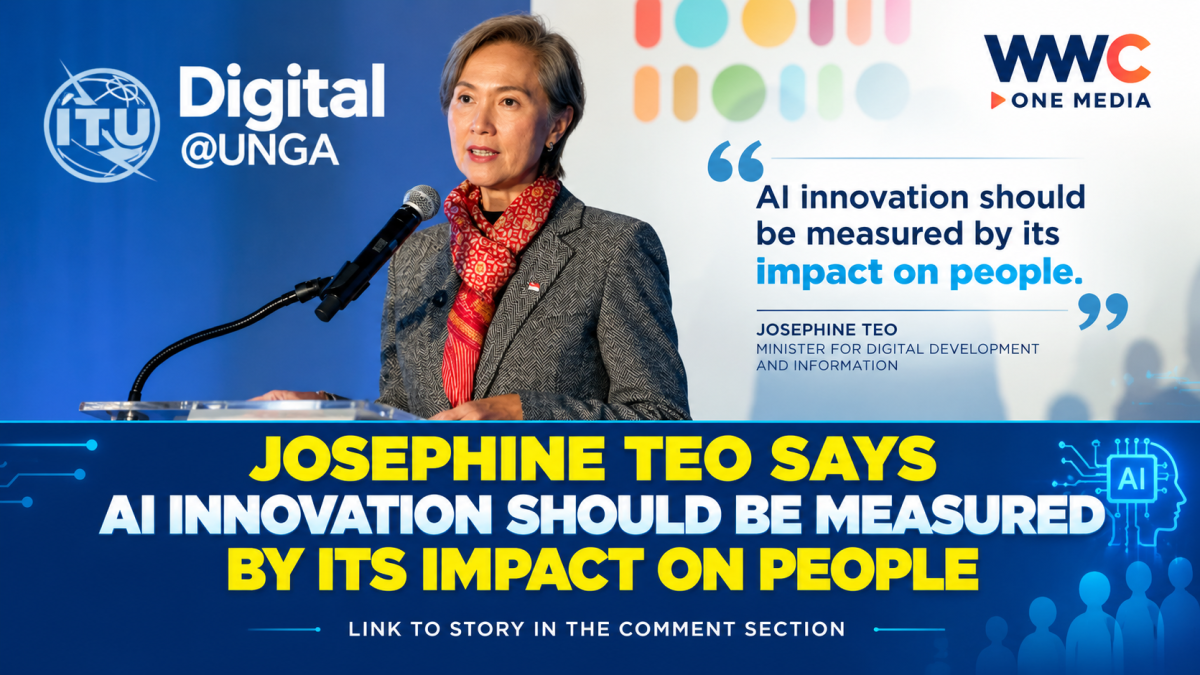
Singapore’s Minister for Digital Development and Information Josephine Teo has called for a shift in how artificial intelligence innovation is measured, saying the real test should be whether AI makes a meaningful difference to people’s lives.
Speaking at the Digital@UNGA platform in New York on Sept. 21, Teo said Singapore was less focused on simply building increasingly powerful AI models and more interested in how the technology could be deployed to improve public services.
She identified three key priorities for AI innovation: impact, trust and inclusivity.
Almost 70 per cent of Singapore’s public officers now regularly use AI tools for tasks including analysing information and preparing drafts. The Government is also exploring AI agents that could redesign entire workflows, while keeping human officers accountable for important decisions.
Singapore is already using AI in several areas of public administration. Machine learning can help route reports about issues such as broken swings or faulty streetlights to the appropriate agency more quickly. AI is also being used to identify unusual patterns among millions of cargo shipments at the country’s borders and to detect signs of phishing and impersonation scams.
Teo said trust would become increasingly important as AI becomes more deeply integrated into everyday life. She pointed to scams and cyberattacks as examples of how the same technology can also be used for harmful purposes.
Her remarks come as Singapore expands its broader national AI strategy. In May, the Government announced refreshed priorities for its National AI Strategy, including deeper AI adoption across the public sector, stronger workforce capabilities, expanded research, better access to data and stronger AI governance.
Singapore has also joined an international push for greater oversight of frontier AI. The country was among 21 governments and the European Union backing a declaration calling for international standards, verification mechanisms and stronger cooperation on AI safety. The statement said AI should remain under human direction, oversight and control.
Another part of Singapore’s approach is making AI more inclusive across different languages and communities. AI Singapore is working with international partners on Project ATLAS, which aims to develop AI-ready datasets for languages that are currently underrepresented in AI systems.
The broader challenge is therefore no longer simply how quickly AI models can become more capable. For Singapore, the focus is increasingly on whether those capabilities can translate into better services, safer digital environments and benefits that reach more people.
As AI moves from experimentation into everyday government and business operations, the question of how much the technology improves people’s lives could become just as important as how powerful the underlying models become.