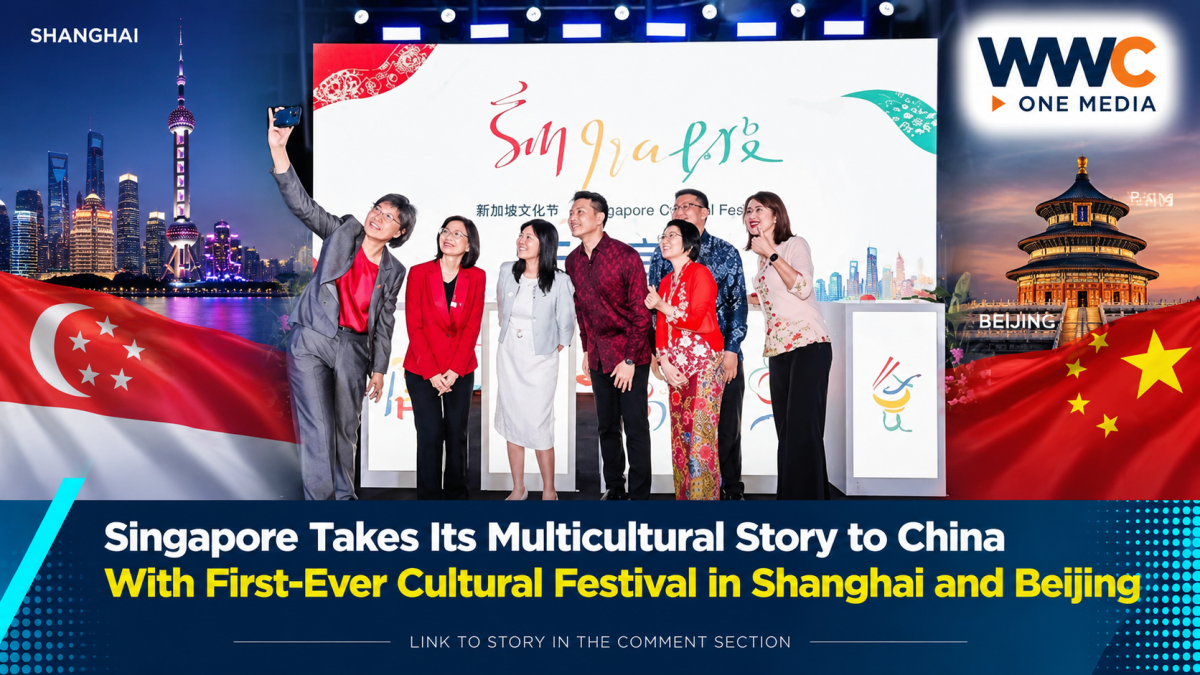
SINGAPORE — Singapore is bringing its distinctive multicultural identity to China through a new cultural festival that puts music, film, food, heritage and digital storytelling on the same stage.
Organised by Singapore’s Chinese-language newspaper Lianhe Zaobao, the inaugural Singapore Cultural Festival officially opened in Shanghai on Sept. 17 and will continue with public programmes in Shanghai from Sept. 19 to 20, before moving to Beijing from Sept. 24 to 26.
Supported by Singapore’s Ministry of Culture, Community and Youth, the festival is designed to give Chinese audiences a broader look at how Singaporean culture has developed through the interaction of Chinese, Malay, Indian, Eurasian and other cultural influences.
More Than a Showcase of Singaporean Culture
The festival goes beyond presenting traditional Singaporean performances.
Its programme combines concerts, Singaporean films, gastronomy, cultural discussions and an interactive digital exhibition, reflecting the organisers’ effort to show Singapore as a multicultural society whose traditions have evolved over generations.
The festival’s Shanghai opening attracted more than 200 guests from Singapore and China, representing government, business, cultural, academic and media circles.
Singapore’s Culture, Community and Youth Minister and Second Minister for Education Edwin Tong said cultural exchanges can help people from both countries better understand how their respective cultures evolved under different historical and social circumstances.
He also described culture as an important bridge between people in Singapore and China.
Music That Connects Singapore’s Different Cultures
One of the festival’s major highlights is the “Harmonic Echoes” concert, presented by Singapore’s Siong Leng Musical Association and the cross-cultural ensemble Artusik.
Siong Leng brings the centuries-old Nanyin tradition—whose roots are in Fujian—to the festival with a distinctly Singaporean interpretation.
Its performance incorporates elements of Indian classical music and dance, demonstrating how an art form with Chinese origins has developed within Singapore’s multicultural environment.
Artusik takes the fusion even further, incorporating musical influences associated with Malay, Chinese, Indian, Middle Eastern and Western traditions.
The performances are therefore not simply attempts to reproduce traditional Chinese music. They are intended to demonstrate how cultural traditions can change after taking root in a different society.
Four Singapore Films Head to Chinese Audiences
Cinema is another major part of the festival.
Four Singaporean feature films are scheduled for screening:
- We Are All Strangers
- Ajoomma
- 667
- Ah Girl
The programme gives audiences in Shanghai and Beijing another way to explore Singaporean stories beyond music and heritage.
Some screenings also include opportunities for audiences to engage with filmmakers, adding a discussion element to the cinematic programme.
Singapore’s Food Story Takes Center Stage
Food is also being used to tell Singapore’s cultural story.
The festival features a specially curated dining experience led by Singaporean chef Justin Quek and culinary researcher David Yip.
Rather than treating Singaporean food simply as a list of famous dishes, the programme explores the country’s culinary evolution and the cultural influences behind its food traditions.
That approach mirrors one of Singapore’s most recognisable features: different communities maintaining their own food traditions while influencing one another over time.
A Digital Window Into Singapore
Another major attraction is “Singapore, In Perspective”, a digital cultural exhibition curated by Singapore’s National Heritage Board.
The exhibition uses interactive installations, multimedia content and games to explore aspects of Singapore’s history, heritage and multicultural society.
Among the themes highlighted is the everyday experience of different communities sharing public spaces—including the familiar image of people from different backgrounds sitting together at a hawker centre.
The exhibition is designed to show that multiculturalism is not only found in major celebrations or official ceremonies, but also in ordinary daily life.
From Shanghai to Beijing
The festival’s first public programmes will take place in Shanghai on Sept. 19 and 20.
The programme then moves north to Beijing from Sept. 24 to 26, extending the cultural exchange to another major Chinese city.
The geographic spread is significant because the festival is intended not merely as a one-night performance, but as a broader cultural programme involving several forms of Singaporean creative expression.
A New Chapter in Singapore-China Cultural Exchange
The festival also arrives against the backdrop of longstanding cultural links between Singapore and China.
At the Shanghai opening, officials highlighted the history of cultural exchanges between the two countries, including artistic and institutional collaborations that predate the establishment of formal diplomatic relations in 1990.
Yicai reported that Tong pointed to earlier cultural exchanges, including a visit by China’s Oriental Song and Dance Ensemble to Singapore in 1979.
More recent collaborations include work between Singapore’s Asian Civilisations Museum and China’s Dunhuang Academy, showing that cultural exchanges extend beyond performances and festivals.
Why the Festival Matters
For Lianhe Zaobao, the festival represents an expansion of its role beyond news publishing.
SPH Media described the newspaper as having a longstanding involvement in Chinese-language education and cultural preservation, while the festival gives it a platform to present Singapore’s Chinese heritage within the country’s wider multicultural identity.
That distinction is central to the festival’s message.
Singapore’s Chinese culture is presented not as an isolated extension of China’s culture, but as something that developed in Southeast Asia through migration, local history and interaction with other communities.
The result is a cultural identity that can have Chinese roots while also being distinctly Singaporean.
Singapore’s Culture Goes on the Road
The inaugural Singapore Cultural Festival ultimately offers a different way of presenting the city-state to audiences abroad.
Instead of relying on a single performance or exhibition, it combines music, cinema, cuisine, heritage and digital technology to tell a larger story about how Singapore’s multicultural society developed.
As the festival moves from Shanghai to Beijing, its central message is becoming increasingly visible: Singapore’s culture is shaped not only by where its traditions came from, but also by how those traditions evolved after different communities began sharing the same city and society.
And with the festival now making its debut in China, Singapore is putting that multicultural story on an international stage.