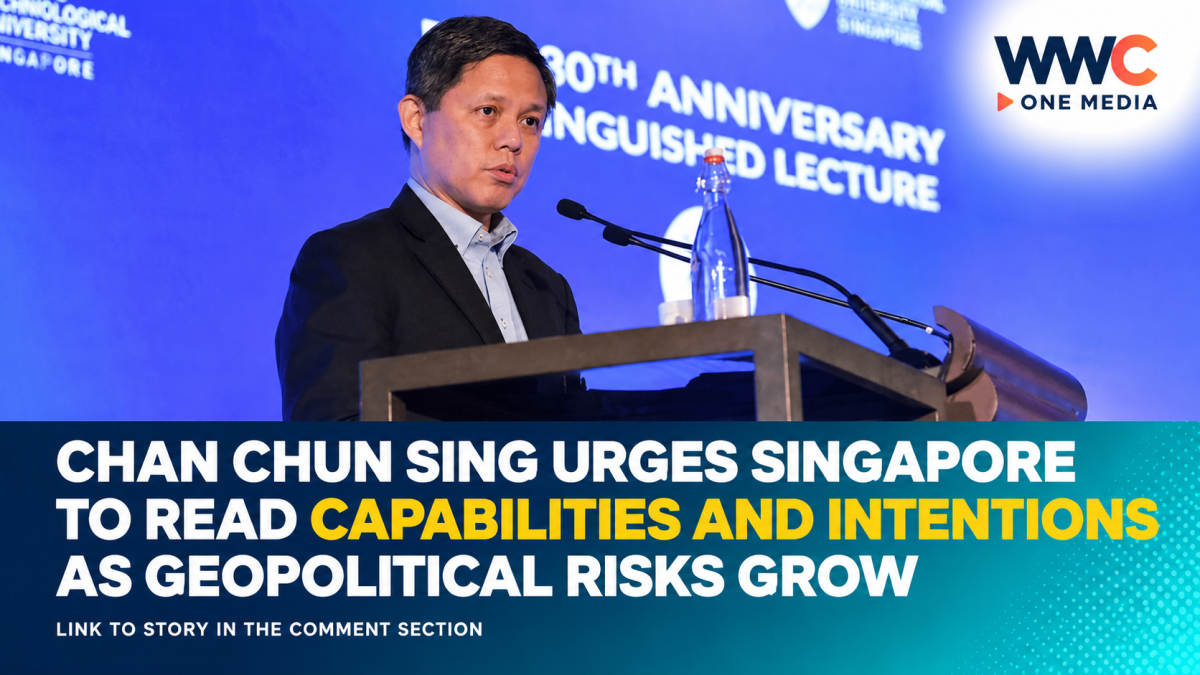
Singapore must deepen its understanding of other countries, their leaders and the forces shaping their decisions as geopolitical competition becomes more complex, Defence Minister Chan Chun Sing said.
Speaking at the 30th anniversary distinguished lecture of the S. Rajaratnam School of International Studies (RSIS) on Sept. 22, Chan said Singapore cannot change its geography or avoid geopolitics, but it can strengthen its ability to anticipate developments and reduce the risk of miscalculation.
He said the international environment has changed significantly since RSIS’s predecessor, the Institute of Defence and Strategic Studies, was established in 1996. The rivalry between the United States and China now extends across trade, technology, supply chains and ideology, while economic interdependence can also be used as leverage.
Chan argued that Singapore needs to understand the world more deeply than might be expected of a small state, using that knowledge to remain relevant and connected while anticipating changes before they become crises.
A major part of that effort, he said, involves understanding not only institutions and broad geopolitical trends but also individual leaders, including their worldviews, domestic pressures and ambitions.
He pointed to China, the United States, Indonesia and Malaysia as examples where domestic developments and political dynamics can have consequences for Singapore and the wider region.
Chan said Singapore’s relationships with Malaysia and Indonesia also cannot be managed on “autopilot”. Understanding those ties requires knowledge of their history, political cultures, economic structures, demographics and internal institutions.
The minister also highlighted the growing impact of technology on security.
Artificial intelligence, autonomous systems and drones are changing how conflicts are conducted and how power is projected. Chan said commercial technologies are giving smaller states and non-state actors capabilities that once required much greater resources.
He also warned that modern conflicts do not necessarily begin with conventional military action. Cyber operations, information warfare and activity in so-called grey zones can take place below the threshold of traditional armed conflict.
For Singapore, that means technological advances must be considered not only in terms of what they can accomplish, but also how they affect decision-making and the risks of escalation. Chan said human judgement should remain central to consequential decisions involving AI and other emerging technologies.
The central message of his lecture was the difficulty of assessing another party’s intentions.
Capabilities can often be assessed through available information, he said, but intentions are much harder to determine. Distinguishing meaningful signals from background noise therefore becomes critical, particularly when countries have limited room for error.
Chan compared the challenge to chess: knowing where the pieces are does not necessarily reveal what the other player intends to do with them.
He said strategic patience is also important because geopolitical decisions do not always unfold in a predictable sequence. Knowing when to act — and when to hold back — requires confidence in one’s own capabilities as well as a clear understanding of the other side.
Poor understanding of others, combined with poor understanding of one’s own capabilities and limitations, can increase the possibility of miscalculation, he said.
As RSIS enters its fourth decade, Chan called on the institution to continue developing deeper research, international relationships and forward-looking analysis so Singapore can better anticipate changes in an increasingly uncertain strategic environment.