
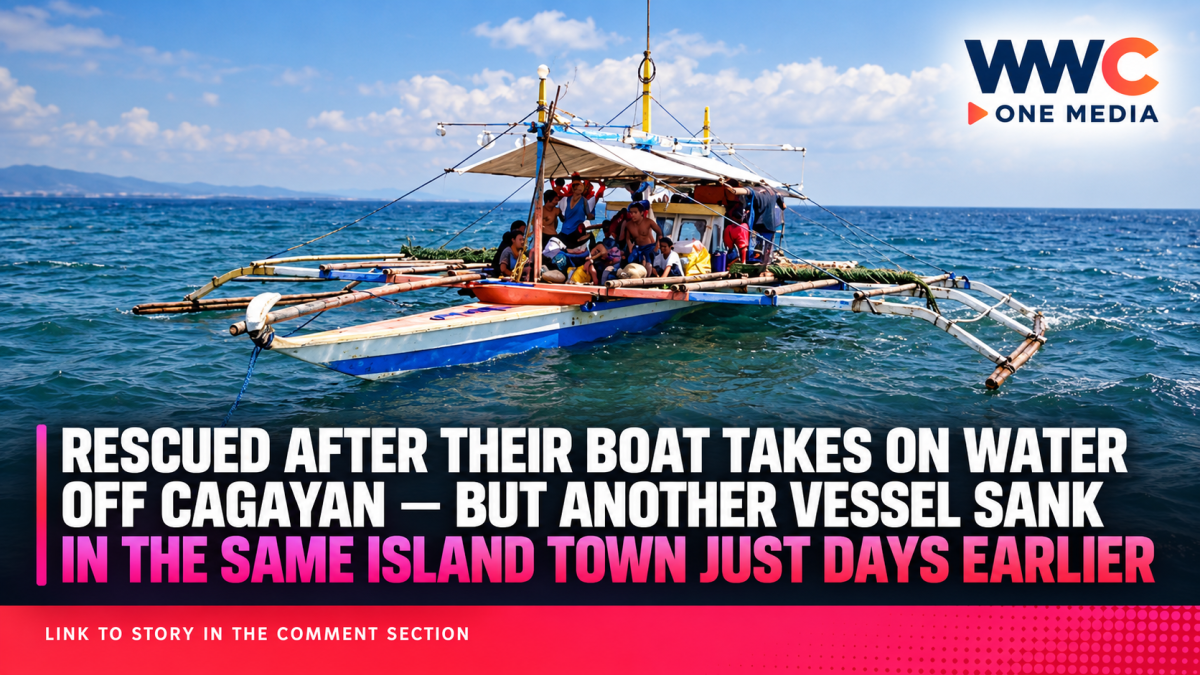
CAGAYAN, Philippines — What began as a routine sea journey between mainland Cagayan and the remote Calayan island group turned into a frightening rescue operation after a passenger motorbanca was battered by strong waves and became partially submerged on Saturday, Sept. 5.
The Philippine Coast Guard rescued 18 people aboard motorbanca Geri Ann, according to a PCG-based report by the Manila Bulletin. The group consisted of 11 passengers and seven crew members, and no deaths were reported.
Separate reporting by the Philippine Daily Inquirer identified the vessel as MB Geri An and said it encountered trouble near Dalupiri Island in Magsidel, Calayan, Cagayan, after departing from the port of Claveria earlier that morning.
The difference in spelling appears in the published reports themselves, with Manila Bulletin using “Geri Ann” and the Inquirer using “Geri An.”
But there is an even more significant discrepancy: the Inquirer reported 17 rescued people, while the PCG-based Manila Bulletin account gave a total of 18.
Until authorities issue a reconciled final manifest, 18 is the best-supported figure from the more detailed PCG account, but the conflicting number should not be concealed.
Strong waves began filling the boat with water
According to Calayan Municipal Disaster Risk Reduction and Management Officer Jeo Robert Arirao, the motorbanca had left Claveria and was traveling toward Calayan when it encountered strong waves.
The waves repeatedly struck the vessel, allowing water to enter until the boat eventually capsized or became substantially submerged near Dalupiri Island, according to the Inquirer account.
The situation could have become considerably worse.
Crew members were still able to transmit a radio distress message to the Coast Guard and local disaster-response personnel. Rescuers then headed toward the distressed vessel.
Another motorbanca, MB Claricel, was used to help pull the damaged vessel, the Inquirer reported.
The passengers and crew were subsequently brought to safety.
Those rescued underwent medical examinations after reaching port and were cleared to return home, according to local disaster officials quoted by the Inquirer.
No deaths — despite a potentially dangerous situation
The most important outcome is straightforward:
Everyone reported aboard survived.
There were no reported fatalities in the available accounts, an outcome that highlights how crucial the crew’s ability to communicate with authorities became once the vessel began taking on water.
For passengers traveling among Cagayan’s northern islands, however, the accident raises another question.
Why did another vessel get into trouble in almost the same area only days after an earlier boat sank?
Another passenger boat sank in Calayan just three days earlier
The Sept. 5 incident was not an isolated maritime emergency around Calayan that week.
On Sept. 2, passenger boat M/B Lance sank while secured along the shoreline of Barangay Magsidel in Calayan.
Unlike Geri Ann, Lance was not transporting passengers when it sank.
The Inquirer reported that the vessel had been kept ashore because of monsoon rains and the threat posed at the time by Tropical Cyclone Pilandok. Strong waves eventually filled it with water and caused it to sink. One worker who went aboard in an effort to retrieve belongings was unharmed.
Residents and volunteers later attached drums to the sunken boat in an effort to raise it and bring it back toward shore.
The Coast Guard had also restricted sea travel because of gusty winds and strong waves, according to that report.
That means two separate vessels encountered serious problems in the Calayan area within only a few days.
The circumstances were different, but both incidents underscore the vulnerability of small vessels operating around the island municipality when sea conditions deteriorate.
Calayan’s geography makes boats essential
Calayan is part of the Babuyan Islands north of mainland Luzon, making maritime transportation essential for residents, workers and cargo moving between the islands and mainland Cagayan.
Routes from places such as Claveria and Aparri can therefore become lifelines for island communities.
But they are also exposed to open-sea conditions.
When winds strengthen and waves rise, smaller wooden or outrigger vessels can become particularly vulnerable to water ingress, damaged outriggers and loss of stability.
The Sept. 5 accident is a clear example: according to the disaster official interviewed by the Inquirer, strong waves—not a collision—were reported as the immediate cause of the boat filling with water.
Habagat was still affecting Luzon
The broader weather picture also matters.
PAGASA reported that the southwest monsoon, or habagat, was affecting Luzon and the Visayas during this period. Its Sept. 4 weekend outlook said Cagayan Valley was expected to experience cloudy conditions with scattered rain showers and thunderstorms.
By Sept. 6, PAGASA was still identifying the southwest monsoon as the dominant weather system affecting Luzon and the Visayas.
That does not by itself prove the habagat caused the Geri Ann incident; investigators and local officials are the proper sources for determining the exact maritime cause.
But it establishes that the rescue unfolded during a period of unsettled weather affecting northern Luzon.
A successful rescue — but also a warning
There was no mass-casualty tragedy off Calayan on Saturday.
Instead, the story ended with passengers and crew safely ashore.
That makes the operation a successful rescue.
But two vessel incidents within several days of one another also put renewed attention on sea-condition monitoring, sailing clearances, passenger manifests, life-saving equipment and the speed with which distress calls can reach rescuers on some of the country’s more remote inter-island routes.
The Geri Ann’s crew managed to radio for assistance.
Rescuers were able to respond.
Another boat was available to help recover the distressed vessel.
And the people onboard made it back alive.
In maritime emergencies, that chain of events can be the difference between a rescue story and a disaster.
For travelers in northern Cagayan, however, the bigger concern remains:
with rough seas already damaging two boats around Calayan in the space of several days, the next decision on whether a small vessel should leave port could matter just as much as the rescue operation waiting on the other end.
WWC ONE MEDIA M.J.E



Leave a Reply