
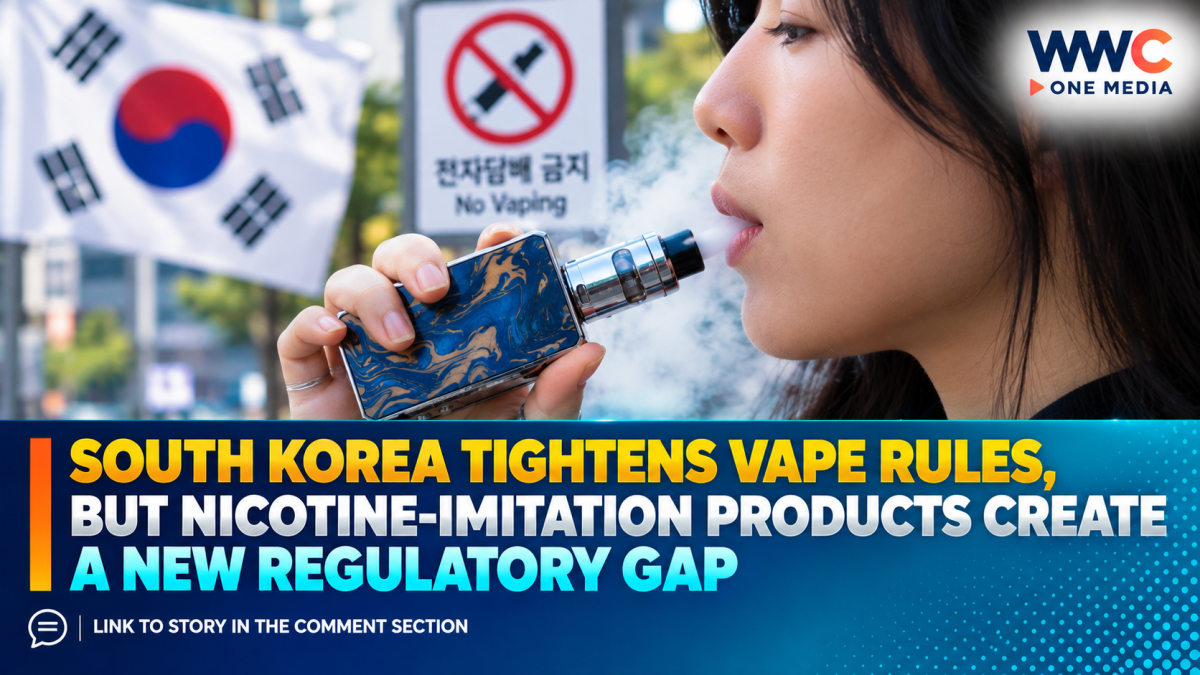
SEOUL, South Korea — South Korea has tightened its rules on electronic cigarettes, bringing natural and synthetic nicotine products under the country’s tobacco-control framework.
But regulators now face a new problem: products marketed as nicotine-free or using nicotine-like chemicals can fall outside the main tobacco law, even as testing has found actual nicotine in some products sold under “nicotine-free” labels.
The emerging loophole is raising concerns about consumer protection, youth access and whether existing regulations can keep pace with rapidly changing nicotine products.
A new vape rule took effect in April
A revision to South Korea’s Tobacco Business Act took effect in April, expanding the legal definition of tobacco to cover products containing both natural and synthetic nicotine.
The change ended a long-standing regulatory gap surrounding synthetic-nicotine e-cigarettes and brought them under rules applying to conventional tobacco products.
The revised framework includes restrictions on where e-cigarettes can be used, bans online sales of regulated e-cigarettes, requires health and ingredient information, and prohibits sales to minors.
The government has described the reform as an effort to close loopholes that allowed some nicotine products to operate outside the tobacco-control system.
But the regulatory landscape is already changing again.
The problem is what’s labeled “nicotine-free”
The Korea Times reported that nicotine-free and nicotine-imitation liquids can remain outside the Tobacco Business Act because the law’s definition centers on tobacco leaf and nicotine.
That has created an opening for some sellers to shift toward products marketed as containing no nicotine or containing alternative substances designed to imitate nicotine’s effects.
The issue is not merely theoretical.
A Korea Consumer Agency survey found actual nicotine in seven of 12 online liquid products marketed as nicotine-free.
That means consumers purchasing products under a nicotine-free description could, in some cases, be exposed to nicotine without the product being presented that way.
A separate examination of 15 e-cigarette liquids found that five had no required warning label and nine had labeling deficiencies.
Those findings have intensified calls for stronger oversight of products sitting between conventional tobacco regulation and the broader consumer-product market.
Enter 6-methylnicotine
One substance receiving particular attention is 6-methylnicotine, a synthetic nicotine analog whose molecular structure resembles nicotine.
It is different from synthetic nicotine itself.
Synthetic nicotine has the same chemical identity as nicotine but is manufactured rather than extracted from tobacco. A nicotine analog, by contrast, is a different chemical designed to produce nicotine-like effects.
That distinction is becoming increasingly important for regulators.
South Korean authorities say 6-methylnicotine has not undergone sufficient safety assessment domestically or internationally. Research has reported nicotine-like activity and cellular toxicity, but the full health consequences of exposure remain uncertain.
The Ministry of Food and Drug Safety plans to complete a hazard assessment of 6-methylnicotine this year and examine how authorities should respond if other nicotine-imitation substances appear.
That assessment could become an important turning point for how South Korea regulates the next generation of nicotine products.
Imports are also rising
The issue is becoming more urgent because nicotine analog imports into South Korea have increased.
According to figures reported from the Korea Customs Service, imports of nicotine analogs totaled about 15 tons from October 2025 through May 2026, with approximately 13 tons arriving during 2026 alone.
The sharp increase has drawn government attention to the supply chain as well as retail sales.
Beginning June 15, importers of related products were required to submit Material Safety Data Sheets containing information about chemical hazards and declare whether products contain nicotine analogs.
That requirement gives authorities another mechanism for identifying substances that might otherwise slip through gaps in existing tobacco rules.
The government has already started responding
South Korean authorities announced cautionary measures in June after testing identified nicotine and nicotine analogs in products promoted as nicotine-free.
The Ministry of Food and Drug Safety recommended that businesses stop selling products in which nicotine analogs were detected and asked online platforms to block sales of affected products.
The Ministry of Economy and Finance has also been examining products containing nicotine for possible violations of the Tobacco Business Act.
The issue is complicated because classification determines more than whether a product can be sold.
It can affect taxation, labeling, advertising, age restrictions, retail licensing and enforcement.
The youth-protection gap remains a concern
The regulatory challenge becomes even more significant when young consumers are involved.
Nicotine-free and nicotine-imitation liquids are subject to youth-protection restrictions under the Juvenile Protection Act, including restrictions on sales to people under 19 and warning-label requirements.
Yet the Korea Consumer Agency found significant problems with labeling among the products it examined.
That creates a potentially confusing situation for consumers and retailers.
A product may be promoted as nicotine-free and therefore appear to be outside conventional tobacco regulation, while authorities may still consider it a product requiring youth protections.
And if a product actually contains nicotine or a nicotine-like substance that is not properly disclosed, the enforcement problem becomes even more complicated.
The global problem is bigger than Korea
South Korea is not alone in confronting nicotine analogs.
Research published in recent years has documented the appearance of products containing substances such as 6-methylnicotine in markets outside Korea.
A 2025 investigation by The Examination reported that nicotine-analog products had appeared in the United States, Europe, Australia and South Korea. Researchers warned that some nicotine analogs can interact with the same biological receptors as nicotine, while the health effects of long-term exposure remain poorly understood.
The report also noted that some nicotine alternatives can be marketed as “nicotine-free” even though they contain chemicals intended to produce nicotine-like effects.
That creates a regulatory race.
As governments regulate one chemical, manufacturers and sellers can potentially turn to another substance that falls outside the wording of existing legislation.
Why 6-methylnicotine has attracted attention
Scientists are particularly interested in 6-methylnicotine because it is structurally related to nicotine and can interact with nicotine receptors.
Laboratory and animal research has raised concerns about its biological effects, while studies have also reported cellular toxicity.
But there is an important limitation: there is still not enough evidence to establish the full long-term health risk to people who use 6-methylnicotine products.
That uncertainty is exactly why South Korean authorities are conducting a formal hazard assessment rather than declaring the substance definitively safe or unsafe.
For consumers, however, uncertainty itself can be a problem.
They may assume “nicotine-free” means there is no nicotine-like substance involved, when the chemistry may be considerably more complicated.
South Korea’s regulators face a moving target
The country’s April reforms represented a major change.
For the first time, synthetic nicotine e-cigarettes were explicitly brought under the same broad tobacco-control framework as conventional nicotine products.
But the emergence of nicotine analogs shows why legislation based on a particular definition of nicotine can quickly become outdated.
The National Assembly Research Service has reportedly called for examination of whether a central coordinating body is needed to oversee the different ministries involved.
It has also recommended developing rules covering areas such as advertising, vending machines and disclosure requirements for nicotine-imitation products.
That could signal the next phase of South Korea’s tobacco-control policy: moving from regulating known nicotine products to regulating a broader category of substances capable of mimicking nicotine’s effects.
The bigger question: can the law keep up?
South Korea has already demonstrated that it is willing to tighten tobacco and vaping regulations.
The April reform was a major step toward closing the synthetic-nicotine loophole.
But the appearance of nicotine analogs presents a different challenge.
If regulation is written around a specific chemical definition, companies can potentially develop or market another substance that produces similar effects without falling under the same legal classification.
That does not automatically mean every nicotine-free or nicotine-imitation product is illegal or dangerous.
It does mean regulators need reliable testing, transparent labeling and rules that can adapt as new substances enter the market.
For consumers, the warning is equally important:
“Nicotine-free” should not automatically be interpreted as “risk-free.”
And for South Korean regulators, the next challenge may be even harder than the one they thought they had already solved.
The government closed one major vaping loophole in April.
Now, a new generation of nicotine-like products may be testing whether the law can close the next one.


Leave a Reply