
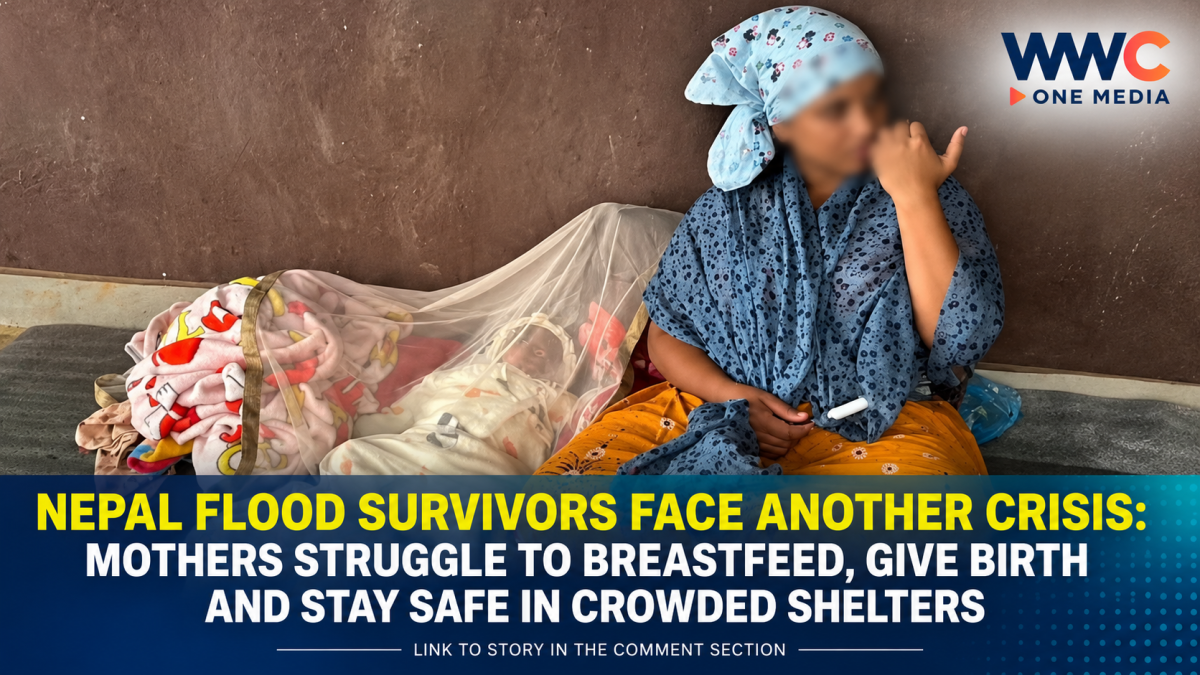
KATHMANDU, Nepal — The floodwaters that tore through communities along Nepal’s Bhote Koshi and Trishuli river systems have receded, but for thousands of displaced families, the humanitarian emergency is far from over.
Among those facing some of the most difficult conditions are pregnant women, new mothers and newborn babies, many of whom are now living in crowded temporary shelters where privacy, adequate nutrition and access to maternity care remain major challenges.
The situation has become particularly urgent because damaged roads and bridges are making it difficult for women in labor or with pregnancy complications to reach hospitals.
A report by The Kathmandu Post described shelters where breastfeeding mothers are sharing cramped spaces with strangers, sometimes dealing with cigarette smoke, inadequate food and a lack of private areas to nurse their babies.
For mothers already recovering from childbirth, the disruption can be especially dangerous.
A mother and newborn forced to flee
UNICEF documented the case of 29-year-old Nanu Maya Majhi, who fled with her family just 13 days after giving birth—and only about a week after undergoing a Caesarean section.
When floodwaters approached on August 26, she carried her newborn toward higher ground while still recovering from surgery.
The family spent four days in an animal shed before reaching a school shelter. Her newborn subsequently developed a facial rash.
The family later received hygiene supplies, water-purification materials and shelter assistance through UNICEF-supported relief efforts.
Her story illustrates how the disaster has created a second emergency: women who would normally receive specialized postpartum care are instead trying to recover while displaced.
Thousands of pregnant women affected
The scale of the problem is substantial.
UNFPA estimates that about 98,560 women of reproductive age have been affected by the disaster, including approximately 5,030 pregnant women.
The agency said damaged health facilities, blocked roads and disrupted transportation are severely limiting access to both routine and emergency maternal healthcare.
The risks go beyond childbirth.
Crowded shelters with inadequate privacy can increase women’s vulnerability to gender-based violence, sexual exploitation and trafficking, particularly when women and adolescent girls are separated from their normal support networks.
UNFPA reported that many displaced families are living in shelters without sufficient privacy or safe, gender-separated facilities.
Hospitals are struggling to maintain maternity services
At Trishuli Hospital, one of the medical facilities serving the affected area, maternity services have continued despite severe logistical problems.
The Kathmandu Post reported that the hospital had carried out nine deliveries after the floods, while also treating pregnant women for conditions including fever, reduced fetal movement and urinary tract infections.
Power disruptions have forced medical staff to rely on generators, while landslides have made travel to Kathmandu unpredictable.
What was previously a roughly two-hour road journey can now become a much longer and uncertain trip, creating additional danger for women requiring emergency obstetric treatment.
Privacy is becoming a humanitarian necessity
For displaced mothers, the problem is not simply finding a roof.
They need somewhere to breastfeed, bathe, change clothes, recover after childbirth and care for their babies safely.
Women’s rights groups working in the disaster zone have reported that women, men, children and medically vulnerable people are sometimes placed together in large, undivided shelters.
In one holding center, more than 1,000 people—including hundreds of women—were reportedly staying together.
Women have also reported inadequate access to sanitary pads and other hygiene supplies.
Aid organizations have therefore called for women- and child-friendly spaces and for relief distributions to account for different needs instead of treating every displaced person as requiring the same assistance.
Aid groups are responding—but the needs are growing
UNFPA said it has distributed thousands of dignity and adolescent kits, while mobile health teams are providing sexual and reproductive health services, gender-based violence assistance and psychosocial support.
The agency has also been working to restore referral pathways so pregnant women can reach appropriate medical facilities when emergencies occur.
Meanwhile, organizations such as Saathi and the Nepal Youth Foundation have established women- and children-friendly spaces, including facilities where women can breastfeed, change clothes and receive psychosocial first aid.
UNICEF has also deployed teams providing health, nutrition, child protection and mental-health support.
The disaster is still unfolding
The maternal-health crisis is unfolding against the backdrop of one of Nepal’s worst recent disasters.
Nepal’s government reported that by September 4, 1,287 bodies had been recovered and about 5,083 people remained missing, while more than 13,000 people had been rescued. Authorities stressed that the figures continue to change as search and identification operations proceed.
The disaster began on August 26, when catastrophic flooding swept through areas including Rasuwa, Nuwakot and Dhading. The flooding destroyed homes, roads, bridges and hydropower infrastructure and left communities cut off from essential services.
The scale of destruction is enormous. UNDP estimated that approximately 2.2 million tonnes of debris had accumulated across the areas assessed in the immediate aftermath of the floods.
And while rescue operations continue, thousands of displaced people remain dependent on temporary shelters and emergency assistance.
For mothers, survival doesn’t end with the rescue
The immediate images of the Nepal disaster have focused on collapsed homes, raging rivers and desperate rescue operations.
But inside crowded shelters, another struggle is taking place quietly.
A mother who has just given birth still needs nutritious food.
A breastfeeding woman still needs privacy.
A pregnant woman still needs access to emergency obstetric care.
And a newborn still needs warmth, hygiene, vaccinations and appropriate nutrition—even when roads have disappeared and hospitals are difficult to reach.
UNICEF’s reporting on displaced families also highlights the psychological toll of the disaster, with mothers and children experiencing fear, anxiety, grief and trauma after witnessing homes destroyed and family members disappear.
The flood may have changed course, but for Nepal’s displaced mothers, the crisis continues long after the water goes down.
WWC ONE MEDIA J.M.S



Leave a Reply