
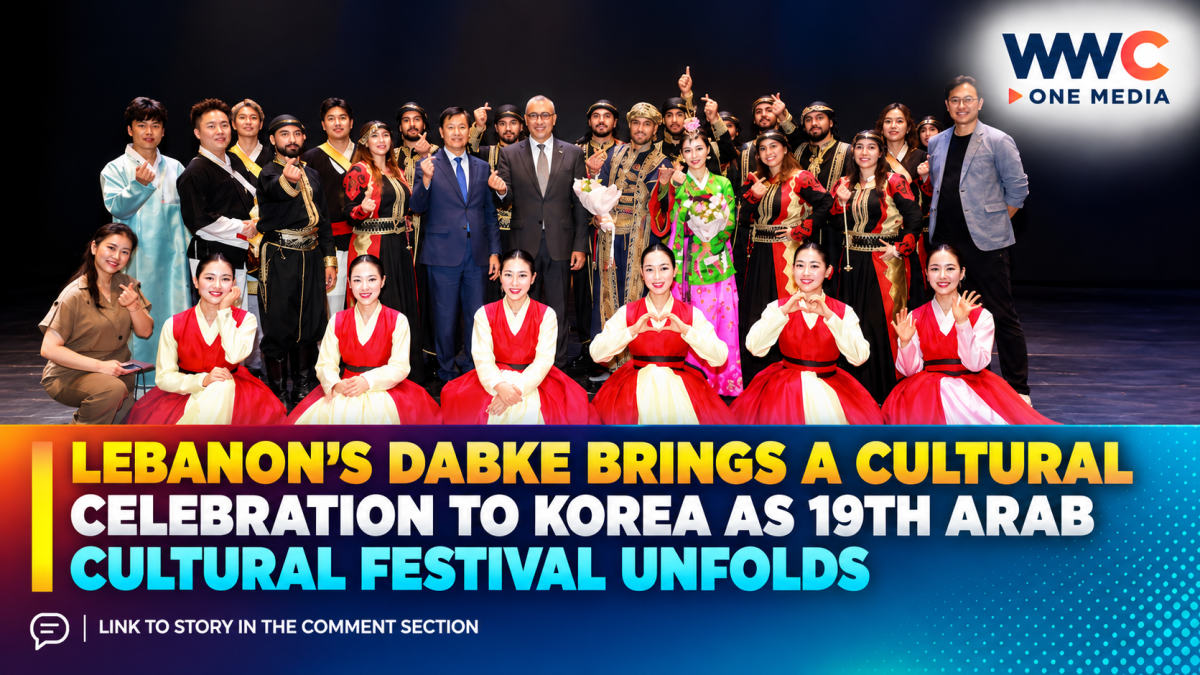
SEOUL — Lebanon is bringing one of its most recognizable cultural traditions to Korean audiences this week, as celebrated dance troupe Hayakel Baalbeck tours the country for the 19th Arab Cultural Festival.
The performances, running from Sept. 5 to 10, are part of a broader cultural exchange marking the 45th anniversary of diplomatic relations between Lebanon and South Korea.
The Lebanese Embassy in Seoul organized appearances in Seoul, Gwangju and Gyeongju, giving Korean audiences an opportunity to experience Lebanese folk traditions through music, costumes, storytelling and the energetic rhythms of dabke, the traditional line dance associated with celebrations and communal identity.
The troupe opened its Korean tour on Sept. 5 at the Yeakdang Theater of the National Gugak Center in Seoul, where Lebanese dabke was presented alongside Korean traditional music from Jindo.
The cultural meeting is significant because it goes beyond a conventional stage performance: it places two distinct traditional performance traditions side by side, using music and dance as a bridge between the two countries.
A Lebanese celebration arrives in Korea
Hayakel Baalbeck is presenting its theatrical production “Laylet Farah,” meaning “A Night of Celebration.”
The production features an 11-part repertoire built around themes including hospitality and homeland. According to the Korea Times, the show combines traditional Lebanese music and costumes with theatrical storytelling and the distinctive movements and rhythms of dabke.
Lebanese Ambassador to Korea Wael Hachem described dabke as a dance representing unity, resilience and joy.
For Lebanon, the performance therefore represents more than entertainment. It offers an opportunity to present an important part of the country’s cultural identity to an international audience.
Hachem also emphasized the role cultural exchanges can play in strengthening relations between countries, arguing that connections between people can complement formal diplomatic ties.
From six dancers to hundreds
Behind the Korean tour is a troupe with more than three decades of history.
Omar Mohamed Hamadeh founded Hayakel Baalbeck in 1991 when he was 20 years old, beginning with just six dancers. The organization has since expanded into a cultural institution with an academy and approximately 300 dancers from different parts of Lebanon, according to the Korea Times.
Hamadeh is leading the 14-member group currently touring Korea.
For him, dabke is also a family tradition. He told the Korea Times that he learned the dance from his family, reflecting how the tradition has been passed between generations.
The troupe has also attracted international attention beyond Lebanon, including a welcoming performance for Pope Leo XIV in Lebanon last December, according to the report.
Why dabke matters
Dabke is more than a choreographed performance. It is traditionally performed collectively, with dancers connected in a line while coordinating steps and movements.
That communal character is particularly important to Lebanese participants in the Korean festival.
Lebanese student Khodor Itani, who traveled from Busan to Seoul for the event, said the dancers holding hands and moving together reflect the connections among Lebanese people.
For Lebanese communities living abroad, cultural events can also serve as a connection to home.
Itani described the embassy gathering as a place where Lebanese culture, friendships and memories of Lebanon come together.
The cultural exchange continues beyond Seoul
The Korean tour does not end in the capital.
According to the National Asian Culture Center, the 19th Arab Cultural Festival is scheduled in Gwangju on Sept. 8, 2026, from 3 p.m. to 4:30 p.m. at ACC Theater 3. The event is hosted by the Korea-Arab Society and organized by the National Asian Culture Center.
Hayakel Baalbeck is also scheduled to perform at Gyeongju Expo Grand Park’s Munmu Hall at 7 p.m. on Sept. 10.
The Korea-Arab Society says the Arab Cultural Festival has been held annually since 2008, with the broader goal of introducing Arab culture to Korean audiences.
45 years of Lebanon-Korea relations
This year’s cultural program carries additional diplomatic significance because 2026 marks 45 years since Lebanon and South Korea established formal diplomatic relations.
The anniversary gives the festival another dimension: alongside traditional dance and music, the events highlight the people-to-people links that have developed between the two countries.
The Korea Times report points to Lebanese students who have studied in Korea, Korean peacekeepers who have served with UNIFIL in southern Lebanon, as well as business and artistic exchanges between the two countries.
The result is a festival that is about more than showcasing one country’s traditions.
It is also a reminder that diplomacy can happen on a stage — through music, movement, shared traditions and audiences discovering a culture they may not otherwise encounter.
A stage where two cultures meet
The most striking element of the Korean tour may ultimately be the cultural dialogue itself.
Lebanon’s dabke and Korea’s traditional performance traditions come from very different historical and geographic settings. Yet both demonstrate how collective music and movement can preserve cultural memory while introducing it to new generations.
For Hayakel Baalbeck, the Korean tour offers a chance to take a tradition rooted in Lebanese communities and place it in front of a new audience.
For Korea, the 19th Arab Cultural Festival provides another window into the diversity of the Arab world.
And as the troupe continues from Seoul to Gwangju and Gyeongju, one message remains at the center of the performances: culture can travel farther than borders — and sometimes, a dance can say what diplomacy cannot.


Leave a Reply