
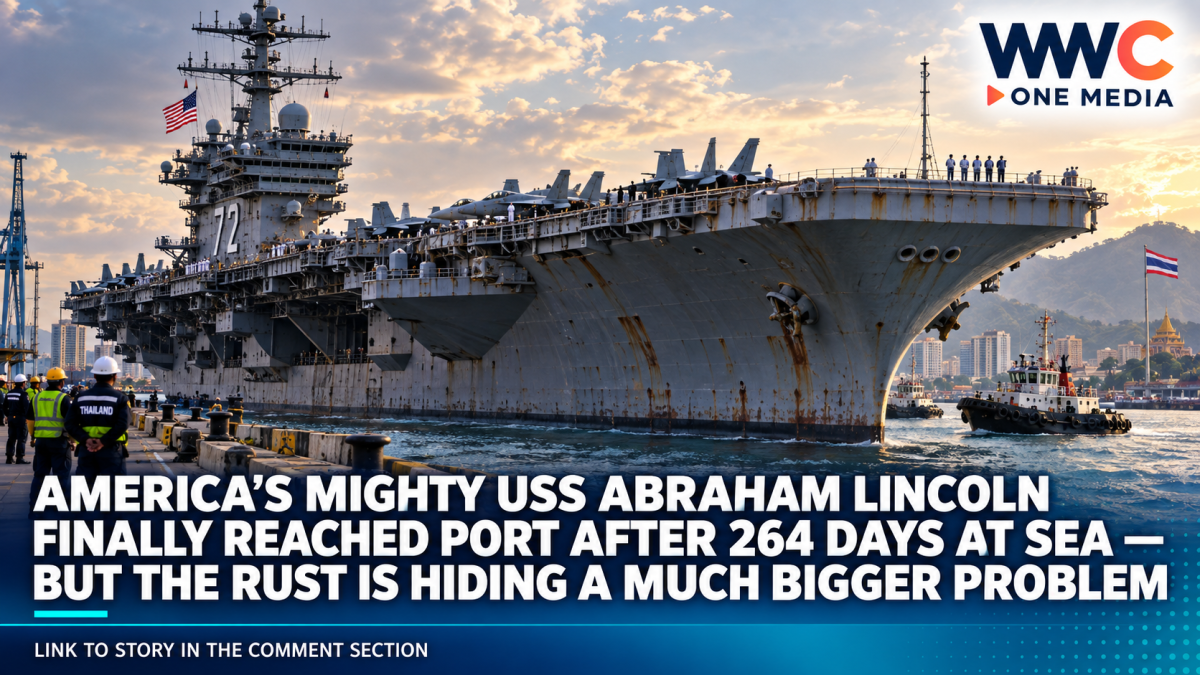
LAEM CHABANG, Thailand — For decades, few objects have projected American military power as dramatically as a U.S. Navy aircraft carrier.
A nuclear-powered supercarrier arriving offshore — packed with combat aircraft, surrounded by escorts and carrying thousands of sailors — has traditionally sent an unmistakable geopolitical message.
But when the USS Abraham Lincoln arrived in Thailand this week after one of the most demanding deployments in recent U.S. naval history, a different image began circulating around the world.
There was visible discoloration and rust on sections of its enormous hull.
There were sailors finally stepping ashore after months without a full port visit.
And behind the photographs were reports from military families describing shortages, malfunctioning toilets, mold in showers, laundry problems and severe fatigue during the ship’s extraordinarily long Middle East deployment.
Those images prompted an provocative argument in an Asia Times opinion essay by Singaporean art historian Hu Chao: perhaps the American aircraft carrier has not lost its military power — but some of the almost mythical “aura” surrounding it is beginning to fade.
That distinction is crucial.
The Lincoln is not a defeated or disabled warship.
If anything, its deployment demonstrates just how much combat power a U.S. carrier can sustain thousands of kilometres from home.
But the episode has exposed something less dramatic and perhaps more strategically significant: even the world’s most formidable naval platforms depend on maintenance, supplies, rested crews and an enormous logistics network — all while potential adversaries are developing increasingly sophisticated weapons designed specifically to keep them away.
The numbers tell a more extreme story than the photographs
The Lincoln’s deployment lasted about 286 days, according to the U.S. Embassy in Thailand.
More strikingly, the carrier had gone 264 consecutive days without a full port call before reaching Thailand’s Laem Chabang port on Sept. 2.
The Associated Press described the uninterrupted stretch as record-setting. Around 5,000 sailors and Marines serve aboard the carrier, making the ship effectively a floating military city.
Reuters likewise reported that the carrier strike group arrived in Thailand following an unusually prolonged Middle East deployment, giving the crew several days of badly needed rest and recreation.
The U.S. Navy itself called the Thai stop a “well-deserved opportunity” for its sailors and Marines to rest and recharge.
That is not the language normally associated with weakness.
It is, however, evidence of extraordinary operational strain.
Why did the USS Abraham Lincoln stay at sea for so long?
The carrier had originally deployed to the Pacific but was subsequently redirected as U.S. military commitments expanded in the Middle East.
Its strike group spent months supporting American combat operations involving Iran.
That meant the Lincoln was not merely sailing around as a diplomatic symbol.
Its carrier air wing was conducting demanding flight operations while thousands of sailors maintained the reactors, aircraft, weapons, radar systems, catapults, elevators and other machinery required to keep an enormous warship functioning around the clock.
The prolonged mission also limited opportunities for ordinary port maintenance and shore leave.
The result was increasingly visible when the carrier finally appeared in Thailand.
Large patches of discoloration and what appeared to be rust were visible around parts of the hull and near the flight deck.
Lincoln commanding officer Capt. Dan Keeler told reporters the appearance was normal after such an extended deployment.
Australian National Security College defense expert Euan Graham offered AP a similarly nuanced assessment: the ship’s exterior could represent American strategic overstretch and fatigue, he said, while the apparently strong condition of its air wing simultaneously demonstrated extraordinary resilience.
That may be the most accurate way to understand the images.
The rust shows stress. It does not prove military failure.
Behind the rust were more serious complaints
The physical appearance of the ship was only part of the controversy.
Weeks before its Thai port call, relatives of sailors had publicly raised concerns about living conditions aboard the Lincoln.
Reports described:
- malfunctioning toilets,
- moldy showers,
- periods without hot water,
- laundry facilities being unavailable,
- shortages of toiletries and fresh food,
- demanding work schedules,
- and declining morale after repeated deployment extensions.
The Los Angeles Times reported that Rep. Mike Levin of California had raised concerns with Pentagon leadership after hearing complaints involving showers, toilets, food and basic supplies.
Task & Purpose similarly reported accounts of broken toilets, mold in showers and unavailable laundry facilities, although the Navy said the carrier remained fully capable of carrying out its missions.
The Independent reported similar complaints from relatives of crew members, including claims that sailors were exhausted by long shifts and limited supplies.
The Navy disputed some of the most severe portrayals of conditions aboard the ship.
Acting Navy Secretary Hung Cao said in August that the Lincoln had successfully performed its mission and would return home as part of a planned rotation, adding that troop welfare remained a priority.
So the evidence supports a more careful conclusion than viral posts sometimes suggest:
There were credible reports of substantial hardship aboard the Lincoln, but there is no evidence that the carrier had become combat-ineffective.
Then 5,000 sailors reached Pattaya
The optics changed again once the carrier reached Thailand.
Thousands of crew members travelled into nearby Pattaya, the seaside city whose history as an international rest-and-recreation destination is closely connected to American military personnel during the Vietnam War era.
Images showed sailors shopping, eating and enjoying their first substantial period ashore after months at sea.
AP reported sailors flooding malls and local businesses, while Pattaya merchants prepared for the economic surge from thousands of visitors.
The Guardian reported that many sailors pursued decidedly ordinary pleasures after months of combat operations — shopping for clothing, eating restaurant food, visiting salons and simply spending time away from the ship.
And that ordinary humanity is central to the argument made by Asia Times.
Hu Chao’s essay is not primarily claiming that the USS Abraham Lincoln has become militarily useless.
It is an essay about visual power.
For decades, audiences have typically seen American carriers through carefully framed images: spotless flight decks, fighter jets launching into blue skies and sailors standing in precise formation.
The Thailand episode showed the same institution from much closer range.
Rust.
Maintenance problems.
Tired personnel.
Laundry.
Food.
Toilets.
Then shore leave.
The machinery of superpower suddenly looked very human.
But losing the “aura” is not the same as losing the warship
This is where separating commentary from military reality becomes essential.
The USS Abraham Lincoln remains a Nimitz-class nuclear-powered aircraft carrier, one of the most sophisticated warships ever constructed.
Its ability to sustain months of combat operations thousands of kilometres from the continental United States is itself evidence of something few other navies can currently reproduce at comparable scale.
An aircraft carrier does not become less lethal because its paint has deteriorated.
Nor do sailors taking shore leave somehow diminish the capability of the aircraft they fly.
Even the original Asia Times commentary explicitly acknowledges that point, noting that the Lincoln remained a formidable military organization after months of operations.
But there is a much deeper debate underway over carriers — and it has almost nothing to do with rust.
The bigger threat is China’s missile arsenal
The fundamental challenge facing American carriers in the Indo-Pacific is not how they look after a long deployment.
It is whether they can safely operate close enough to an advanced adversary to matter in a major war.
China has spent decades constructing what military analysts call an anti-access/area-denial network, combining missiles, aircraft, submarines, sensors and other systems intended to make it increasingly dangerous for U.S. forces to approach China’s coastline.
Among the most closely watched capabilities are Chinese anti-ship ballistic missiles and increasingly sophisticated hypersonic weapons.
The Center for Strategic and International Studies said in its updated 2026 assessment of China’s missile arsenal that Beijing’s combination of ballistic and cruise missiles is designed partly to threaten U.S. and allied military assets throughout the Pacific.
CSIS specifically concluded that these developments reduce the survivability of major American power-projection assets, including aircraft carriers and forward air bases.
That is a far more serious strategic question than whether the Lincoln’s hull needs another coat of paint.
A $13 billion ship inside a missile age
Aircraft carriers concentrate enormous military capability in one place.
That is their greatest strength.
It is also their most obvious vulnerability.
A U.S. nuclear-powered carrier itself costs roughly $13 billion, according to CSIS estimates, before counting its aircraft, escorts and other parts of a carrier strike group.
CSIS has estimated that adding the carrier air wing and escorting warships can push the wider package into the tens of billions of dollars.
The question facing naval strategists is therefore increasingly uncomfortable:
How close should something that valuable get to an adversary capable of launching dozens — potentially hundreds — of precision missiles?
Carrier defenses are formidable.
Destroyers and cruisers can carry sophisticated missile interceptors.
Aircraft provide additional protection.
Electronic warfare can interfere with enemy targeting.
Submarines operate around carrier groups.
And the U.S. military is investing heavily in distributed sensors and long-range weapons.
But no defensive system offers perfect protection against unlimited attack.
China calls them vulnerable — while building more of its own
There is another irony in predictions that the carrier age is ending.
China is building aircraft carriers too.
And quickly.
China’s Liaoning and Shandong operated outside the so-called first island chain for a combined 58 days during 2025, according to CSIS, substantially increasing their activity compared with the previous year.
Its newer Fujian represents another major technological step for the People’s Liberation Army Navy.
Meanwhile, satellite analysis published by CSIS in May showed rapid progress on what analysts assess with near certainty is China’s fourth aircraft carrier, currently under construction at Dalian.
That creates an important reality check.
If aircraft carriers were simply obsolete floating targets, Beijing would have little reason to spend enormous resources constructing them.
Instead, both Washington and Beijing appear to believe carriers remain useful — while simultaneously investing in weapons designed to destroy the other side’s carriers.
CSIS captured that paradox in an August report examining how American forces could hold Chinese carriers at risk using submarines, distributed anti-ship missiles, long-range weapons, electronic warfare and unmanned systems.
In other words:
The vulnerability cuts both ways.
Taiwan makes the carrier debate impossible to ignore
The Lincoln’s arrival in Thailand also came against the backdrop of continuing U.S.-China military signaling around Taiwan.
On Aug. 21, a U.S. Navy P-8A Poseidon maritime patrol aircraft flew through international airspace over the Taiwan Strait.
The U.S. Seventh Fleet said the mission demonstrated Washington’s commitment to a free and open Indo-Pacific and maintained that American forces would continue operating wherever international law permits.
China’s military monitored the aircraft during the transit.
The episode illustrates why military presence remains important to Washington.
American ships and aircraft do more than fight wars.
They reassure allies.
They deter potential opponents.
They demonstrate access to contested areas.
And perhaps no weapon performs that symbolic role more visibly than the aircraft carrier.
But America’s fleet is being asked to do a lot
The Lincoln’s deployment also highlights a quieter problem: demand.
America operates 11 nuclear-powered aircraft carriers, but only a portion can be deployed at any one time because ships must cycle through maintenance, training and refit periods.
CSIS warned earlier this year that sustained U.S. operations involving Iran and other global commitments were creating significant wear on ships and stressing readiness.
The think tank argued that a prolonged conflict with China could strain U.S. inventories of missiles, interceptors and other critical weapons, with some munitions requiring years to replace at existing production rates.
That makes the Lincoln story significant beyond one ship.
A supercarrier may be extraordinarily powerful.
But no navy has unlimited ships.
No crew can remain deployed indefinitely.
And even nuclear-powered vessels still need food, ammunition, aircraft parts and thousands of people able to keep everything operating.
So has the American aircraft carrier really lost its aura?
Perhaps part of it.
But that is different from losing its military relevance.
The viral photographs of the USS Abraham Lincoln may weaken the almost cinematic image of effortless American naval dominance.
Yet they simultaneously demonstrate something remarkable.
After 264 uninterrupted days without a full port call, months of combat operations and enormous strain on thousands of sailors, the carrier was still sailing.
Its aircraft were still operating.
Its reactors were still generating power.
Its escort ships were still alongside it.
And after a short stop in Thailand, the strike group was preparing to continue toward home.
The more consequential question therefore is not whether American carriers still look invincible.
They never were invincible.
The real question is whether a platform designed to dominate the oceans of the late 20th century can remain survivable, affordable and strategically decisive in an era of satellite tracking, submarines, drones, long-range precision missiles and hypersonic weapons.
That question will not be answered by rust on the USS Abraham Lincoln.
It may eventually be answered thousands of kilometres away — in the Western Pacific.
WWC ONE MEDIA M.J.E




Leave a Reply