
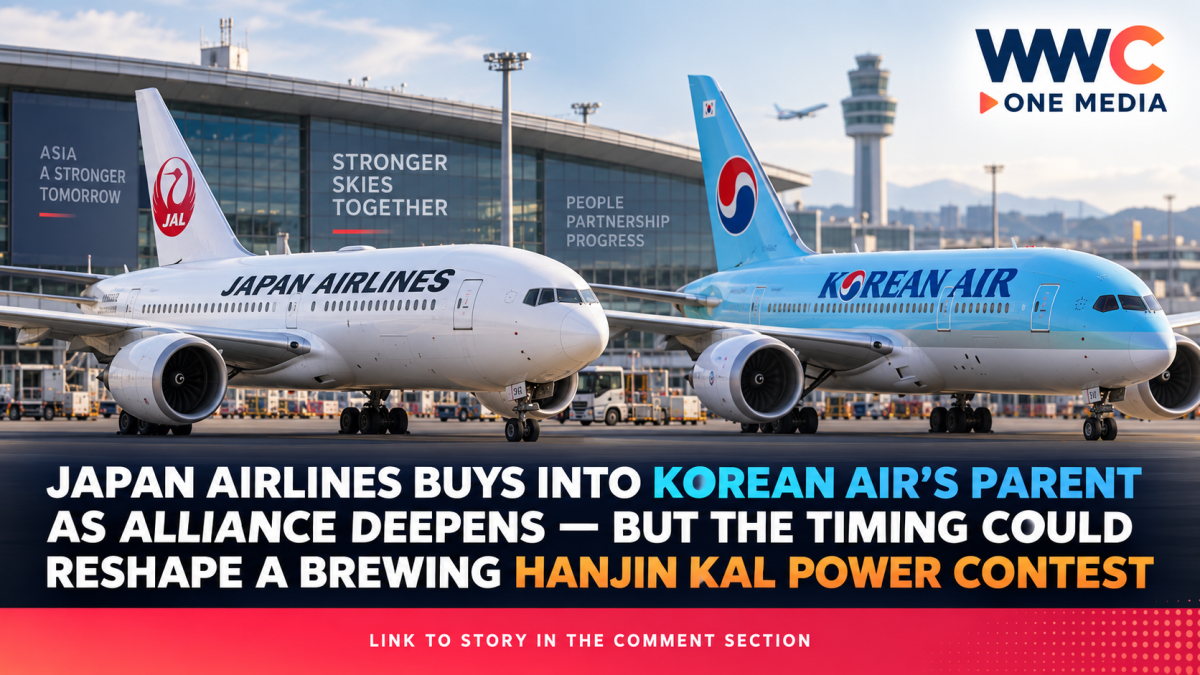
Japan Airlines Buys Into Korean Air’s Parent as Alliance Deepens — But the Timing Could Reshape a Brewing Hanjin KAL Power Contest
SEO Meta Description: Japan Airlines has reportedly acquired an undisclosed stake in Korean Air parent Hanjin KAL while expanding its strategic alliance with Korean Air ahead of the December Asiana merger, raising questions about Hanjin Group’s shareholder balance.
SEO Keywords: Japan Airlines Korean Air partnership, JAL Hanjin KAL stake, Korean Air Asiana merger, Walter Cho Hanjin KAL, Hoban Group Korean Air, Korea Japan flights, Hanjin KAL shareholders, Korean Air Japan Airlines codeshare
SEOUL — Japan Airlines is moving far beyond a conventional airline partnership with Korean Air.
The Japanese flag carrier has reportedly acquired an undisclosed stake in Hanjin KAL, the holding company that controls Korean Air, just as the two airlines prepare for a sweeping expansion of their decades-old partnership.
On the surface, the deal is about flights, mileage benefits, cargo, aircraft maintenance and the rapidly expanding Korea-Japan travel market.
But the timing is drawing even more attention.
Hanjin KAL is sitting at the center of an increasingly sensitive shareholder landscape in which construction conglomerate Hoban Group has steadily increased its holdings and moved strikingly close to the stake controlled by Hanjin Group Chairman Walter Cho and related parties.
That has turned what might otherwise have been a routine strategic investment into one of the more closely watched corporate moves in South Korea’s aviation industry.
JAL reportedly takes a stake — but the size remains secret
The Korea Herald reported that Japan Airlines purchased shares in Hanjin KAL as the carriers unveiled their expanded partnership.
Neither the size of the stake nor the acquisition price has been disclosed. The Herald noted that no regulatory disclosure showing JAL holding at least 5 percent had emerged, suggesting the investment could be below that reporting threshold.
Seoul Economic Daily separately reported the acquisition, citing airline-industry sources and Japanese reporting, while describing JAL’s investment as potentially significant to Hanjin KAL’s ownership structure.
There is, however, an important distinction.
The official JAL announcement issued Sept. 3 focuses on the strategic partnership and does not specify an equity investment or reveal an ownership percentage. It says the airlines intend to deepen cooperation across their expanded networks following Korean Air’s integration with Asiana Airlines.
For that reason, claims that JAL is formally supporting Chairman Cho in a shareholder battle go beyond what the airlines have publicly confirmed.
Why the investment is attracting so much attention
Hanjin KAL controls Korean Air, making its shareholder structure strategically important.
According to Korea Herald, Chairman Cho and affiliated shareholders held about 20.57 percent, while Hoban Group had raised its stake to approximately 20.15 percent in July.
That leaves a headline gap of only around 0.42 percentage point between the two positions.
The comparison requires some caution because reported holdings can come from disclosures with different reference dates.
Still, Hoban’s buying has unquestionably narrowed the gap.
Seoul Economic Daily reported in July that Hoban increased its stake from about 18.46 percent to 20.15 percent through open-market purchases. Hoban has said the purpose of the investment is simply financial rather than an attempt to seize management control.
Markets have nevertheless been watching for signs of another Hanjin KAL governance fight.
That is why JAL’s arrival as a shareholder matters.
Is Japan Airlines becoming Walter Cho’s new ‘white knight’?
Some Korean media have described JAL as a potential “white knight” for Walter Cho — effectively another shareholder that could strengthen his position if control of Hanjin KAL were ever challenged.
But that interpretation remains speculative.
There has been no disclosed shareholder agreement showing that Japan Airlines is required to vote alongside Cho, nor has JAL publicly said the investment was made to protect Hanjin management.
The airline has instead characterized its relationship with Korean Air as a strategic commercial partnership.
That distinction is important because another foreign airline already occupies a powerful position in the shareholder structure.
Delta Air Lines owns 14.9 percent of Hanjin KAL, while the state-run Korea Development Bank holds about 10.58 percent. Both have historically been viewed by Korean financial media as shareholders supportive of the existing Hanjin leadership.
Earlier this year, Delta and KDB voted in favor of Cho’s reelection as a Hanjin KAL director, while South Korea’s National Pension Service opposed it.
Adding even a relatively small JAL holding to that landscape could therefore attract intense attention whenever major shareholder votes arise.
But until JAL discloses its actual stake and voting intentions, calling it a guaranteed ally would be premature.
The airline deal itself is much bigger than the share purchase
Away from the ownership drama, Korean Air and Japan Airlines are preparing for one of the broadest expansions of their commercial relationship in decades.
The two carriers formally announced their strategic partnership in Tokyo on Sept. 3.
Korean Air said cooperation will expand beyond passenger operations into cargo, ground handling, aircraft maintenance and sustainable aviation fuel, with additional new-business opportunities also being explored.
JAL’s own announcement said existing codeshare arrangements and frequent-flyer cooperation will be reviewed and progressively expanded across the enlarged Korean Air network.
That network is about to become considerably larger.
Then comes Asiana
The biggest catalyst arrives in December.
Korean Air is scheduled to complete its integration with longtime rival Asiana Airlines, creating a substantially enlarged flag carrier with access to Asiana’s aircraft, routes, airport slots and international traffic rights.
Korean Air’s merger timetable points to the integration and merger registration taking effect in mid-December, with the combined airline expected to launch around Dec. 17, 2026.
The merger has already cleared key corporate approvals.
In August, Korean Air’s board and Asiana shareholders formally approved the merger agreement, with 99.3 percent of participating Asiana shares voting in favor, according to Korean Air information reported by the Philippine News Agency.
For Japan Airlines, that changes the economics of the partnership dramatically.
JAL will no longer be cooperating only with today’s Korean Air network. It will potentially gain commercial access to routes and passenger flows currently operated by Asiana.
Korea-Japan codeshare flights could jump to around 400 a week
One of the most visible changes could come on routes between South Korea and Japan.
Korean business media report that the expanded partnership could raise codeshared Korea-Japan services from roughly 250 weekly flights to around 400 after the Asiana integration.
Codesharing allows one airline to market and sell seats on flights operated by another carrier under its own flight number.
For travelers, expanded cooperation could eventually mean:
- more Korea-Japan destinations bookable through either carrier;
- smoother connecting itineraries;
- broader mileage earning or redemption possibilities;
- greater schedule flexibility;
- and potentially easier connections between regional Japanese cities, Seoul and Korean Air’s broader international network.
The exact mileage rules and additional codeshare routes have not yet all been announced.
Two rival alliances are cooperating anyway
The partnership is particularly noteworthy because Korean Air and Japan Airlines belong to rival global airline alliances.
Korean Air is a member of SkyTeam, while Japan Airlines belongs to Oneworld.
Yet their bilateral relationship predates both modern alliance systems.
JAL says the two carriers signed a cooperation agreement in 1963, even before diplomatic relations between South Korea and Japan were normalized in 1965. Joint Korea-Japan operations followed in 1964.
The airlines later launched formal codesharing in 2004 and subsequently added mileage cooperation.
More than six decades later, that old relationship is becoming strategically valuable again.
Cargo, maintenance and sustainable fuel are part of the next phase
The partnership also extends beyond passenger tickets.
Korean Air says the carriers will examine cooperation in ground services and aircraft maintenance, while also looking at sustainable aviation fuel as the industry tries to reduce carbon emissions.
Seoul Economic Daily reported that potential areas under discussion include shared cargo facilities, training and other future aviation businesses.
Many of those initiatives remain exploratory rather than finalized commercial programs.
Still, the logic is straightforward.
Korean Air will soon be operating on a much larger scale after absorbing Asiana, while JAL brings one of Japan’s strongest domestic and international networks.
Pooling infrastructure in selected areas could lower costs while creating a much denser Northeast Asian travel network.
But the shareholder story may become just as important as the airline story
Commercially, the partnership gives both companies a stronger platform as travel between Korea and Japan continues expanding.
Corporately, the JAL share purchase introduces another variable into Hanjin KAL’s increasingly complicated ownership structure.
That is where investors will be watching closely.
Three questions now matter:
How large is Japan Airlines’ actual Hanjin KAL stake?
Will JAL buy more shares?
And most importantly, if a genuine battle for control of Hanjin KAL ever emerges, which way would Japan Airlines vote?
For now, none of those questions has been definitively answered.
JAL and Korean Air are publicly emphasizing customers, connectivity and their 60-year relationship.
But with Hoban Group sitting near 20 percent, Delta already owning 14.9 percent and Korea Development Bank holding another major block, even a comparatively small new shareholder could eventually matter.
That makes Japan Airlines’ investment more than an airline partnership story.
It could also become a crucial piece on the board in the next chapter of the fight over who ultimately controls Korea’s biggest airline group.
WWC ONE MEDIA M.J.E




Leave a Reply