
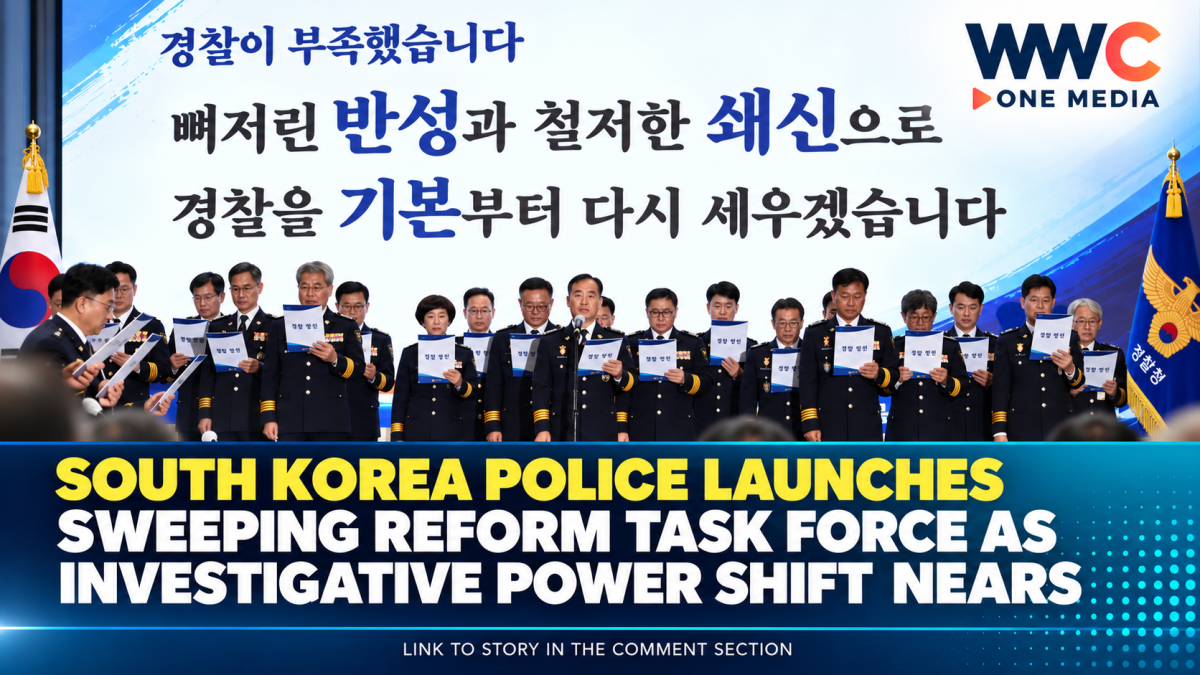
SEOUL — South Korea’s police are preparing to launch a dedicated reform task force this week, signaling a major internal overhaul as the agency faces mounting public scrutiny and prepares to assume significantly greater investigative responsibility.
The Korean National Police Agency said Sunday that the new body will conduct a broad review of police systems, working practices, the chain of command and supervisory gaps.
The task force will be led by an officer holding the rank of senior superintendent general, with the agency saying further details on its structure and direction will be announced when it formally launches.
The move comes at a particularly consequential moment for South Korea’s criminal-justice system.
A recently revised Criminal Procedure Act is set to fundamentally reshape the division of investigative authority, removing prosecutors’ direct investigative powers and leaving investigative authority with the police. The changes are scheduled to take effect Oct. 2.
Police facing pressure from inside and outside
The reform push follows a series of cases that have intensified questions about police investigations and internal oversight.
One of the most damaging controversies involves missing-person cases on Jeju Island, where a police officer was accused of prematurely closing multiple cases without confirming that the people reported missing were safe. Two of those missing people were later found dead, according to Yonhap.
The controversy prompted President Lee Jae Myung to demand a fundamental police overhaul.
Lee said the police should conduct an overall review of their practices and systems and ensure there are no gaps in protecting people’s lives and rights.
The president’s intervention comes as the police prepare to take on greater investigative responsibility — making questions about accountability, competence and internal controls increasingly important.
New police leadership promises a ground-up overhaul
The reform effort is also being driven by new police leadership.
Kim Jong-chul, acting head of the Korean National Police Agency, has pledged sweeping internal reforms aimed at rebuilding public trust.
At a leadership meeting on Sept. 3, Kim called for a comprehensive review of how missing-person cases are handled, from the initial response and search through investigation, reporting and closure.
The police leadership has also said officers could face accountability regardless of rank if dereliction of duty is established.
Kim’s latest weekend briefing sessions focused heavily on preparing officers for the revised investigative system.
He ordered police to ensure frontline officers understand the new investigative procedures and receive training throughout September.
A major change in Korea’s criminal justice system
The police reform campaign cannot be separated from the much larger restructuring of South Korea’s prosecution system.
Under the revised Criminal Procedure Act, prosecutors will lose their authority to conduct direct investigations, including supplementary investigations.
Instead, prosecutors can request that police conduct additional investigations, with police given up to two months to complete them.
The change represents a fundamental redistribution of investigative power.
The ruling Democratic Party has argued that the reform is necessary to reshape the country’s criminal-justice system, while the opposition People Power Party has challenged the revision before the Constitutional Court, arguing that it raises constitutional concerns involving separation of powers, prosecutors’ warrant-related authority and citizens’ rights.
That political and legal dispute means the police reform effort is unfolding under an unusually bright spotlight.
Missing-person cases become a test of reform
The Jeju controversy has already triggered more targeted changes.
Police are moving toward a dedicated system for overseeing missing-person cases, including monitoring the progress of investigations and strengthening regional supervision.
They are also reviewing whether missing-person policy, searches and investigations should be consolidated under the National Office of Investigation to address fragmentation between different police divisions.
Another planned change would require approval from a chief of criminal investigation before a missing-person case can be closed, preventing individual officers from unilaterally ending cases.
Police are also considering stronger legal grounds for tracing information involving missing adults and changes that would place at least two officers on missing-person cases during nights and holidays.
These measures are intended to address the kind of oversight failures that have fueled public criticism.
The ruling party is running its own reform effort
The government’s police reform initiative should not be confused with a separate task force established by the ruling Democratic Party of Korea.
The DPK launched its own Police Reform Task Force on Sept. 1, identifying what it described as six major police problems: protecting colleagues, burying cases, unauthorized case closures, concealment or fabrication of evidence, leaking investigative information and privacy violations.
The party has proposed measures including stronger external audits, greater accountability for investigators and victims, stronger responsibility for poor investigations and enhanced privacy protections.
It is also discussing broader questions surrounding democratic control of the police, the National Police Commission, autonomous policing and the investigative capabilities of the National Office of Investigation.
The existence of both government and ruling-party reform initiatives highlights just how politically significant the police overhaul has become.
Investigators are also leaving key units
Another issue confronting police leadership is personnel.
Kim has ordered officials to examine why experienced officers are leaving investigative units and consider personnel reforms that could encourage skilled investigators to remain in those positions longer.
That issue could become increasingly important as police prepare to handle a larger share of investigative work.
Greater authority requires not only new rules but also enough trained personnel to carry them out effectively.
What happens next?
The new police reform task force is expected to examine the organization from the inside out — from frontline practices to supervision and command structures.
Kim has emphasized that reform must ultimately be visible at the level where officers interact with the public.
“The field has to change for the police organization to change,” he said, according to Seoul Economic Daily.
That may be the biggest test of the entire reform effort.
South Korea is not simply changing who investigates crimes. It is attempting to rebuild public confidence in the institution that will hold significantly greater investigative responsibility once the revised system takes effect.
For citizens, the question is no longer simply whether the police will receive more power.
The real question is whether the new power will come with enough oversight, accountability and safeguards to prevent the failures that triggered this reform in the first place.
And with the new task force preparing to begin work this week, South Korea is about to find out whether its promised police overhaul can move from political declarations to changes people can actually see.



Leave a Reply