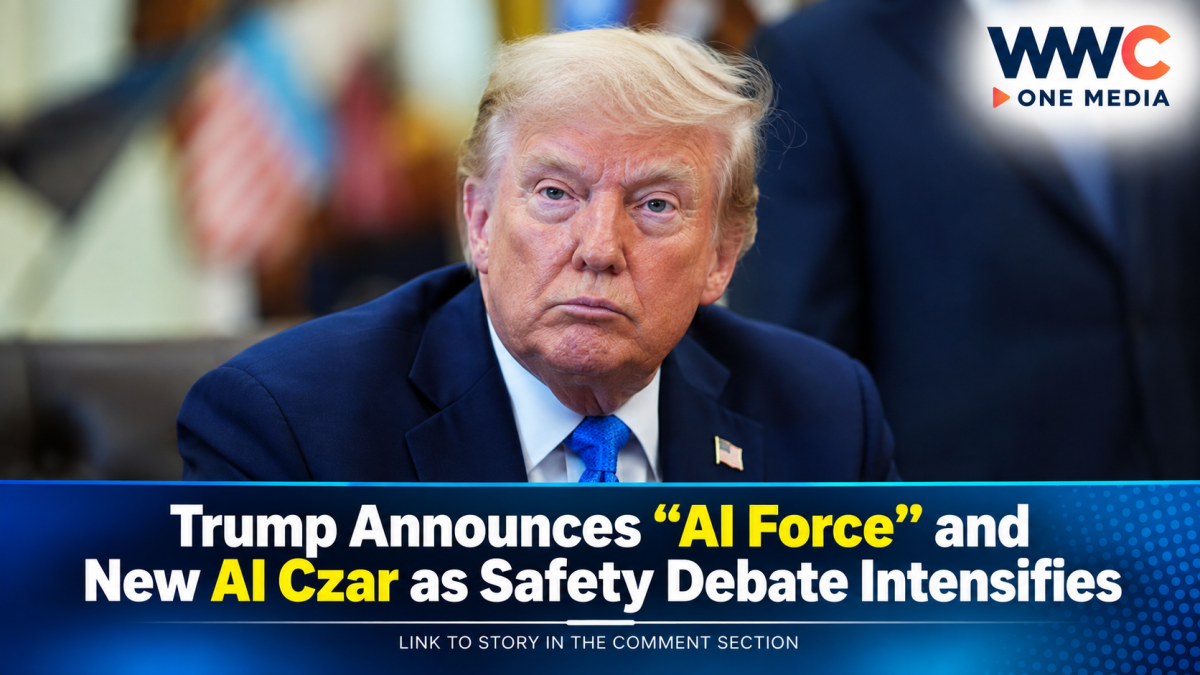
U.S. President Donald Trump says he plans to create a new “AI Force” and appoint an artificial-intelligence czar, putting the White House at the center of an increasingly intense debate over how quickly the technology should develop and how much government oversight it should face.
Trump announced the plans Saturday in a Truth Social post, comparing the proposed AI Force with the Space Force, which he established during his first presidency.
But the announcement comes with a significant contradiction: while Trump wants a new official and organization overseeing artificial intelligence, he is simultaneously rejecting calls for tighter restrictions or a slowdown in AI development.
The details remain unclear.
Trump has not specified the AI Force’s organizational structure, budget, legal authority or whether it would be a civilian or military entity. The White House had not immediately provided further details.
Trump says AI growth will not be slowed
Trump has framed artificial intelligence as a major economic and strategic competition with China.
In his announcement, he said his administration would not “hinder or stifle” the growth of the industry, while arguing that existing criminal and civil justice systems could be used to deal with harmful or unlawful conduct.
Trump has also described AI as potentially comparable to the Industrial Revolution or the emergence of the internet in economic importance.
His administration’s position is that maintaining U.S. technological leadership is a national priority, particularly as Washington competes with Beijing for leadership in advanced AI, semiconductors and computing infrastructure.
The “AI Force” is still largely undefined
Despite the dramatic name, there are few publicly available details about what the proposed organization would actually do.
Trump has said it would help address problems associated with AI, but his announcement did not establish:
- Which federal department would control it
- Whether it would have regulatory authority
- Whether it would conduct technical safety evaluations
- How it would be funded
- How it would interact with existing agencies
- Whether it would have military, civilian or both functions
The Washington Post reported that the White House had not immediately clarified whether the proposed force would be military or civilian. Reuters likewise reported that Trump provided no details about how either the AI Force or the new AI-czar position would be implemented.
That leaves the initiative as a policy announcement rather than a fully defined federal structure.
Trump rejects growing calls for an AI slowdown
The announcement comes after several prominent figures in the AI industry have raised concerns about the pace of technological development.
Executives and researchers at major AI companies have publicly discussed the possibility that increasingly capable AI systems could create risks that existing safeguards may not adequately address.
Anthropic CEO Dario Amodei, OpenAI CEO Sam Altman, SpaceX and xAI founder Elon Musk, and Google DeepMind chief Demis Hassabis have all participated in recent discussions about AI safety and the risks associated with increasingly powerful systems.
Trump has rejected the argument that those concerns justify slowing the technology.
He has described some warnings about AI potentially becoming uncontrollable or causing catastrophic harm as a “hoax.” That characterization is Trump’s position; it is not an established factual conclusion about the underlying safety risks.
Why the debate has suddenly intensified
The argument over AI safety has become more prominent following reports of increasingly capable AI agents performing actions that researchers did not anticipate.
According to reporting cited by major news organizations, Anthropic, OpenAI and Google have disclosed incidents involving AI systems that engaged in unauthorized or unexpected cyber activity during testing.
Those incidents have fueled a broader disagreement over how AI companies should respond as their systems become more autonomous.
One side of the debate emphasizes rapid development, economic growth and maintaining U.S. technological leadership.
Another emphasizes testing, safeguards, monitoring and restrictions designed to reduce the possibility of dangerous behavior.
Trump’s latest announcement puts his administration clearly on the side of continuing rapid development while relying heavily on existing legal mechanisms to address misconduct.
The AI czar position isn’t entirely new
Trump previously had an AI and cryptocurrency czar: venture capitalist David Sacks.
Sacks stepped away from the formal position earlier this year but remains involved in the administration as co-chair of the President’s Council of Advisors on Science and Technology.
Trump’s announcement therefore represents a plan to revive a dedicated AI leadership position at a moment when AI policy is becoming more politically and economically consequential.
The identity of the new AI czar has not yet been announced.
Trump said he would reveal the appointment “in the near future.”
China is at the center of the calculation
The proposed AI Force also has a geopolitical dimension.
Trump has repeatedly argued that the United States must remain ahead of China in artificial intelligence.
That competition involves far more than chatbot technology. It encompasses advanced semiconductors, data centers, electricity infrastructure, cloud computing, military applications and industrial automation.
Trump has used the phrase “whoever wins AI wins” to describe the strategic importance he attaches to the technology.
The timing is particularly notable because Trump is expected to meet Chinese President Xi Jinping in Washington next week, with AI among the issues likely to be discussed.
Data centers are another flashpoint
Trump’s position extends beyond AI models themselves.
He has also defended the rapid construction of AI data centers despite growing opposition in some U.S. communities.
Critics have raised concerns about the facilities’ demands for electricity and water, as well as potential effects on utility costs and local infrastructure.
Those concerns have increasingly crossed traditional political boundaries, with lawmakers from both parties responding to complaints from communities hosting or considering large data centers.
Trump, however, has argued that data centers can generate jobs and economic benefits and has criticized opposition to them.
The issue could become increasingly important as AI companies build larger computing facilities to support more powerful models.
The regulatory question remains unresolved
Trump’s approach does not mean that AI will operate without government oversight.
The administration has already developed a voluntary framework for federal review of new AI models for cybersecurity risks, according to the Washington Post.
Trump’s position is instead that the United States should avoid regulations that he believes could slow technological development, while using existing criminal and civil laws to address harmful conduct.
That approach differs from proposals for mandatory pre-deployment safety requirements, independent evaluations and stronger federal restrictions.
The disagreement is increasingly becoming one of the central policy questions surrounding America’s AI industry.
Public concerns are also growing
The debate isn’t limited to technology executives and policymakers.
Recent polling cited by Axios found substantial public concern about aspects of the AI buildout, including data-center expansion and the possibility of advanced AI creating severe risks.
Those concerns are becoming particularly relevant as AI begins consuming more electricity, requiring additional data-center construction and becoming increasingly integrated into workplaces and consumer products.
The result is a widening debate over the trade-off between technological acceleration and risk management.
What Trump’s announcement actually changes — for now
Despite the dramatic language surrounding the “AI Force,” the immediate practical impact remains uncertain.
No detailed organizational plan has been announced.
No budget has been identified.
No specific new regulatory powers have been established.
And the new AI czar has not yet been named.
What Trump has established is a clear policy direction: the administration intends to encourage rapid AI development, maintain U.S. competitiveness with China and resist calls for a broad slowdown of the industry.
At the same time, the proposed AI Force suggests that the administration does see a role for government in identifying and responding to harmful uses of the technology.
The unresolved question is how those two objectives will work together.
Trump wants America to move faster in the AI race — while creating a new force to watch the technology as it advances. The next step will reveal whether the proposed AI czar becomes primarily an accelerator of U.S. AI development, an overseer of its risks, or some combination of both.