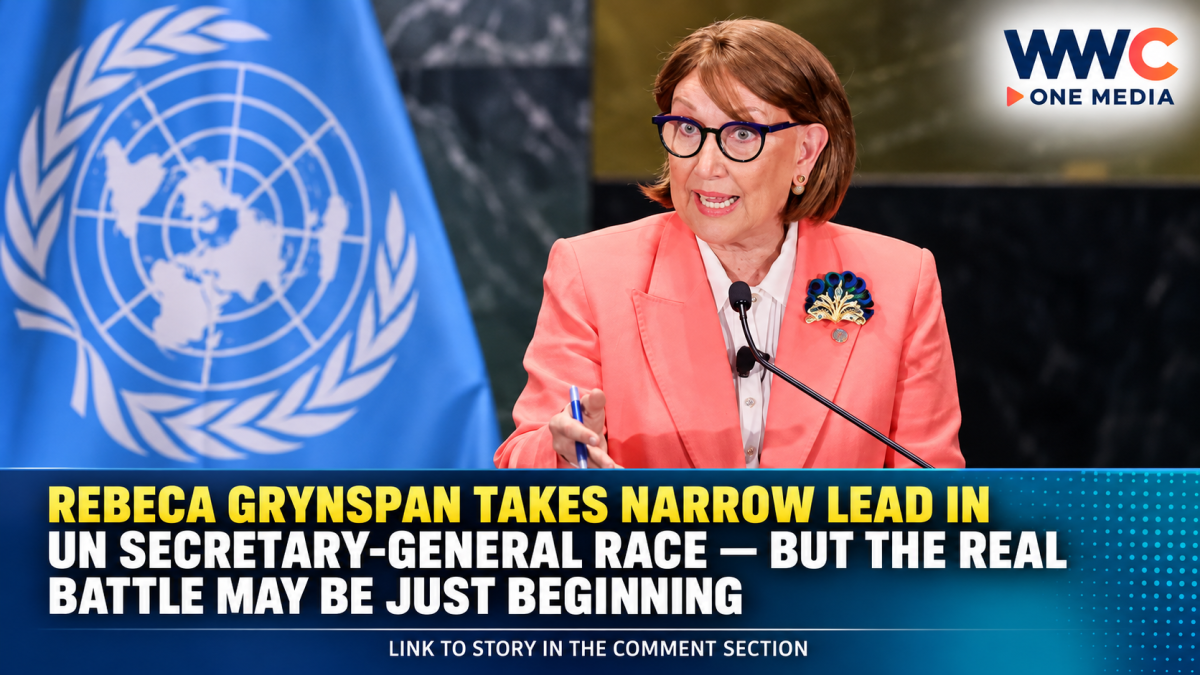
UNITED NATIONS — Costa Rica’s Rebeca Grynspan has regained a narrow lead in the race to become the next United Nations secretary-general, but the latest Security Council straw poll shows that the contest remains wide open.
Grynspan, a former vice-president of Costa Rica and current secretary-general of the UN Conference on Trade and Development (UNCTAD), received nine “encourage” votes, five “discourage” votes and one “no opinion” in the third confidential straw poll held by the 15-member UN Security Council on September 18, according to diplomats and sources familiar with the process.
Guyana’s UN ambassador and former foreign minister Carolyn Rodrigues Birkett followed closely, receiving eight “encourage” votes, six “discourage” votes and one “no opinion.”
The results underline how closely fought the race remains as UN member states prepare for the annual high-level General Assembly session in New York.
Grynspan returns to the top
The latest result marks Grynspan’s return to first place after Rodrigues Birkett narrowly led the previous straw poll in August.
Grynspan also led the first informal vote in July, meaning the Costa Rican has now topped two of the three confidential rounds conducted so far.
However, her latest nine positive votes do not represent a decisive breakthrough.
The straw poll is designed to measure the level of support and opposition among Security Council members. Candidates can receive “encourage,” “discourage” or “no opinion” votes, giving diplomats an early indication of where a candidate stands before the selection process advances.
Eight candidates remain in the race
Eight candidates are currently seeking to succeed António Guterres, whose second five-year term ends on December 31, 2026.
Alongside Grynspan and Rodrigues Birkett, the field includes:
- Rafael Mariano Grossi, director general of the International Atomic Energy Agency;
- Macky Sall, former president of Senegal;
- Ivonne A-Baki, an Ecuadorian diplomat;
- Michelle Bachelet, former president of Chile and former UN High Commissioner for Human Rights;
- María Fernanda Espinosa, former Ecuadorian foreign minister and former president of the UN General Assembly; and
- Olara Otunnu, a Ugandan diplomat and former UN under-secretary-general.
The latest poll showed significant differences in the level of support for the candidates.
Grossi received five “encourage” votes against eight “discourage” votes, while Otunnu received five encouragements, seven discouragements and three “no opinion” votes. Sall received five encouragements and nine discouragements.
Espinosa received three encouragements, six discouragements and six “no opinion” votes. Bachelet received one encouragement and 11 discouragements, while Baki received no encouragements, 10 discouragements and five “no opinion” votes, according to Reuters.
Why the nine-vote threshold is not enough by itself
The numbers from the straw poll should not be interpreted as a final election tally.
Under the UN selection process, the Security Council must ultimately recommend a candidate to the 193-member General Assembly. A Security Council decision requires at least nine affirmative votes, while the five permanent members — China, France, Russia, the United Kingdom and the United States — possess veto power.
That means a candidate can accumulate substantial support among the Council’s 15 members and still fail to advance if one of the permanent members opposes the candidacy.
The identities of individual countries behind the confidential straw-poll votes are not publicly disclosed at this stage.
A potentially historic choice
The race is also being closely watched because no woman has ever served as UN secretary-general during the organisation’s more than eight decades of existence.
Both Grynspan and Rodrigues Birkett are women, and several UN member states have expressed interest in seeing the organisation select its first female secretary-general.
Grynspan brings extensive experience inside the UN system. According to her official UN curriculum vitae, she served as Costa Rica’s vice-president and later as a UN under-secretary-general and associate administrator of the UN Development Programme before becoming UNCTAD secretary-general in 2021.
She became the first woman to head UNCTAD and has worked extensively on trade, development finance, debt, investment and multilateral cooperation.
The race could still change
The latest results have not produced a clear consensus candidate.
Analysts cited by Reuters said the lack of a decisive breakthrough could encourage weaker candidates to leave the contest — or potentially encourage additional candidates to enter it.
There is also speculation that the permanent members could ultimately seek a compromise candidate if the current field fails to generate sufficient support.
That possibility makes the coming stages of the selection process particularly important.
The UN says the current selection process is intended to follow principles of transparency and inclusivity. Candidates are nominated by member states and submit vision statements, curricula vitae and campaign-financing disclosures, while the General Assembly conducts interactive dialogues with the contenders.
The Security Council’s confidential straw polls, however, remain a crucial part of the diplomatic process.
What happens next?
The Security Council is expected to conduct additional rounds of informal voting as diplomats attempt to identify a candidate capable of securing the required support while avoiding a veto from any permanent member.
The eventual nominee will then be formally recommended by the Security Council to the General Assembly, which will appoint the next secretary-general.
For now, Grynspan is back on top — but only narrowly.
With Rodrigues Birkett close behind, eight candidates still in contention and the five permanent powers holding the ability to block a nomination, the latest straw poll signals momentum for Grynspan without settling the race.
The decisive question may not simply be who can attract the most “encourage” votes — but who can eventually assemble the broadest consensus inside the Security Council without triggering a veto.