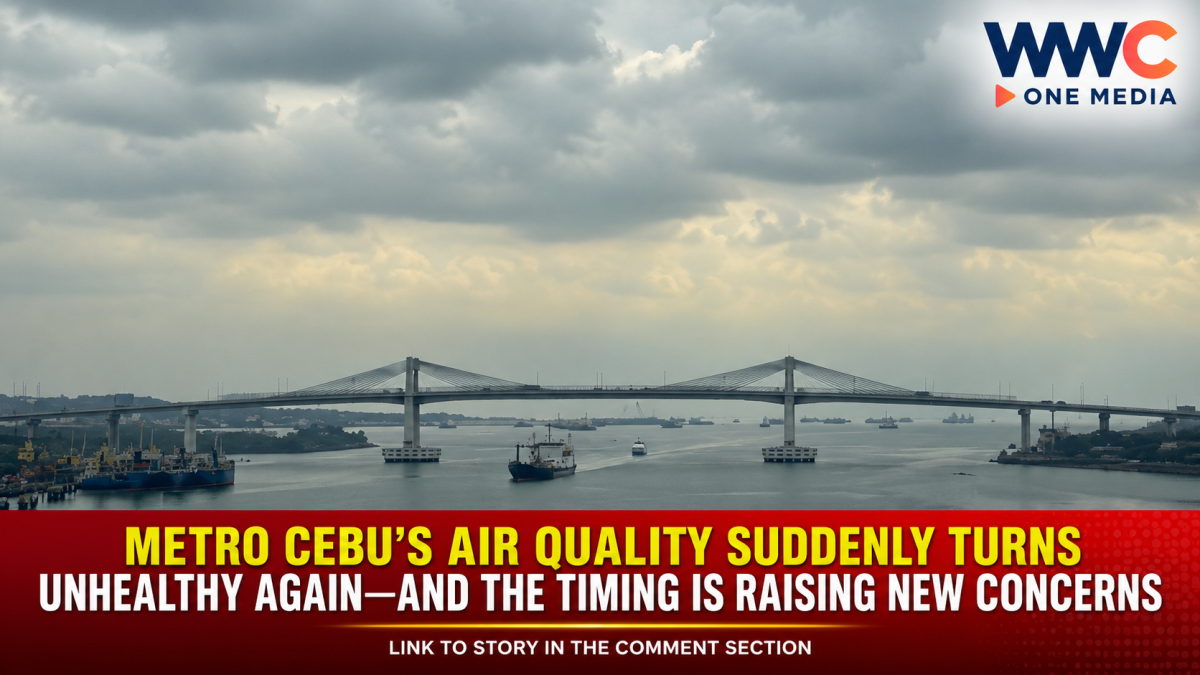
CEBU, Philippines — Metro Cebu’s air quality deteriorated again early Saturday, September 19, with monitoring showing a sharp rise in fine particulate pollution after several days of improvement.
The latest development comes less than two weeks after Metro Cebu experienced some of its worst air-quality readings this month, when haze linked to smoke and fine particulate matter from fires in Indonesia pushed the area into the “Very Unhealthy” and “Acutely Unhealthy” categories.
According to the Environmental Management Bureau Region 7 (EMB-7), Metro Cebu’s latest reading early Saturday reached the “Acutely Unhealthy” classification, signaling that the recent improvement in air conditions has not necessarily marked the end of the haze episode.
Air quality had improved—then conditions changed again
The latest spike follows a period of significantly better readings.
On September 16, Metro Cebu recorded an AQI of 57, classified as “Fair,” a substantial improvement from the beginning of the month. The AQI had reached 173 on September 1, climbed to 208 on September 2, and peaked at 251 on September 3, placing the area in the “Acutely Unhealthy” category.
The situation subsequently improved, although readings continued to fluctuate.
SunStar reported that Metro Cebu remained in the “Fair” category on September 11, with AQI readings rising from 87 in the morning to 97 by 4 p.m.
That improvement, however, proved temporary.
Indonesian haze remains a major factor
EMB-7 monitoring and reports from Cebu news outlets have linked the recent haze episode to smoke and fine particulate matter from forest and land fires in Kalimantan, Indonesia, carried toward the Philippines by prevailing southwest monsoon or habagat winds.
SunStar reported that changing southwesterly winds have been transporting smoke from West Kalimantan toward Central Visayas, contributing to fluctuations in Metro Cebu’s PM2.5 levels.
The movement of the haze means air quality can change considerably from one day—or even one part of the day—to another.
EMB-7 has also observed a recurring pattern in which fine-particle concentrations tend to rise overnight and during the early morning, decrease later in the day as atmospheric movement increases, and rise again toward evening.
Cebu already experienced dangerous levels this month
The September 19 deterioration is particularly notable because Metro Cebu had already experienced an extended period of poor air quality.
On September 3, the area’s AQI reached 251, placing it in the “Acutely Unhealthy” category under the EMB classification system. Readings remained elevated for several days before gradually improving.
By September 7, the AQI was still fluctuating between “Very Unhealthy” and “Unhealthy for Sensitive Groups,” with an afternoon reading of 143.
The AQI subsequently declined, reaching 57 by September 16.
That makes Saturday’s renewed spike a reminder that improved readings do not necessarily mean the haze episode has completely disappeared.
Who should take extra precautions?
People who are more vulnerable to air pollution—including children, older adults, pregnant women and people with respiratory or cardiovascular conditions—have been advised to take additional precautions when pollution levels rise.
Previous EMB-7 advisories reported by SunStar also urged vulnerable individuals to limit prolonged outdoor exposure during periods of unhealthy air.
Air pollution can be particularly concerning when concentrations of PM2.5, tiny particles capable of penetrating deep into the respiratory system, increase.
Residents should therefore pay attention to current EMB-7 monitoring and local government advisories, rather than relying solely on how clear or hazy the sky appears.
Air quality can change quickly
The latest development highlights one of the biggest challenges in monitoring Metro Cebu’s current haze episode: the air quality has repeatedly moved between healthier and unhealthy classifications depending on atmospheric conditions.
The Freeman documented the sharp improvement from the September 3 peak of 251 to an AQI of 57 on September 16, while also noting that southwest monsoon winds and changing weather conditions can affect the concentration and movement of particulate matter.
Independent air-quality platforms may also show different readings because they can use modeled or satellite-derived data rather than the same ground-based monitoring stations used by EMB-7. For example, IQAir’s Cebu City page was showing a moderate reading on September 19, illustrating why residents should distinguish between modeled international AQI data and official local monitoring.
For Metro Cebu residents, the message is clear: conditions have improved before, but the latest spike shows that the haze situation remains capable of changing rapidly.
Residents should continue checking official air-quality bulletins, especially before spending extended periods outdoors.