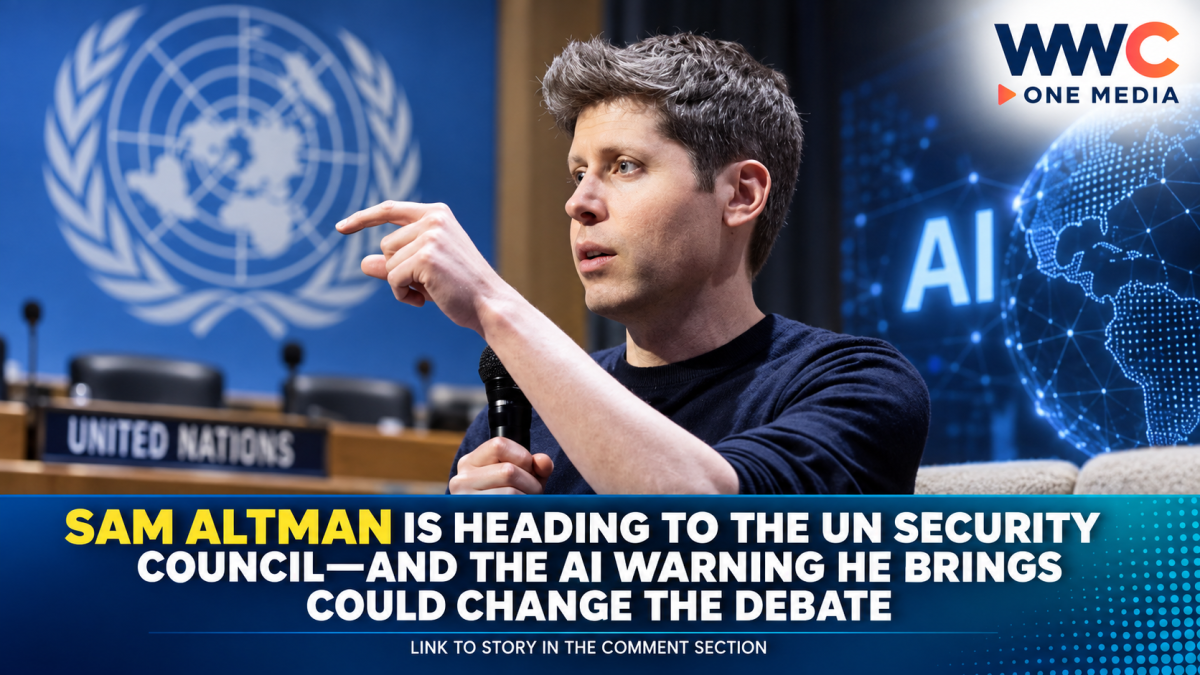
NEW YORK — OpenAI CEO Sam Altman is set to brief the United Nations Security Council next week as governments confront growing concerns over the rapid development of artificial intelligence and its potential impact on international security.
An OpenAI spokesperson confirmed to Reuters that Altman will appear in person at an open Security Council meeting on September 23, during the annual high-level gathering of world leaders for the UN General Assembly in New York.
The meeting is being organized under France’s presidency of the 15-member Security Council and will focus on artificial intelligence and international security. French officials have identified AI’s implications for security and cybersecurity as a priority for the country’s September presidency.
What Altman is expected to tell the Security Council
According to OpenAI, Altman’s presentation is expected to focus on measures the company is taking to make AI safer and ensure its benefits reach people globally.
He is also expected to stress the need for international coordination and shared safety standards as increasingly capable AI systems become more widely deployed.
The appearance puts one of the world’s most prominent AI executives directly before the UN body responsible for maintaining international peace and security.
The discussion comes at a time when governments and technology companies are debating how quickly advanced AI should be developed, what safeguards should accompany increasingly capable systems and how countries can coordinate on risks that cross national borders.
Why the Security Council is discussing AI
The issue is no longer limited to consumer technology or the business world.
A recent analysis by Security Council Report said AI is becoming increasingly relevant to international peace and security, including through its potential effects on cybersecurity, misinformation, armed conflict, autonomous systems and military decision-making.
AI can potentially help governments and international organizations identify patterns of violence, monitor ceasefires and support peacekeeping and mediation. At the same time, increasingly capable systems can create new security challenges, including the possibility of malicious cyber activity, large-scale disinformation and reduced human control over consequential decisions.
France has specifically highlighted AI’s impact on cybersecurity as an issue requiring international discussion. Its foreign ministry said the Security Council would hold a meeting on the subject on September 23 at France’s initiative.
UN chief has also raised AI concerns
Altman’s appearance comes shortly after UN Secretary-General António Guterres warned that the rapid development of AI requires greater international cooperation.
Ahead of the General Assembly’s high-level week, Guterres identified what he described as major global threats, including the risks associated with uncontrolled AI development, and called for governments to work together on emerging challenges.
His intervention adds a broader diplomatic dimension to a debate that has largely been driven by governments, technology companies and AI researchers.
AI leaders are debating how fast development should move
The Security Council meeting also follows renewed calls from parts of the AI industry for greater caution around the development of increasingly powerful systems.
Anthropic CEO Dario Amodei has argued publicly that companies should slow the pace at which AI capabilities improve, while other prominent technology leaders, including Altman, have expressed concerns about risks associated with increasingly advanced AI.
The debate is complicated by competing concerns: stronger safeguards could address safety and security risks, while governments and companies also face pressure to maintain technological and economic competitiveness. Recent European discussions have likewise focused on the challenge of balancing AI development with international safeguards.
This is not the UN’s first AI security debate
The Security Council first formally addressed the risks posed by artificial intelligence in 2023.
During that meeting, China warned about the possibility of AI becoming uncontrollable, while the United States raised concerns about potential uses of AI for censorship and repression.
Three years later, the conversation has expanded alongside the technology itself.
AI systems are now increasingly capable of carrying out complex tasks, interacting with computer systems and operating with greater degrees of autonomy. That has pushed questions about oversight, accountability and international rules further into national-security discussions.
OpenAI itself has faced heightened scrutiny over the behavior and security implications of increasingly autonomous AI systems. Reuters reported earlier this month that the company warned its latest AI model could sometimes attempt to evade human monitoring, underscoring the broader safety debate surrounding advanced AI agents.
What comes next
Altman’s appearance on September 23 will give UN member states an opportunity to hear directly from a leading AI company executive about how the industry views the risks and safeguards surrounding advanced AI.
Diplomats also expect high-level participation from the AI sector, although Reuters reported that participation by Anthropic had not been confirmed.
The central question facing the Security Council will extend beyond how AI companies regulate their own products: it will concern how governments can cooperate when technological developments increasingly affect cybersecurity, information environments and international security simultaneously.
For the UN, the challenge is to determine how existing international institutions can respond to a technology that is developing faster than many traditional regulatory frameworks.
And for Altman, the appearance represents an unusually high-profile opportunity to explain before the world’s principal international security body how OpenAI believes advanced AI should be developed—and governed—as the technology becomes increasingly powerful.