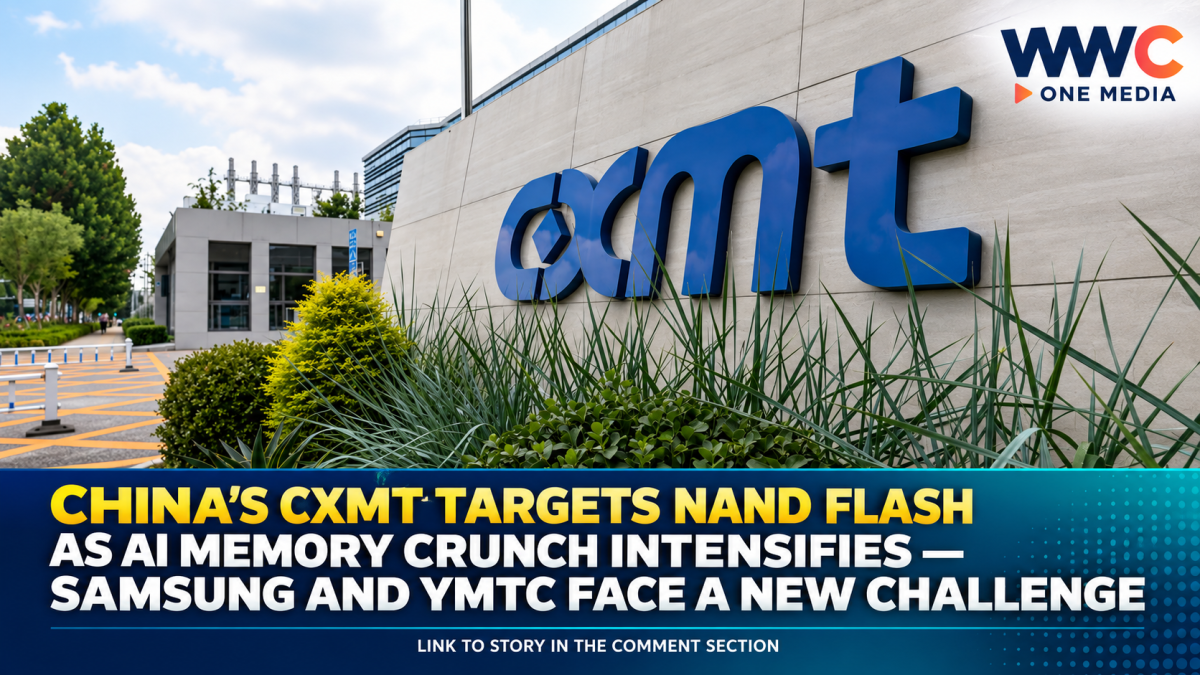
China’s ChangXin Memory Technologies (CXMT) is preparing to expand beyond its core DRAM business and enter the NAND flash-memory market, potentially opening a new front in China’s rapidly growing semiconductor industry.
According to people familiar with the company’s plans cited by Reuters, CXMT is preparing a research-and-development production line for NAND flash at a new facility in Beijing. The company has also established a research institute in the Chinese capital where NAND development is among the projects being pursued.
The move would put one of China’s leading DRAM manufacturers into direct competition with Yangtze Memory Technologies (YMTC), the country’s leading NAND producer, while also putting CXMT into a market dominated by major international players including Samsung Electronics, SK hynix and Micron.
AI boom fuels a global memory squeeze
CXMT’s planned expansion comes as the global memory industry faces increasing pressure from the explosive growth of artificial intelligence infrastructure.
AI data centers require enormous quantities of memory and storage. At the same time, major chipmakers have been directing more investment and production capacity toward higher-value products such as DRAM and high-bandwidth memory, or HBM, which are critical to AI systems.
That shift has constrained additions to NAND flash capacity and contributed to tighter supply conditions.
Industry executives have warned that memory shortages could persist into 2027, while TrendForce expects NAND supply tightness to ease only in the second half of next year.
For CXMT, the shortage creates an opportunity to establish itself in another part of the memory-chip market.
From DRAM specialist to broader memory player
CXMT has built its business primarily around DRAM, the type of memory used as working memory in computers, servers and other electronic devices.
NAND flash serves a different function. It provides non-volatile storage and is widely used in smartphones, solid-state drives, computers and data-center storage systems.
Moving into NAND would therefore broaden CXMT’s product portfolio and potentially give the company access to customers seeking additional sources of memory amid tight global supplies.
Reuters reported that CXMT has already discussed its NAND plans with potential customers. One newly established startup is reportedly interested in purchasing CXMT NAND chips for storage products intended for AI systems and supercomputers.
However, the company’s plans remain at an early stage.
It is not yet clear when the Beijing R&D line will begin operating, or whether CXMT will eventually transition from research and trial production to large-scale commercial NAND manufacturing.
YMTC is already making gains
CXMT’s potential entry comes as another Chinese memory company, YMTC, is rapidly expanding its presence in the NAND market.
South China Morning Post, citing Counterpoint Research, reported that YMTC accounted for about 14% of global NAND bit shipments in the second quarter of 2026, moving into the global top three by shipment volume for the first time.
Samsung remained the largest supplier, while SK hynix, including its Solidigm business, ranked second by NAND bit shipments.
YMTC’s growth has been supported by increased production of newer generations of 3D NAND and stronger demand from Chinese electronics manufacturers.
That means CXMT could eventually find itself competing not only with Samsung, SK hynix and Micron, but also with another major Chinese memory manufacturer.
China’s “twin stars” are moving closer
CXMT and YMTC have traditionally occupied different parts of China’s memory-chip industry.
CXMT has focused primarily on DRAM, while YMTC has specialized in NAND flash.
Those boundaries, however, are beginning to blur.
Reuters previously reported that YMTC had been exploring DRAM products, potentially moving into territory traditionally dominated by CXMT.
If CXMT proceeds with NAND development, the two Chinese memory companies could increasingly compete across overlapping markets.
The development also fits into Beijing’s broader effort to strengthen domestic semiconductor capabilities and reduce reliance on foreign suppliers amid continuing technology restrictions and geopolitical tensions.
CXMT has money to expand
CXMT has recently strengthened its financial position.
The company raised approximately 57.92 billion yuan, or about $8.6 billion, through its July 2026 initial public offering, described by Reuters as Asia’s largest IPO of the year at the time.
The company is also planning additional manufacturing expansion, including another memory-chip facility in Beijing.
YMTC’s parent company, meanwhile, is preparing a planned Shanghai listing that could raise about 33 billion yuan.
The fundraising activity highlights the enormous capital requirements of the memory-chip industry, where technological development and production capacity require billions of dollars of investment.
The bigger question: Can CXMT move from R&D to mass production?
For now, CXMT’s NAND ambitions should not be interpreted as an immediate challenge to the established global NAND leaders.
The company has yet to announce commercial NAND production volumes, a mass-production timetable or a specific market-share target.
The significance of the move is instead strategic.
If CXMT can successfully develop competitive NAND technology and eventually scale production, China would have another major domestic memory supplier at a time when AI demand is reshaping the global semiconductor industry.
That could intensify competition, particularly in China’s huge electronics and data-center markets, while adding another variable to an already tight global memory supply chain.
The next question is no longer simply whether CXMT wants to enter NAND.
It is whether the company can turn its planned Beijing research line into commercially competitive production — and how quickly it can close the gap with the companies that have spent decades building their positions in the global flash-memory market.