MANILA, Philippines — The battle for the Philippines’ digital future is moving beyond faster internet connections.
As businesses and government agencies shift more operations to cloud computing and artificial intelligence, Converge ICT Solutions Inc. is building a domestic infrastructure network designed to give organizations greater control over where critical data is stored, processed and connected.
The company’s strategy recently earned it the Philippines Technology Excellence Award for Infrastructure Technology – Telecommunications at the Asian Technology Excellence Awards 2026 in Bangkok. The awards ceremony was held on September 17, with Converge recognized for its sovereign-ready digital infrastructure.
At the heart of the strategy is a combination of Tier III data centers, a nationwide fiber network and international subsea cable connections—infrastructure that Converge says can support local cloud computing, AI workloads and data-governance requirements.
A digital fortress built inside the Philippines
Converge’s infrastructure strategy goes beyond traditional broadband.
The company says its ecosystem now includes Tier III data centers in Caloocan City and Angeles City, a nationwide pure-fiber network, and international connectivity through the Bifrost and SEA-H2X submarine cable systems.
Cable landing stations for those systems are located in Davao and La Union, respectively. Converge says its nationwide fiber assets have surpassed 960,000 kilometers.
The idea is to connect the entire stack—from local users and enterprises to data centers and international networks—rather than relying on separate infrastructure providers for each component.
For companies handling sensitive information, that could provide more options for keeping workloads and data within Philippine jurisdiction.
But the infrastructure also has another purpose: preparing for the enormous computing requirements associated with AI.
Why AI is changing the data-center race
Artificial intelligence requires considerably more computing infrastructure than many conventional digital applications.
AI systems can require high-density computing, large amounts of storage and reliable, low-latency connectivity. As Philippine businesses experiment with generative AI, analytics and automated systems, demand for data-center capacity is expected to grow.
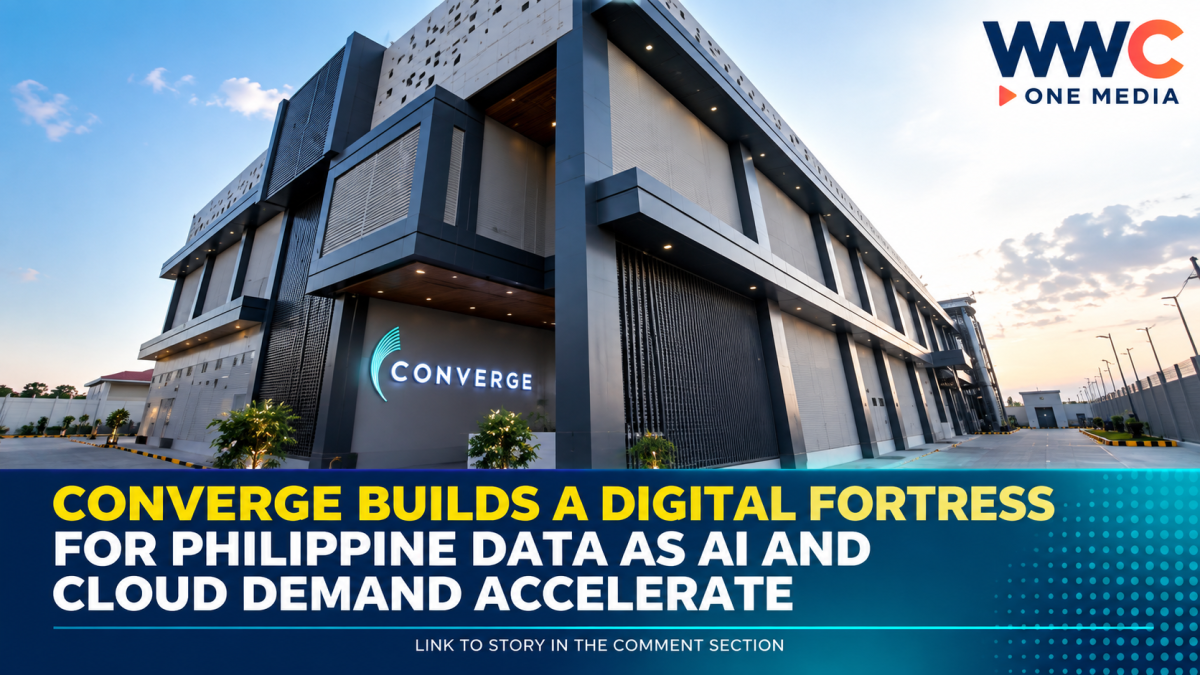
Converge completed its Angeles Data Center in March 2026 as part of its broader National Digital Infrastructure.
The facility is designed as an AI-ready site and includes infrastructure intended for high-performance computing and cloud workloads. Converge also plans to house its Converge Cloud sovereign cloud infrastructure there.
The Angeles facility occupies a 5,000-square-meter site and has a planned capacity of 12 megawatts, with built-in redundancy designed to support resilient operations.
That puts the facility at the intersection of two rapidly developing markets: cloud computing and AI.
The government is also pushing data closer to home
Converge’s expansion comes as the Philippine government has introduced new rules governing government data.
On July 13, 2026, President Ferdinand Marcos Jr. signed Executive Order No. 119, updating the government’s data-classification system and establishing a framework for data residency and cross-border data transfers.
The order covers government data handled by national government agencies and other specified public institutions.
Importantly, EO 119 does not apply broadly to ordinary private-sector commercial data. The Supreme Court E-Library version specifically says the order covers government data and that its private-sector provision concerns data handled in connection with government-related activities, rather than all commercial information held by private companies.
Under the new framework, highly sensitive government information faces stronger requirements concerning Philippine storage and jurisdiction, while other classifications can be subject to different cloud and cross-border arrangements depending on their security requirements.
The Department of Information and Communications Technology said the policy is intended to strengthen government data protection while providing a more predictable framework for digital infrastructure investment.
That regulatory shift potentially creates additional demand for Philippine-based data-center capacity.
Converge wants a piece of that market
Converge has been positioning its Angeles facility as a sovereign cloud platform capable of hosting sensitive government and enterprise workloads locally.
When President Marcos visited the facility in July, Converge presented the data center as part of its strategy to support local government data hosting, cloud services and AI-ready computing.
Converge CEO and co-founder Dennis Anthony Uy has said the company’s investments in data centers, fiber and international cables are intended to give Philippine businesses the infrastructure needed to innovate while maintaining greater control over their data.
The company is therefore positioning itself not simply as an internet provider, but increasingly as a digital infrastructure and enterprise technology company.
The Angeles data center is already being treated as a strategic investment
The infrastructure push has also attracted government investment support.
In August, Converge’s digital infrastructure arm, Pentagon Digital Global Corp., secured a Green Lane Certificate of Endorsement from the Board of Investments for the Angeles Data Center.
The Green Lane mechanism is intended to speed up permitting and licensing for qualified strategic investments. The facility is expected to support enterprise computing, cloud workloads, colocation and regional data storage.
That recognition reflects the growing importance of data centers as physical infrastructure for the digital economy.
Data may be intangible, but the systems that store and process it require enormous amounts of land, electricity, cooling, connectivity and capital.
International cables are just as important as local data centers
A Philippine data center cannot operate in isolation.
While local hosting can address residency and jurisdiction considerations, businesses still need connections to international cloud platforms, content providers and global markets.
That’s where Converge’s submarine cable investments come into play.
The company says its Bifrost and SEA-H2X systems provide international connectivity through landing stations in Davao and La Union.
The combination gives Converge an infrastructure model that links local fiber → domestic data centers → international subsea networks.
That architecture could become increasingly important as Philippine companies move more applications into cloud environments and adopt AI tools that depend on both domestic and international connectivity.
The bigger race is no longer just about internet speed
The Philippine telecommunications market has historically focused heavily on broadband availability, speed and coverage.
But the next phase of competition is increasingly about what sits behind the connection.
Who owns the data-center capacity?
Where is sensitive information stored?
How quickly can AI workloads be processed?
How resilient is the network during international disruptions?
And can Philippine companies and government agencies access cloud infrastructure without surrendering control over critical information?
Those questions are becoming more important as digital services become embedded in banking, government services, healthcare, manufacturing, retail and other sectors.
The government’s new data-residency framework adds another layer to that transformation.
Converge is betting that the Philippines needs a complete digital stack
Converge announced in March that its National Digital Infrastructure had been completed, combining its fiber backbone, satellite network, international subsea cable systems, cable landing stations and expanded data-center footprint.
The company subsequently introduced Converge Cloud, emphasizing sovereign computing, data residency, AI readiness and multi-cloud capabilities for Philippine organizations. Philstar reported in June that this marked the company’s move beyond connectivity toward a broader enterprise technology strategy.
The latest Asian Technology Excellence Award provides another public recognition of that strategy.
But the real measure of the infrastructure will ultimately come from how effectively it is used: whether businesses adopt local cloud services, whether government agencies migrate appropriate workloads, and whether the country’s growing AI economy generates enough demand to justify continued investment.
For Converge, the pieces are increasingly in place.
The company now has domestic data centers, a nationwide fiber backbone and international subsea connections—and it is adding AI-ready capacity at the same time the Philippines is tightening its framework for government data residency.
The next chapter may determine whether those assets simply make the Philippines more connected—or help turn the country into a serious regional hub for sovereign cloud and AI infrastructure.