SEOUL — North Korea has rejected a new resolution from the United Nations’ nuclear watchdog criticizing its nuclear program, with Kim Jong Un’s powerful sister, Kim Yo-jong, insisting that Pyongyang’s nuclear status cannot be reversed.
The confrontation followed the International Atomic Energy Agency’s (IAEA) 70th General Conference in Vienna, where member states adopted a resolution expressing serious concern over North Korea’s expanding nuclear activities and calling on Pyongyang to halt them. The resolution reaffirmed that North Korea cannot be recognized as a nuclear-weapons state under the Nuclear Non-Proliferation Treaty (NPT).
The IAEA resolution passed with 103 countries voting in favor, six against and 14 abstaining, according to Yonhap and CNA. Russia and China were among those opposing the measure.
Pyongyang pushes back
Kim Yo-jong accused the IAEA of applying what she described as double standards and argued that North Korea’s nuclear development is necessary for its security.
In a statement carried by North Korea’s state-run Korean Central News Agency, she criticized the agency for condemning Pyongyang while, in North Korea’s view, failing to adequately address U.S. nuclear arrangements involving allies such as South Korea and Japan.
Kim also reiterated that North Korea considers its nuclear-armed status permanent.
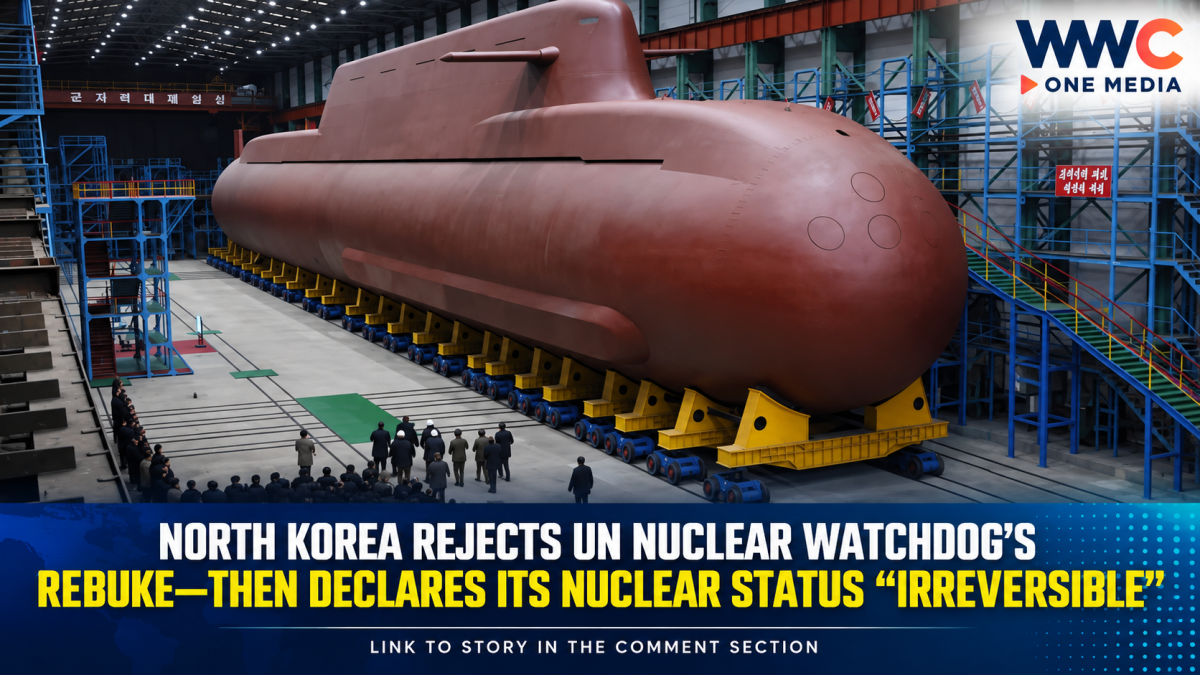
North Korea’s Foreign Ministry separately rejected the IAEA resolution, declaring that the country’s nuclear status is “irreversible” and that its nuclear deterrent is central to its national security.
IAEA points to expanding nuclear infrastructure
The latest dispute comes as the IAEA has reported evidence suggesting that North Korea continues to expand its ability to produce nuclear material.
IAEA Director General Rafael Grossi said the agency had identified an additional uranium-enrichment facility at the Yongbyon nuclear complex. The facility appears capable of accommodating as many as 28 centrifuge cascades, according to reporting based on the IAEA findings.
The agency also reported activity at the Kangson enrichment site, where an expanded annex appeared to have begun operating earlier this year. CNA reported that the developments point to a further expansion of North Korea’s capacity to produce weapons-grade nuclear material.
The IAEA has also identified continued activity at other parts of North Korea’s nuclear infrastructure, including the Yongbyon reactor complex, while the Punggye-ri nuclear test site remains capable of supporting a nuclear test, according to reporting by Yonhap.
No IAEA inspectors inside North Korea
One major limitation is that the IAEA has not had inspectors inside North Korea since 2009, meaning the agency cannot conduct conventional on-site inspections of the country’s nuclear facilities.
Instead, the watchdog has relied heavily on satellite imagery, publicly available information and other forms of remote monitoring to assess developments inside the country.
That limitation has also become part of the diplomatic dispute.
Russia, for example, has questioned whether the IAEA can draw reliable conclusions about North Korea’s nuclear infrastructure without direct access, according to NK News.
A widening gap over denuclearization
The latest exchange highlights the widening gap between international demands for North Korea to abandon its nuclear weapons program and Pyongyang’s increasingly firm position that its nuclear capability is permanent.
The IAEA continues to call for North Korea to comply with its international nonproliferation obligations and cease nuclear activities that violate relevant resolutions. North Korea, meanwhile, argues that its nuclear arsenal is necessary for national security and has rejected calls for denuclearization.
For now, the dispute is unfolding alongside evidence of continued development of North Korea’s nuclear infrastructure—leaving the international community facing a difficult question: how can meaningful nuclear negotiations resume when Pyongyang says its nuclear status is no longer negotiable?