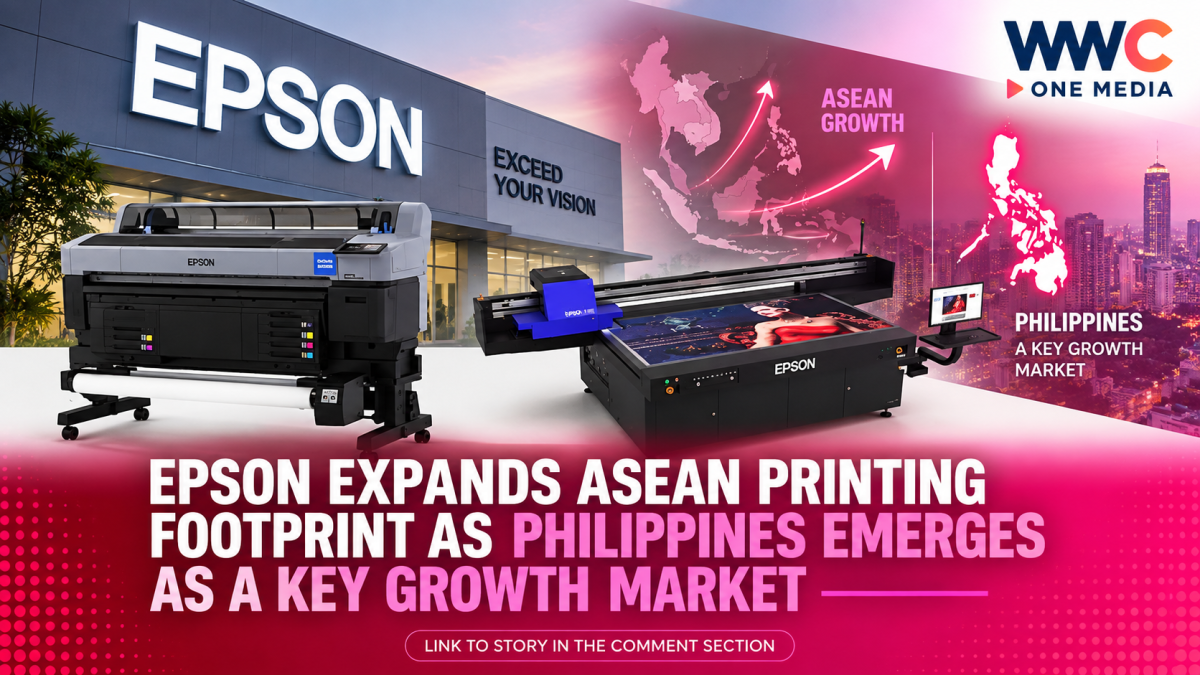
Epson is strengthening its position in Southeast Asia’s professional printing industry, with new market-share data showing significant gains across large-format, textile, photo and signage printing — including a sharp increase in the Philippines.
According to International Data Corporation (IDC) data cited in Epson’s latest regional announcement, Epson was the leading brand in ASEAN for four professional printing categories in calendar year 2025: Large Format Printer, Graphic Textile, Photo Graphic and Signage.
The most notable gains came in large-format printing, where Epson’s ASEAN market share climbed to 21.1% in 2025, up from 19.2% in 2024.
The Philippines was among the markets where Epson recorded its strongest improvement. Its large-format printer share in the country increased by 4.7 percentage points to 26.9%.
Indonesia posted an even larger year-on-year increase of 6.5 percentage points, reaching 23.2%, while Thailand reached 28.3%, Singapore 32.8% and Malaysia 16.8%.
Textile printing remains Epson’s strongest ASEAN category
Beyond conventional large-format printing, Epson maintained an especially strong position in graphic textile printing.
Its ASEAN market share in the category increased to 45.6% in 2025, compared with 43% a year earlier.
The company reported particularly high shares in Singapore at 60%, Indonesia at 59.1% and the Philippines at 54.6%.
The growth comes as textile manufacturers and print businesses increasingly look toward digital printing technologies for customized designs, shorter production runs and more flexible manufacturing.
Epson has been expanding its textile portfolio with dye-sublimation and direct-to-fabric technologies. The company has also highlighted the potential of on-demand digital printing to reduce unnecessary production and material waste.
Epson also gains ground in signage printing
Epson’s signage business recorded another increase during 2025.
Its ASEAN market share in signage printing rose to 11.1%, from 10.5% in 2024.
The company launched several new signage models during the year, including the SureColor S7130, S8130 and S9130, as it sought to capture demand from businesses producing advertising materials, displays, retail graphics and other large-format applications.
Epson has also positioned its large-format printers as tools for businesses adapting physical retail spaces, offices and events, where printed displays continue to play a role despite the growth of digital communications.
Professional photo printing adds another layer
Epson also held a 22.3% share of the ASEAN Photo Graphic (Aqueous Ink) market in 2025.
The company’s professional photo-printing portfolio includes models such as the SureColor P9530 and P6530E, aimed at applications requiring high-quality photographic and graphic output.
This gives Epson exposure beyond traditional office printing, extending its business into commercial photography, graphics, signage and specialized production.
Why Southeast Asia matters to Epson
The latest numbers fit into a broader strategy by Epson to deepen its business presence across Southeast Asia.
In an earlier interview with CNA, Epson global president and CEO Junkichi Yoshida described Southeast Asia as one of the company’s important growth engines.
The company has manufacturing facilities in both Indonesia and the Philippines, producing models for global markets, while its regional headquarters is located in Singapore.
Epson’s 2025 integrated report likewise identifies Southeast Asia as a high-growth region and highlights local production as a way to unlock additional market opportunities. The company says sales in Southeast Asia continue to grow as demand expands across consumer, small-office, corporate and government markets.
That regional manufacturing footprint also gives the Philippines a role that extends beyond being a sales market.
The Philippines is becoming more important to Epson
Epson has been expanding its physical and operational presence in the Philippines alongside its wider ASEAN strategy.
In February 2026, Epson Philippines opened a new office and Solution Center in Cebu Business Park, establishing a stronger regional base for serving customers and partners in the Visayas.
The facility is intended to provide product demonstrations, training, technical engagement and access to Epson’s printing, imaging and digital solutions.
The company’s manufacturing operations in the Philippines are also significant.
Epson Precision (Philippines), Inc., based in Lipa, Batangas, manufactures printers and LCD projectors. As of March 31, 2026, the facility employed more than 20,000 people, according to Epson.
In September 2026, the facility received Platinum recognition under the Responsible Business Alliance’s Validated Assessment Program following independent third-party audits covering areas including labor practices, health and safety, environmental standards and ethics.
From printers to broader business solutions
Epson’s ASEAN strategy is increasingly moving beyond selling individual printers.
CNA reported that the company is pursuing a broader business-to-business approach combining hardware, software and services as companies look for ways to improve operational efficiency, manage energy use and modernize workflows.
The acquisition of professional printing software company Fiery has also strengthened Epson’s ability to provide integrated solutions for commercial and industrial printing, according to CNA.
That shift reflects how the professional printing industry is changing. Printers are increasingly being positioned as part of wider production systems rather than standalone machines.
For Epson, the latest IDC figures suggest that strategy is gaining traction across several important ASEAN printing segments.
With the Philippines posting one of the company’s strongest large-format gains and maintaining a substantial position in graphic textile printing, the country is becoming an increasingly important part of Epson’s Southeast Asian growth story.
The bigger question now is whether Epson can turn its expanding market share into sustained growth as Southeast Asia’s printing, textile, signage and commercial-production industries continue to evolve.