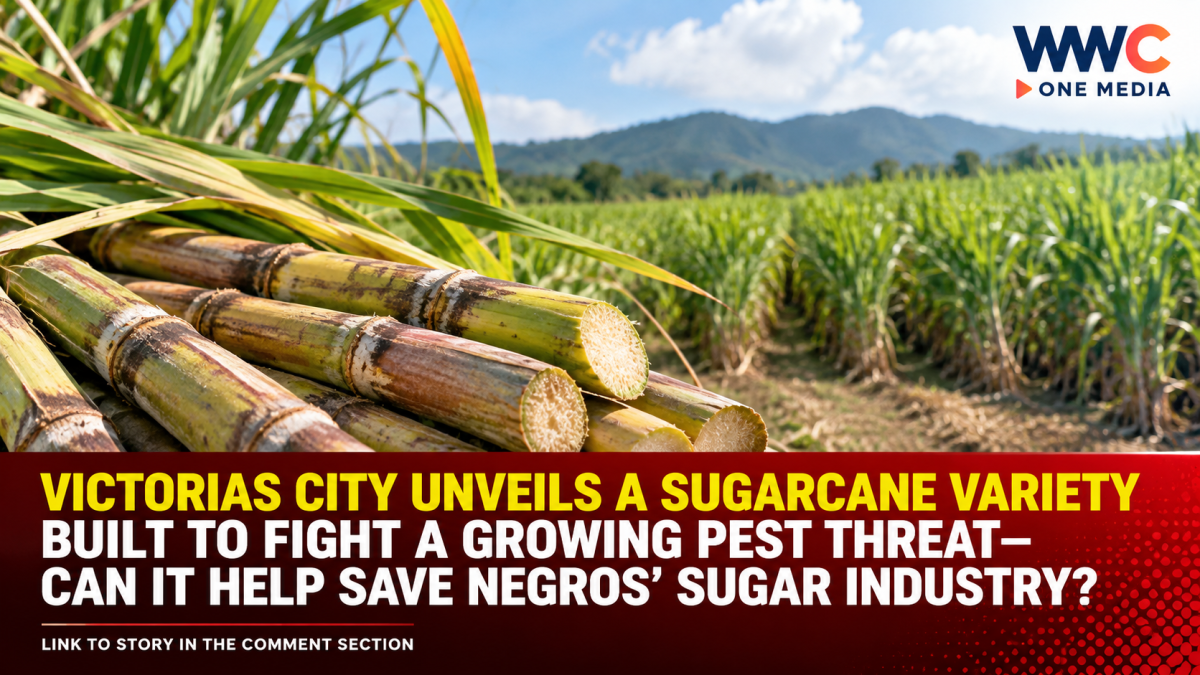
VICTORIAS CITY, Negros Occidental — A new front has opened in the battle against a destructive sugarcane pest in Negros Occidental, with Victorias City distributing a high-yielding, pest-tolerant variety to farmers whose livelihoods are increasingly threatened by the red-striped soft scale insect (RSSI).
For more Philippines agri-business coverage, see our Philippines hub and Business desk.
On September 17, 2026, the city government turned over PSR 03-171 planting materials to 50 Agrarian Reform Beneficiaries (ARBs) in Barangay V for field cultivation, according to reports from the Philippine Daily Inquirer and local news outlets.
The rollout is part of a partnership between the city government and the Philippine Sugar Research Institute Foundation Inc. (PHILSURIN) aimed at bringing research-developed sugarcane varieties directly to small farmers.
Why PSR 03-171 Matters
PHILSURIN Director General Maria Regina B. Martin said PSR 03-171 was selected for its high yield potential, ease of cultivation and tolerance to RSSI, a pest that has become a major concern for sugarcane growers in Negros. The variety has reportedly shown minimal to no stunting in areas affected by the insect.
The variety is not entirely new to the Philippine sugar industry. PHILSURIN has been evaluating PSR 03-171 for years, with earlier trials showing strong sugar-yield performance and adaptability across several sugar-producing areas.
A previous PHILSURIN-related report said PSR 03-171 produced average sugar yields of 182 LKg/ha in plant crops and 190 LKg/ha in ratoon crops across seven locations, outperforming VMC 84-524 in those trials.
Earlier research also documented its ratooning performance, with PSR 03-171 recording higher sugar yields than several check varieties in successive cropping cycles.
The Pest Behind the Urgency
The timing of the distribution is significant.
RSSI, scientifically known as Pulvinaria tenuivalvata, feeds on the sugarcane plant’s phloem sap. Heavy infestations can cause yellowing and drying of leaves, stunted growth and reduced crop performance. The insect also produces honeydew that can encourage the development of sooty mold, potentially interfering with photosynthesis.
The pest was first detected in the Philippines in Pampanga in 2022 and was subsequently confirmed in Negros Occidental in 2025. Since then, it has become a significant concern in the country’s principal sugar-producing region.
SRA-validated figures cited in August 2026 put the affected sugarcane area nationwide at about 20,693.7 hectares, with 17,506.16 hectares in the Negros Island Region.
That threat has already begun to affect expectations for national sugar production.
The Philippine Star reported earlier this month that the Sugar Regulatory Administration projected 2026–2027 sugar production at about 1.66 million metric tons, down from approximately 1.85 million MT in the previous milling season, with the RSSI infestation among the factors threatening output.
Victorias Builds Its Own Seed Supply
The Victorias initiative goes beyond simply distributing planting materials.
The city established a 2-hectare primary seed farm for initial propagation before expanding production through a 12-hectare secondary seed farm. The resulting planting materials were then made available to the 50 farmer-beneficiaries for actual field cultivation.
Negros Now Daily reported that Victorias became the first local government unit to institutionalize a formal partnership with PHILSURIN specifically for the propagation of PSR 03-171. The initiative began under then-Mayor Javier Miguel Lopez Benitez and has continued under Mayor Abelardo Bantug III.
The effort could also expand beyond Victorias. PHILSURIN said other local governments—including Sagay, Cadiz, Manapla, EB Magalona, Silay, Talisay and Murcia—have started establishing seed farms in preparation for the coming crop year.
A Variety Is Not a Stand-Alone Solution
Despite the optimism surrounding PSR 03-171, experts and agricultural authorities continue to emphasize that farmers need a broader strategy against RSSI.
The National Crop Protection Center of the University of the Philippines Los Baños has worked with farmers and local governments in Negros Occidental on science-based and environmentally sustainable RSSI management, including field assessments and farmer training.
Meanwhile, the Negros Occidental provincial government has expanded biological-control efforts, including the production of beneficial insects and Metarhizium, an entomopathogenic fungus used against insect pests.
Entomologist Ravindra Joshi has likewise urged farmers to strengthen early detection, field sanitation and protection of natural enemies as part of integrated pest management.
That broader approach is important because “pest-tolerant” should not be interpreted as completely pest-proof or immune. PSR 03-171 is being promoted because of its observed tolerance and performance, while RSSI management still requires monitoring and other control measures.
What Comes Next?
For Victorias City’s 50 farmer-beneficiaries, the real test now moves from research plots and seed farms to commercial fields.
If PSR 03-171 performs as expected under actual farm conditions, the program could provide farmers with another tool for coping with RSSI while helping expand the supply of planting materials for future planting cycles.
But with thousands of hectares already affected across Negros and national sugar production under pressure, the variety’s rollout is only one piece of a much larger effort to protect the country’s sugar industry.
The bigger question now is whether PSR 03-171 can translate its research and trial performance into stronger harvests for farmers facing one of the industry’s most serious pest challenges.