
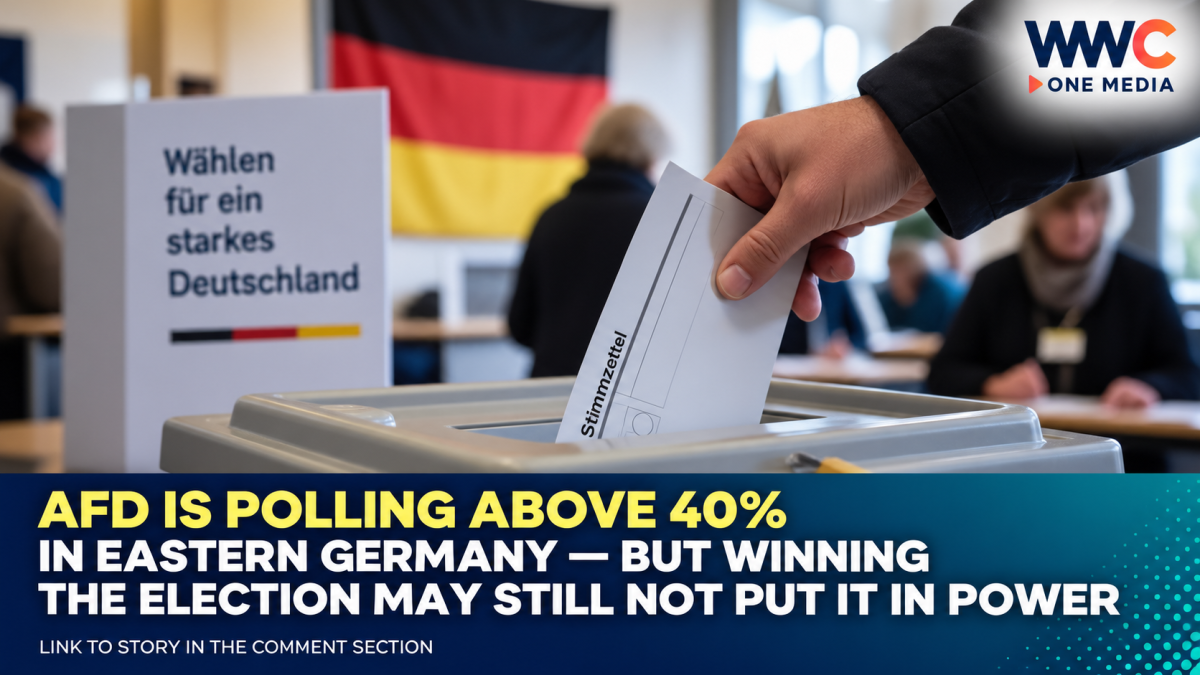
MAGDEBURG, Germany — Germany is watching one of its most consequential regional elections in decades.
More than 1.7 million eligible voters in the eastern state of Saxony-Anhalt are choosing a new state parliament Sunday in an election that could produce something postwar Germany has never seen: a far-right party not merely winning a regional vote, but potentially taking control of a state government.
The Alternative for Germany, or AfD, entered election day with a commanding polling advantage.
The latest ZDF survey cited by AFP put the party at 41%, compared with just 23% for Chancellor Friedrich Merz’s Christian Democratic Union, or CDU. The Left was polling around 11.5%, the Social Democrats at 8.5% and the Greens at 6%, while several smaller parties were hovering below Germany’s critical 5% threshold for entering parliament.
Those numbers make the AfD the overwhelming favorite to finish first.
But they do not yet tell Germans who will govern Saxony-Anhalt.
That question could prove far more complicated.
AfD Has Already Doubled Its Support Since the Last State Election
The change from five years ago is extraordinary.
In the 2021 Saxony-Anhalt election, the CDU won decisively with 37.1%, while the AfD finished second at 20.8%. Turnout was 60.3%.
If Sunday’s polls prove accurate, the positions could effectively reverse.
AfD support would have almost doubled.
The CDU’s share would have fallen by roughly 14 percentage points.
That makes this more than an ordinary state-government change.
It would represent one of the most dramatic political realignments in eastern Germany since reunification.
The Man Trying to Make History Is 35-Year-Old Ulrich Siegmund
The AfD campaign is being led by Ulrich Siegmund, a 35-year-old politician who has cultivated a large social-media following and a less abrasive public image than some of the party’s better-known national figures.
Siegmund has made his objective unusually clear.
He wants to govern.
And because nearly every other established party refuses to cooperate with the AfD, he has openly discussed winning enough seats to do it alone.
AFP quoted him saying that if rivals maintain their political firewall against his party, then the AfD will simply have to secure enough power to govern without them.
That possibility is no longer purely theoretical.
Polling above 40% does not normally translate into an absolute majority of parliamentary seats in Germany’s proportional system.
But if several parties fail to cross the 5% threshold, millions of votes cast for those parties would not translate into representation.
The remaining parliamentary seats would then be divided among fewer parties.
That could push the AfD closer to a majority even with considerably less than 50% of the popular vote.
This Is Why the 5% Threshold Could Decide Germany’s Biggest Political Story
The most important numbers Sunday night may therefore not belong to the AfD or CDU.
They could belong to the smallest parties.
The liberal FDP, which is currently part of the state government, has been polling below 5%.
The populist-left BSW has also appeared vulnerable to falling short.
The SPD is safely above that line in some polls but remains historically weak, while the Greens have hovered close enough to the threshold that their performance could dramatically alter the parliamentary mathematics.
If more parties enter parliament, an AfD majority becomes harder.
If several disappear below 5%, an AfD majority becomes more plausible.
That is what gives a relatively small number of percentage points enormous importance.
The AfD Can Win Without Governing
Germany has already seen this movie once.
In Thuringia in September 2024, the AfD became the first far-right party since World War II to win a German state election, taking about one-third of the vote.
Yet it did not form the government.
Other parties eventually united around an alternative coalition, keeping the AfD in opposition.
The episode demonstrated the power of Germany’s political “Brandmauer,” or firewall—the refusal by mainstream parties to form governing coalitions with the AfD.
That firewall is again being tested in Saxony-Anhalt.
CDU state premier Sven Schulze has ruled out governing with the AfD.
Other major parties have taken similar positions.
So if the AfD finishes first but falls short of an absolute majority, Schulze could still theoretically remain premier by assembling enough parties behind him.
That is where the arithmetic becomes difficult.
The CDU May Need Parties It Also Refuses to Govern With
The CDU’s problem is that it has its own firewall.
The party refuses formal coalitions not only with the AfD but also with The Left, whose political roots extend partly to the former East German ruling party.
Polls suggest a CDU-SPD-Green combination might still fall short of a majority.
The Left could provide the extra votes needed—but a conventional CDU-Left coalition is ruled out under current party policy.
One possibility is therefore a minority CDU government, with The Left agreeing not to bring it down on key confidence votes.
Germany has used variations of that arrangement before.
But such an outcome would mean a remarkable situation:
The AfD could win the election by a huge margin and still watch a CDU politician remain premier.
That would almost certainly intensify the party’s argument that Germany’s established parties are conspiring to deny it power.
What Would an AfD Government Actually Try to Change?
The stakes matter because German state governments control significant areas of everyday life.
Education.
Police.
Culture.
Parts of domestic security.
Public broadcasting.
Administration of immigration rules.
And representation in Germany’s Bundesrat, the upper chamber through which state governments participate in federal legislation.
The AfD’s Saxony-Anhalt platform would therefore have practical consequences beyond symbolism.
Among its most prominent proposals are what the party calls a “remigration and deportation offensive,” tougher immigration enforcement and changes to refugee protections.
It also wants to prohibit rainbow pride flags at public schools, halt new wind-farm development and reshape education toward what it considers a more patriotic German identity.
Reuters reports that the party also wants major changes to cultural institutions and public broadcasting and advocates a more socially conservative approach to schools and family policy.
Supporters describe those proposals as restoring national identity, public order and political accountability.
Critics describe them as discriminatory, economically damaging and potentially corrosive to Germany’s liberal-democratic institutions.
Intelligence Authorities Add Another Layer of Controversy
Germany’s domestic intelligence authorities have classified the Saxony-Anhalt AfD organization as right-wing extremist.
That designation is regularly cited by the party’s opponents as evidence that this is not simply another conservative party competing for office.
The AfD rejects the characterization and says state institutions are being politically weaponized against it.
For accuracy, this distinction matters.
It is appropriate to say the state branch has been classified that way by Germany’s domestic intelligence service.
It is less precise to simply state without attribution that every AfD voter, member or policy is “extremist.”
Millions of Germans support the party for different reasons, ranging from migration and economic policy to dissatisfaction with established parties and resentment over the legacy of reunification.
Why the AfD Is So Much Stronger in Eastern Germany
The party’s rise cannot be explained by immigration alone.
Reuters reporting from Saxony-Anhalt and neighboring Mecklenburg-Western Pomerania highlights a deeper pattern.
Eastern Germany continues to experience lower incomes, demographic decline, shortages of skilled workers and a persistent perception that political and economic power remains concentrated in the west, more than three decades after reunification.
Many communities lost young residents after 1990.
Industries disappeared or were restructured.
Populations aged.
Some towns remain considerably poorer than western German equivalents.
For voters who believe the promises of reunification were never fully delivered, the AfD has successfully cast itself as the party willing to challenge a political establishment they see as distant and western-dominated.
That sense of being ignored is one of the party’s most powerful political assets.
Russia Is Another Major East-West Divide
The election also exposes Germany’s unresolved debate over Russia.
The AfD wants closer economic and political relations with Moscow and opposes Berlin’s current support for Ukraine.
That message has found a particularly receptive audience in parts of the former East Germany, where Russia and the former Soviet Union occupy a very different place in collective memory than they do in much of western Germany.
Some voters remember Soviet troops as part of ordinary life under the German Democratic Republic.
Others associate the prewar relationship with Russia with cheaper energy and economic stability.
Chancellor Merz’s government, by contrast, has moved toward higher defense spending and a harder security stance toward Moscow.
So the Saxony-Anhalt election is also a referendum of sorts on Germany’s direction in Europe.
Economists Warn That the AfD’s Immigration Policy Could Backfire
There is a contradiction at the heart of the party’s economic appeal.
Saxony-Anhalt is aging and losing workers.
Yet the AfD’s toughest policies are directed at immigration.
The German Economic Institute has warned that restrictive immigration policies could be economically damaging to a region already dependent on foreign-born workers and struggling with labor shortages.
Businesses need engineers, healthcare workers, skilled tradespeople and factory employees.
Universities increasingly depend on international students and researchers.
AfD supporters counter that Germany needs more controlled immigration, stronger incentives for German families and economic policies designed to retain young local workers instead of using immigration to compensate for demographic decline.
That disagreement—whether migration is part of the solution or part of the problem—is one of the central political divides driving Sunday’s vote.
The Election Is Also a Judgment on Chancellor Friedrich Merz
Saxony-Anhalt has just 2.1 million inhabitants, but the election is being watched nationally because of what it says about Chancellor Friedrich Merz.
Merz came to power promising economic reform, tougher migration policies and stronger conservative leadership.
Yet the AfD has continued climbing.
Reuters reported in late August that one national Forschungsgruppe Wahlen poll put the AfD at 27% nationally and the CDU at 22%, although individual polls vary and no single survey should be treated as an election forecast.
A crushing CDU defeat in Saxony-Anhalt would therefore strengthen critics who argue that Merz’s strategy of adopting a harder line on migration has failed to win AfD voters back.
Political scientist Wolfgang Schroeder told AFP that an AfD victory would intensify pressure on the chancellor, although he saw no obvious internal challenger capable of replacing him immediately.
The AfD Is Already Looking Toward 2029
Siegmund and the national AfD leadership are not presenting Saxony-Anhalt as an isolated regional contest.
They describe it as a stepping stone.
AfD co-leader Alice Weidel has publicly predicted that her party will eventually govern at the federal level, while Siegmund has talked about creating a political “domino” effect beginning in Saxony-Anhalt and culminating in Germany’s 2029 national election.
That ambition helps explain why Sunday’s result matters far beyond Magdeburg.
A first AfD-led state government would provide the party with something it has never had:
A record of executive government that it could either showcase—or be judged by—before a national election.
Another Eastern State Votes in Just Two Weeks
Saxony-Anhalt is also not the end of Germany’s September election drama.
Mecklenburg-Western Pomerania votes on September 20.
The AfD leads there as well, although its advantage is considerably narrower.
An Infratest Dimap poll released September 3 put the AfD at 35% and the governing SPD at 32%, while a separate Forsa survey put the gap at 37% to 28%.
That means even if the firewall blocks the AfD in Saxony-Anhalt, the same political problem will return almost immediately somewhere else.
Do Not Call This Election Yet
One final accuracy point matters especially for social-media headlines.
The AfD has not won Saxony-Anhalt yet.
At the time of this report, voting is still taking place.
Polls show a commanding AfD lead.
They do not constitute an official result.
Voting closes at 6 p.m. local time, and the first projections are expected shortly afterward.
The eventual seat distribution could also differ significantly from the raw vote percentages depending on which smaller parties cross the 5% threshold.
That means the most dramatic question Sunday is not simply:
Will the AfD finish first?
Polls suggest that is very possible.
The bigger question is:
Will it win enough seats to force Germany’s political firewall to finally break?
If the answer is no, the AfD could celebrate its biggest Saxony-Anhalt result ever—and still remain outside government.
If the answer is yes, Germany enters territory its postwar political system has never had to navigate.
The AfD has already shown it can win elections. Saxony-Anhalt may decide whether it can finally turn those votes into power.
WWC ONE MEDIA M.J.E




Leave a Reply