
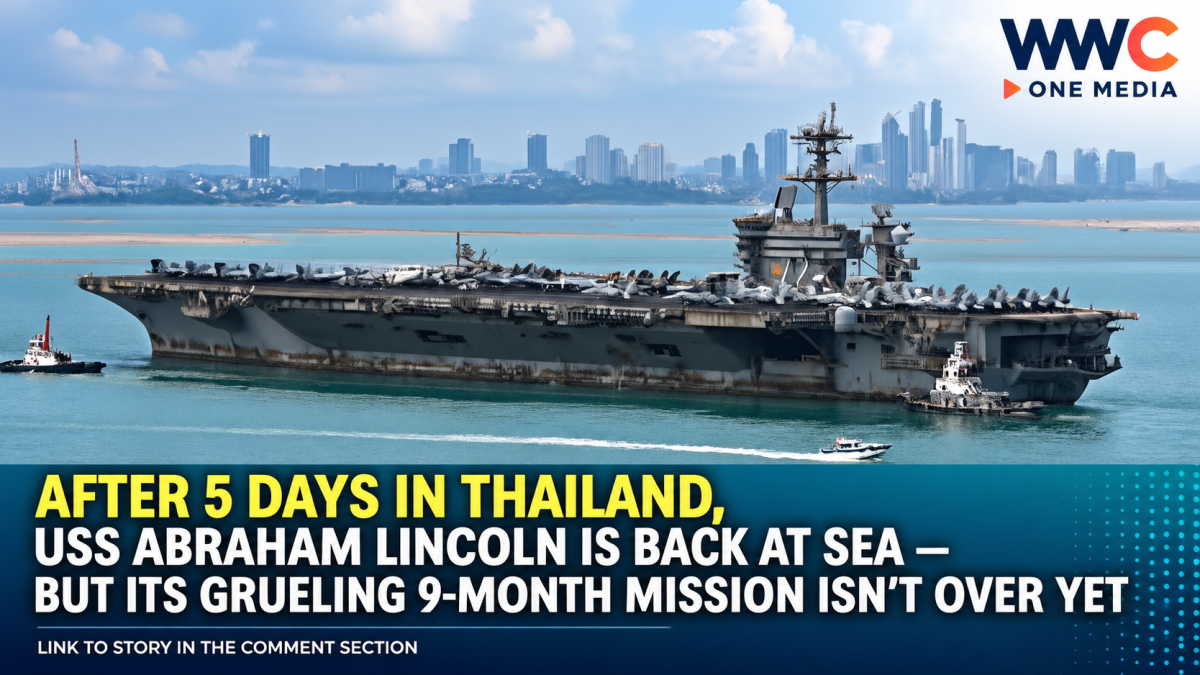
LAEM CHABANG, Thailand — The nuclear-powered aircraft carrier USS Abraham Lincoln has left Thailand after a five-day port visit, sending nearly 5,000 U.S. sailors and Marines back to sea after one of the most demanding stretches of operations endured by a modern American carrier crew.
The Nimitz-class carrier departed Laem Chabang on Sunday, September 6, after arriving on September 2. The U.S. Navy confirmed that the Abraham Lincoln Carrier Strike Group is now conducting routine operations in the U.S. 7th Fleet area, meaning the massive warship has resumed its mission in the Indo-Pacific rather than simply ending its deployment the moment it left Thailand.
The departure closes a brief but closely watched chapter in an extraordinary deployment that took the Lincoln from the Western Pacific into the Middle East, placed its crew in combat operations connected to the war with Iran and kept sailors away from a proper port call for more than 260 consecutive days.
Five days of relief after months of relentless operations
The Abraham Lincoln arrived at Laem Chabang with a deployment already stretching to roughly nine months. Its last previous port visit had been in Guam in December 2025, according to USNI News, meaning the crew had spent more than 260 straight days without another port call before Thailand.
That distinction matters because some reports describe the carrier as having spent about 286 days “at sea.” The more precise picture is that the overall deployment had reached roughly 286 days by its arrival in Thailand, while its uninterrupted period without a port visit was around 264 to 265 days. Associated Press reporting described it as a modern record-setting stretch for a U.S. aircraft carrier.
For thousands aboard, Thailand therefore represented much more than an ordinary stop.
Sailors and Marines poured into Pattaya, about 150 kilometers southeast of Bangkok, for shopping, sightseeing, food and long-awaited time away from the ship. Thai businesses had prepared for a major influx during what is normally a slower tourism season.
Pattaya Mayor Poramase Ngampiches estimated that visiting American personnel spent as much as 100 million baht, or around US$3 million, during the visit. Local suppliers also reportedly sold millions of baht worth of provisions and personal-care products to the ship.
A deployment shaped by the Iran war
The Thailand stop followed months of intense operations far from the carrier’s original Pacific mission.
The Abraham Lincoln left San Diego in November 2025 and was subsequently sent toward the Middle East as tensions escalated into open conflict with Iran. Reuters reported that the carrier took part in the U.S. naval blockade and combat operations during the war.
The ship was eventually relieved in the Middle East by the USS George Washington, allowing the Lincoln strike group to move back toward the Indo-Pacific.
The extended mission put extraordinary pressure on the carrier’s roughly 5,000-person crew.
Reports from the Associated Press, Washington Post, Reuters and other outlets described concerns about fatigue, mental health, food and hygiene supplies, plumbing problems and the cumulative strain of months at sea with few opportunities for sailors to leave the ship.
Democratic lawmakers subsequently demanded answers from the Pentagon, describing the continuous time at sea as a modern record and requesting information about medical care, food, water, hygiene and crew welfare.
The Pentagon has disputed portrayals suggesting the ship was in crisis.
Defense Secretary Pete Hegseth said in August that reports about conditions aboard the Lincoln had been “completely misrepresented,” while emphasizing the difficult circumstances sailors face during prolonged wartime deployments.
That leaves an important distinction for responsible coverage: serious concerns about conditions were reported by sailors, relatives, lawmakers and news organizations, but U.S. defense leaders contested some descriptions of their severity.
Thailand visit ends largely without incident
Despite preparations for thousands of sailors descending on Pattaya — a city famous for both beaches and nightlife — Thai police said the visit was largely peaceful.
Pattaya police chief Anek Srathongyoo told AFP that the port call went smoothly overall. Authorities reported one minor dispute between U.S. personnel early in the visit, after which two sailors were returned to the carrier, but no major disturbances were reported.
The Navy also organized recreational activities and tours through its Morale, Welfare and Recreation program, while thousands of personnel explored the Pattaya and Si Racha areas.
The stop carried diplomatic weight as well.
Thailand is a longstanding American treaty ally, and the U.S. Navy framed the visit as another demonstration of Washington’s military partnership with Bangkok and its broader commitment to Southeast Asia.
Where is the USS Abraham Lincoln going now?
This is where some coverage can become misleading.
While previous reporting indicated the Abraham Lincoln was ultimately expected to return to the United States after its exceptionally long deployment, the Navy’s September 6 statement did not say the carrier was sailing directly to San Diego.
Instead, Capt. Dan Keeler said the crew looked forward to continuing its mission in the 7th Fleet alongside regional allies and partners. The Navy said the strike group was conducting routine operations within the 7th Fleet area.
USNI News previously projected that the carrier could reach its home port around late September or early October, although operational schedules can change and the Navy has not publicly announced a final arrival date in its latest statement.
That makes the Thailand departure more than the end of a five-day vacation.
For the thousands aboard the Abraham Lincoln, it marks the beginning of what could be the final phase of an unusually long deployment — but until the carrier finally enters its home port, one of the U.S. Navy’s most closely watched voyages is not quite over.
WWC ONE MEDIA M.J.E




Leave a Reply