
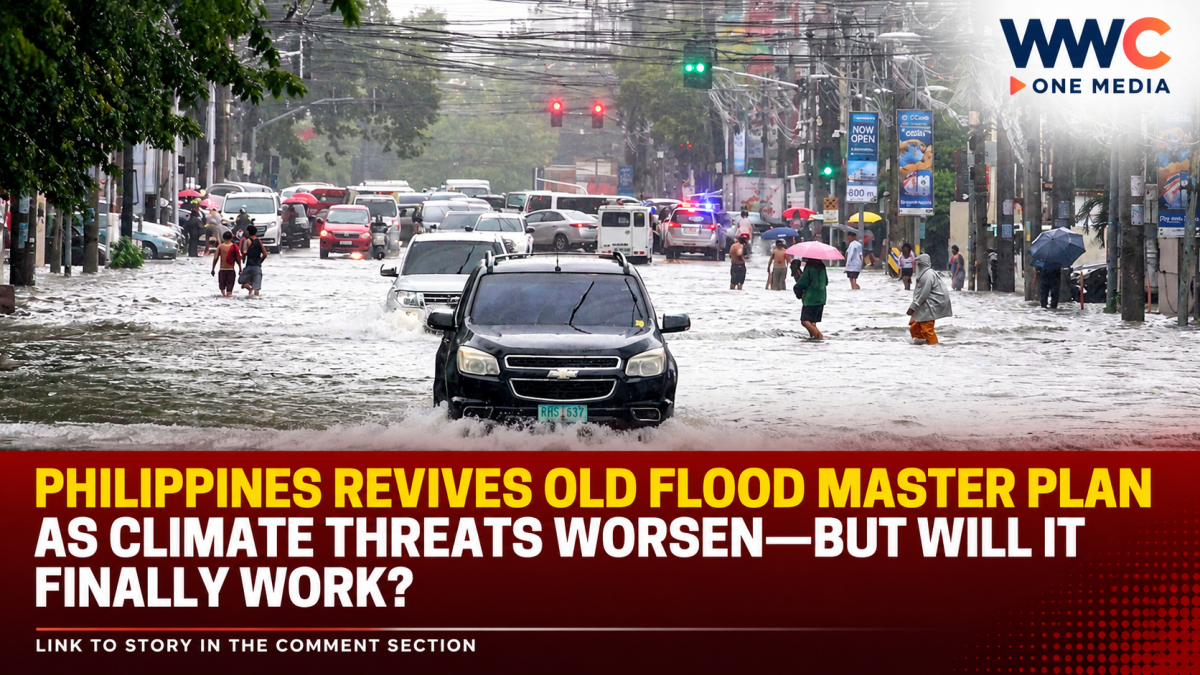
MANILA, Philippines — The Philippine government is once again revisiting long-standing flood management plans as increasingly extreme rainfall, destructive flooding and the growing impact of climate change expose the country’s vulnerability—and raise difficult questions about why previous solutions were never fully implemented.
Malacañang confirmed that the government is reviewing earlier flood-control strategies, including the so-called Aquino-Singson Master Plan, while the Department of Public Works and Highways (DPWH) continues updating flood management plans for major river basins across the country.
The renewed review comes after President Ferdinand Marcos Jr. said the Philippines had already possessed a flood-control master plan for decades but that it had not been fully carried out.
“We already have a masterplan. It’s just never been executed. We are only executing it now,” Marcos said during a recent inspection in Tarlac.
The Palace has acknowledged, however, that older flood-control plans may no longer be sufficient on their own because climate change has dramatically altered rainfall patterns, flooding risks and the country’s infrastructure needs.
Aquino-Era ₱351-Billion Flood Plan Back in the Spotlight
One of the plans now being revisited was developed during the administration of former President Benigno Aquino III under then-Public Works Secretary Rogelio “Babes” Singson.
The Aquino administration approved a long-term ₱351-billion flood management master plan in 2012, designed primarily to address the chronic flooding problem in Metro Manila and surrounding areas. Full implementation was envisioned as a long-term undertaking extending to around 2035 because of the scale of the infrastructure required.
But the plan was not fully implemented by succeeding administrations.
Palace Press Officer and Presidential Communications Office Undersecretary Claire Castro said Public Works Secretary Vince Dizon had mentioned the Aquino-Singson plan as one of the proposals now being examined alongside existing flood-control master plans for major river basins.
According to Castro, the various plans will need to be consolidated, reviewed and updated to ensure they reflect today’s climate realities.
Why the Government Is Revisiting the Plan Now
The urgency has intensified after severe flooding repeatedly struck Metro Manila, Central Luzon and other parts of the country.
Government officials have increasingly acknowledged that the Philippines can no longer rely exclusively on old flood-control strategies designed for a different climate, population size and urban landscape.
Recent government discussions have focused on:
- Updating flood-control master plans using current climate and hazard data
- Prioritizing major river basins
- Improving drainage and waterways
- Strengthening land-use planning
- Enforcing no-build zones and environmental regulations
- Developing nature-based and water-retention solutions
- Addressing local differences in geography and topography
The DPWH has been updating flood management plans for 18 major river basins and other critical principal rivers, with government officials saying most of the master plans and feasibility studies had already been updated as of May 31, 2026.
The remaining plans for critical basins, including the Cagayan and Pasig-Maríkina-Laguna Lake systems, are targeted for completion by the end of 2026.
DPWH Turns to Science and Updated Hazard Data
The government’s latest direction signals a shift toward more science-based flood planning.
According to the Philippine News Agency, the DPWH has ordered the updating of flood management master plans and is working with the University of the Philippines’ Project Nationwide Operational Assessment of Hazards, or UP NOAH, local government units and other agencies.
The goal is to integrate updated hazard maps and scientific information before major infrastructure projects move forward.
This is crucial because infrastructure designed using outdated rainfall assumptions may no longer provide enough protection against increasingly intense weather events.
From Concrete Projects to a River Basin Approach
The government is also pushing for a more integrated river basin approach instead of relying solely on isolated flood-control structures.
Under this strategy, flood management would consider an entire watershed or river system—from upland areas to downstream communities—rather than treating flooding as a problem that can be solved by simply constructing more dikes, drainage channels or pumping stations.
Malacañang said the approach is intended to account for the Philippines’ highly varied geography and the unique conditions affecting different flood-prone communities.
Officials have stressed that solutions suitable for one river basin may not necessarily work in another.
Metro Manila Also Faces a Major Infrastructure Challenge
The flood problem is particularly urgent in the National Capital Region, where rapid urbanization has placed enormous pressure on decades-old drainage systems.
Government plans now include a number of proposed flood-mitigation interventions across Metro Manila, including:
- Bioretention areas
- Detention ponds
- River floodplains
- Inland wetlands
- River restoration or renaturation projects
Recent reports have also highlighted how parts of Metro Manila’s drainage infrastructure were built more than half a century ago, when the capital region had a much smaller population and significantly less urban development.
That means the country’s flood-control challenge is no longer just about building new infrastructure—it is also about redesigning systems for a much denser and more climate-vulnerable population.
Billions Spent, But Why Does Flooding Persist?
The renewed focus on a comprehensive flood-control strategy comes amid growing public scrutiny over the massive amounts spent on flood management projects through the years.
Sen. Panfilo Lacson recently stressed that flood-control master plans should survive changes in administration, warning against repeatedly abandoning previous strategies whenever a new government takes office.
According to figures cited in recent reports, DPWH flood-control spending reached approximately:
- ₱183.55 billion from 2011 to 2016
- ₱748.42 billion from 2017 to 2022
- Around ₱1 trillion from 2023 to 2025
Lacson argued that a technically sound national strategy should continue across administrations, while still allowing adjustments for new scientific data, climate conditions and local realities.
The Bigger Question: Will This Time Be Different?
The government’s decision to revisit old plans while updating river-basin strategies could represent an important turning point in the Philippines’ long-running battle against flooding.
But experts and critics have repeatedly pointed to a familiar problem: the Philippines has had plans before. The bigger challenge has been implementation, continuity, coordination and accountability.
The Marcos administration now faces pressure to ensure that flood management does not become another cycle of ambitious plans followed by delays, fragmented projects and policy changes under future governments.
The Palace has indicated that the government is open to making flood-control planning more transparent and has emphasized the need for stronger political will.
For millions of Filipinos who experience flooding year after year, however, the question is becoming increasingly urgent:
How many more floods will happen before a national strategy finally survives long enough to make a real difference?
As climate risks intensify and extreme rainfall continues to test the country’s aging infrastructure, revisiting the old flood master plan may be only the first step.
The real test is whether the Philippines can finally turn decades of plans into projects—and projects into lasting protection.




Leave a Reply