
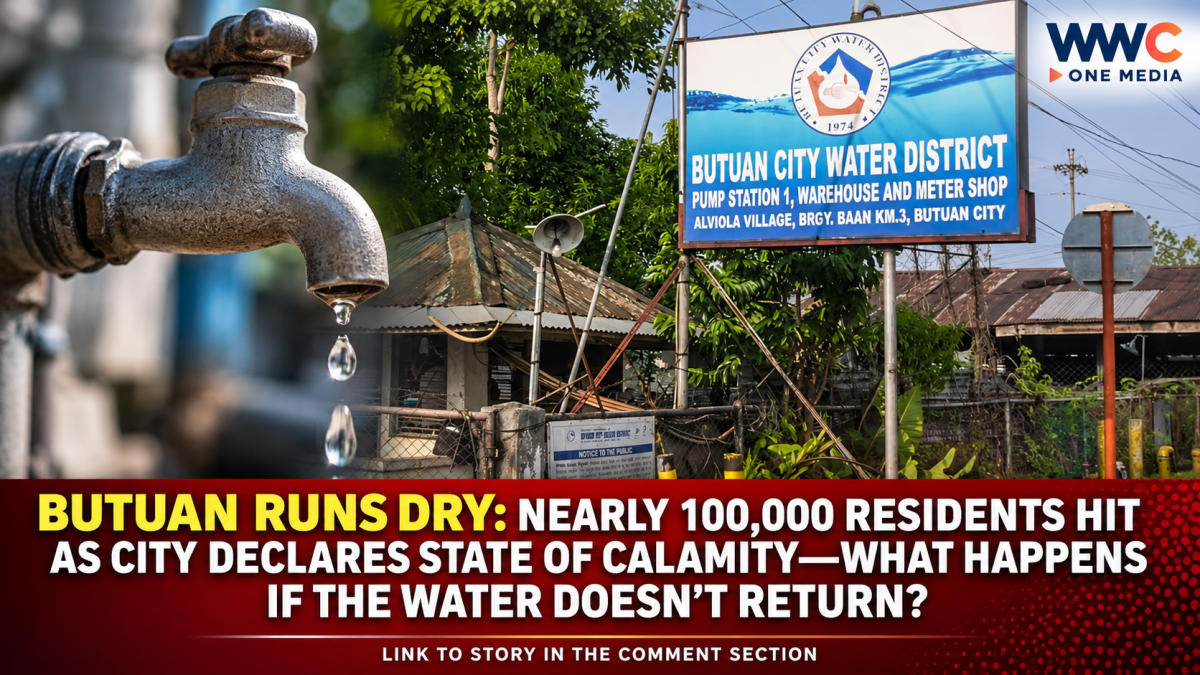
BUTUAN CITY — A worsening water shortage has pushed Butuan City into a state of calamity, with more than 91,000 residents now experiencing low water pressure or no water service as prolonged dry conditions continue to drain the city’s water sources.
The Sangguniang Panlungsod approved the declaration on Saturday, September 5, 2026, through Resolution No. 17-444-2026, as officials confronted what authorities described as a severe and continuing disruption to the city’s water supply.
The latest figures from the Butuan City Water District (BCWD) show that 91,425 residents in 58 villages were experiencing low-pressure or no-water conditions as of September 4.
That represents roughly one-third of the population served by the water district, turning what was initially a supply problem into a citywide emergency.
Water supply falls far below normal
The situation has become particularly alarming because the city’s available water supply has fallen sharply.
According to BCWD data cited by PNA, water availability has dropped to only 37.36 million liters per day (MLD), compared with the normal requirement of approximately 55 MLD.
The shortage has been linked to the prolonged dry spell affecting Agusan del Norte, including Butuan City. PAGASA confirmed that Agusan del Norte had entered dry spell conditions on August 23 following a significant rainfall deficit.
BCWD had already warned residents weeks earlier that the situation was becoming critical.
In an August 24 advisory, the water district said the Taguibo area had experienced 23 consecutive days of drought, causing streamflows to fall dramatically. The district also reported that dam levels had dropped below its critical threshold.
Water rationing is no longer enough
To cope with the declining supply, BCWD has implemented rationing and alternative water-fetching measures.
Its Oplan Sag-Ob program allows affected consumers to obtain water from designated collection points. Residents have also been instructed to conserve water and store supplies whenever water becomes available.
BCWD has warned residents to boil fetched or stored water before drinking or cooking, underscoring the need to protect water quality while alternative sources are being used.
But despite these emergency measures, officials acknowledge that the available supply remains inadequate.
The state of calamity declaration gives the city government and affected barangays greater access to emergency resources and quick-response funds that can be used for immediate interventions, including water tanks, tankers, pumps, filtration systems and other equipment needed for distribution.
City explores new water sources
Authorities are now looking beyond temporary rationing as they search for ways to increase Butuan’s water supply.
The city government and BCWD are assessing several existing pumping stations for possible rehabilitation. Pumping Stations 2, 3 and 16 have been identified as possible sources of additional water, according to the Inquirer report.
Officials are also considering geo-resistivity surveys to identify potential groundwater sources, determine aquifer conditions and establish whether underground water is fresh or saline.
Possible re-drilling sites are also being evaluated.
However, authorities say any potential source must first undergo testing for water quality, yield and long-term reliability before it can be developed for public distribution.
Crisis exposes a deeper problem
The current emergency is also reviving questions about the city’s long-term water security.
Residents have raised concerns over the reliability of existing water sources, the adequacy of contingency plans and the situation of consumers who are receiving little or no water service.
Some residents and former officials have argued that recurring water shortages should prompt stronger investments in infrastructure rather than relying primarily on emergency rationing.
The concern is particularly significant because BCWD itself has acknowledged the need for both short-term and long-term measures to establish a more reliable and resilient water system.
A wider warning for Mindanao
Butuan’s water emergency is unfolding amid broader concerns over prolonged dry conditions in parts of Mindanao.
In neighboring Dinagat Islands, authorities recently declared a state of calamity after prolonged dry conditions severely affected water sources. More than 18,000 residents were reported affected or at immediate risk, with communities increasingly dependent on water hauling and rationing.
PAGASA’s monitoring cited by MindaNews has also pointed to continuing El Niño conditions, with below-normal rainfall expected in the Caraga region.
The developments highlight the vulnerability of communities whose water systems depend heavily on rainfall-sensitive rivers, springs and groundwater.
For Butuan, however, the immediate priority is much more basic: getting enough safe water to tens of thousands of households before the shortage becomes even more severe.
With the city’s available supply already far below normal levels, residents and officials are now facing the same urgent question:
How long can Butuan keep its water system running if the rains do not return?
WWC ONE MEDIA J.M.S



Leave a Reply