
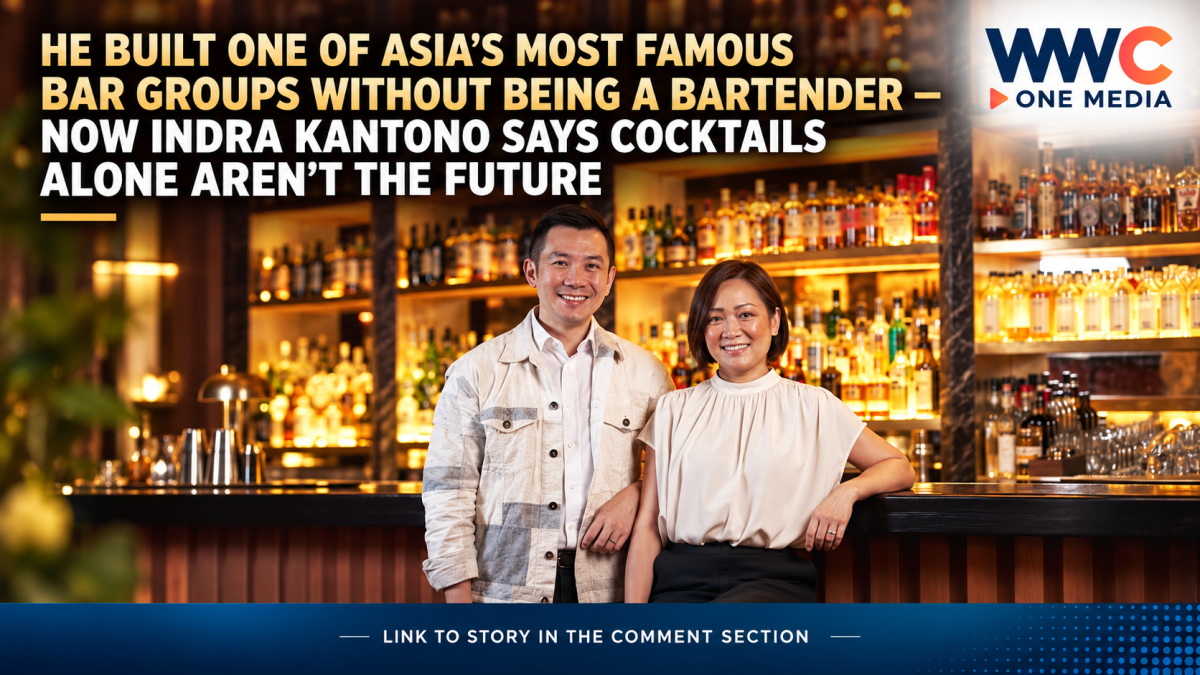
SINGAPORE — Fourteen years ago, Indra Kantono and Guoyi Gan entered Singapore’s emerging cocktail industry with an unusual résumé.
Neither was a professional bartender.
Kantono came from consulting and private equity. Gan had been a Singapore Airlines cabin crew member. They learned classic cocktails from books, videos and visits to bars overseas before risking their savings on an idea that could easily have failed.
Instead, that idea became Jigger & Pony, one of the most internationally recognised names in Singapore hospitality.
Today, the husband-and-wife founders oversee a group spanning eight venues across Singapore and Jakarta, while CNA reports that the company employs roughly 120 people. Tatler independently lists the current portfolio as including Jigger & Pony, Gibson, Humpback, Caffe Fernet, Live Twice, Pop City, BOP and Jakarta’s Cosmo Pony.
But after spending more than a decade helping establish Singapore as a serious cocktail destination, Kantono is now asking a different question:
What happens when making excellent cocktails is no longer enough?
His answer could offer a glimpse of where Asia’s bar industry is heading next.
2026 Has Become Kantono’s Biggest Recognition Year Yet
Kantono’s influence received unusually strong recognition this summer.
In July, the Tales of the Cocktail Foundation named him Best International Bar Mentor at its 2026 Spirited Awards. The award recognises people whose professional work helps improve bartenders, bars and the wider cocktail industry.
Days later, Asia’s 50 Best Bars presented him with its Roku Industry Icon Award, describing him as an important figure in modern Asian hospitality whose influence extends beyond individual drinks into company culture, staff development and sustainable hospitality businesses.
His venues were simultaneously producing results of their own.
The 2026 Asia’s 50 Best Bars ranking placed:
Jigger & Pony at No. 9 in Asia, making it Singapore’s highest-ranked bar;
Cosmo Pony at No. 15, giving the group an unusually strong showing in Jakarta; and
BOP at No. 52 on the extended 51-100 ranking only months after opening in Singapore.
The Straits Times noted that Jigger & Pony slipped from No. 3 in 2025 to No. 9 this year, but it still retained the ranking’s title of The Best Bar in Singapore.
Those rankings are industry awards based on voting and should not be treated as an objective scientific measurement of bar quality.
But taken together with Kantono’s individual honours, they show the unusual durability of a business that began with two founders who had never professionally made drinks.
The S$400,000 Gamble
According to CNA, Kantono was born in Indonesia and raised in Singapore before studying in New York.
He later worked at Bain & Company and a private-equity firm, following the type of stable professional career he had initially been expected to pursue.
Gan wanted something different.
When they began discussing a business together, Kantono originally imagined a boutique hotel. The capital requirements were too high.
They considered restaurants but decided cooking looked even harder.
A cocktail bar became the compromise.
By 2010, the couple had accumulated about S$400,000 in combined savings, according to CNA. Gan used her international flying schedule to visit bars abroad and bring home spirits and mixers, while both founders studied cocktails independently.
Trips to Japan and Europe altered their thinking.
In Tokyo, they encountered the precision of Japanese bartending.
In Madrid, they absorbed another lesson that would become central to Jigger & Pony’s philosophy: customers may order drinks, but what they remember is often the social experience surrounding them.
Jigger & Pony eventually opened in 2012, when Singapore’s modern craft-cocktail industry was still relatively young.
Then Singapore’s Cocktail Scene Exploded
The environment around Jigger & Pony changed dramatically.
Singapore is now one of Asia’s deepest cocktail markets.
Four Singapore venues made the main Asia’s 50 Best Bars 2026 ranking: Jigger & Pony at No. 9, Nutmeg & Clove at No. 12, Offtrack at No. 16 and Origin Bar at No. 43.
Several more Singapore venues appear between positions 51 and 100, including BOP, Side Door, The Elephant Room, Native, Cat Bite Club, Bar Bon Funk and Stay Gold Flamingo.
Jigger & Pony has been part of that rise for years.
The bar reached No. 1 on Asia’s 50 Best Bars in 2020, while Tales of the Cocktail later named the Amara Hotel venue Best International Hotel Bar in 2023.
That history makes Kantono’s latest argument particularly interesting.
He is not predicting the death of cocktail bars.
He is suggesting the category has matured enough that simply serving expertly made drinks may no longer be sufficient differentiation.
The Next Cocktail Bar May Be Half Restaurant
Kantono told CNA he expects cocktail bars increasingly to stretch beyond their traditional definition.
One obvious direction is food.
His newest Singapore concept, BOP — Bartenders of Pony — opened in January with South Korean bartender Uno Jang leading a concept inspired by Korean drinking culture. The idea combines cocktails, food, music and nightlife rather than treating food as an afterthought accompanying drinks.
Kantono argues that this hybrid model can offer customers something between a traditional restaurant and a conventional cocktail bar.
And BOP’s appearance at No. 52 in Asia’s extended ranking during its opening year gives the experiment some early industry validation.
The broader Singapore market is already moving in similar directions.
Kantono points to Offtrack, which integrates music deeply into its identity rather than simply playing a playlist behind the bar. Offtrack itself reached No. 16 in Asia’s 50 Best Bars this year.
His thesis is essentially that tomorrow’s strongest bars may be places where cocktails are one element of an experience built around food, music, design, sport or another cultural interest.
Jakarta May Be the More Important Experiment
The group’s international expansion provides another clue.
In 2024, Jigger & Pony Group partnered with Indonesian hospitality company Union Group to create Cosmo Pony at Grand Hyatt Jakarta, its first venue outside Singapore.
Kantono’s Indonesian roots gave the city personal significance, but the expansion was also strategic.
Before opening permanently, the group conducted pop-ups and guest shifts in Indonesia to better understand Jakarta customers and the local bar community. Tatler reported that Jigger & Pony saw growing demand for more sophisticated cocktail experiences in the Indonesian capital.
The gamble appears to have gained momentum.
Cosmo Pony now sits at No. 15 on Asia’s 50 Best Bars 2026, while Jakarta placed four venues in the top 50 overall: Modernhaus at No. 11, Cosmo Pony at No. 15, Carrots Bar at No. 21 and The Golden Tooth at No. 40.
That makes Jakarta one of Southeast Asia’s increasingly important cocktail markets.
For Jigger & Pony, it also demonstrates something potentially more valuable than a ranking:
the company may be able to export its hospitality system without simply copying and pasting its Singapore flagship.
Kantono Calls the Idea ‘Global Fluency’
Kantono describes the philosophy behind that expansion as being globally sophisticated while remaining genuinely local.
Cosmo Pony is not meant to be Jigger & Pony transported intact from Singapore to Jakarta.
BOP does not attempt to reproduce Seoul inside Singapore.
Instead, the group tries to combine its operating philosophy with the culture of the place or people behind a particular concept.
That may explain why the company’s eight venues look so different.
A conventional restaurant chain often scales through repetition.
The same logo.
The same menu.
The same furniture.
The same customer experience.
Jigger & Pony increasingly appears to be attempting the opposite: scale the organisation and its hospitality culture while allowing the individual concepts to remain distinct.
That is much harder operationally.
It may also make the company more difficult to imitate.
The Real Product May Be the Staff
Kantono’s mentor award helps explain another part of the strategy.
Instead of viewing mentorship primarily as senior professionals periodically giving advice to individual bartenders, he has tried to institutionalise training inside the company.
CNA says employees move through structures including the group’s Pony Academy learning platform and senior-buddy system, designed to spread knowledge across teams rather than making development dependent on one mentor.
Asia’s 50 Best Bars highlighted the same idea when giving Kantono its Industry Icon Award.
Its citation praised his emphasis on deliberately building company culture, developing future leaders and turning hospitality careers into something more sustainable than temporary service jobs.
That matters in an industry where the quality of the guest experience depends heavily on people.
A cocktail recipe can be written down.
A competitor can buy similar spirits.
Furniture can be copied.
What is much harder to reproduce is a workforce trained to deliver the same standard of service night after night.
That may ultimately be Jigger & Pony’s strongest competitive advantage.
The Business Is Becoming Bigger Than Drinks
Kantono now describes himself less as someone running cocktail bars and more as someone working with taste, atmosphere and cultural trends.
He remains involved in design, music and the overall feeling of the group’s venues.
That shift reveals where the Jigger & Pony story may be heading.
The first phase was proving two outsiders could open a serious cocktail bar.
The second was turning that bar into one of Asia’s most recognised hospitality brands.
The third was building multiple Singapore concepts.
The fourth was exporting the model to Jakarta.
Now comes a potentially more ambitious phase:
Can a company built around cocktails become a broader Asian hospitality and culture business without losing the thing that made it successful?
That is the tension behind Kantono’s belief that cocktail bars must evolve.
And Jigger & Pony Has Already Had Failures
The group’s growth has not been a perfect sequence of successful openings.
Tatler previously reported that some concepts did not work, including whisky-focused Flagship, which operated from 2015 until 2019.
Kantono later concluded that the concept had moved too far away from the group’s core emphasis on convivial hospitality and craft.
That history makes the current expansion strategy more interesting.
Jigger & Pony’s growth has involved closing concepts as well as opening them.
In other words, the “Jigger & Pony way” is not simply a formula guaranteeing success.
It is a framework that the group continues testing.
Awards Are Useful — But They Are Not the Business
The temptation with a company like Jigger & Pony is to tell its story entirely through rankings.
No. 1.
No. 3.
No. 9.
Best bar.
Industry Icon.
International Bar Mentor.
But Kantono’s own comments point somewhere else.
The goal is not ultimately a trophy.
It is creating places where people want to spend time with each other.
That is why his argument about the future of cocktail bars matters beyond Jigger & Pony.
If Singapore’s cocktail market is now as mature as he believes, technical competence becomes the starting point rather than the final advantage.
Many bars can make a good drink.
The battle increasingly becomes about everything surrounding that drink:
the people;
the food;
the music;
the design;
the story;
and whether customers feel enough attachment to come back.
Fourteen years after betting S$400,000 on a business they barely knew how to operate, Kantono and Gan have already helped prove that Singapore can build cocktail bars respected internationally.
Their next bet is riskier: that the most successful cocktail bars of the future may have to become something much bigger than cocktail bars at all.
WWC ONE MEDIA M.J.E



Leave a Reply