
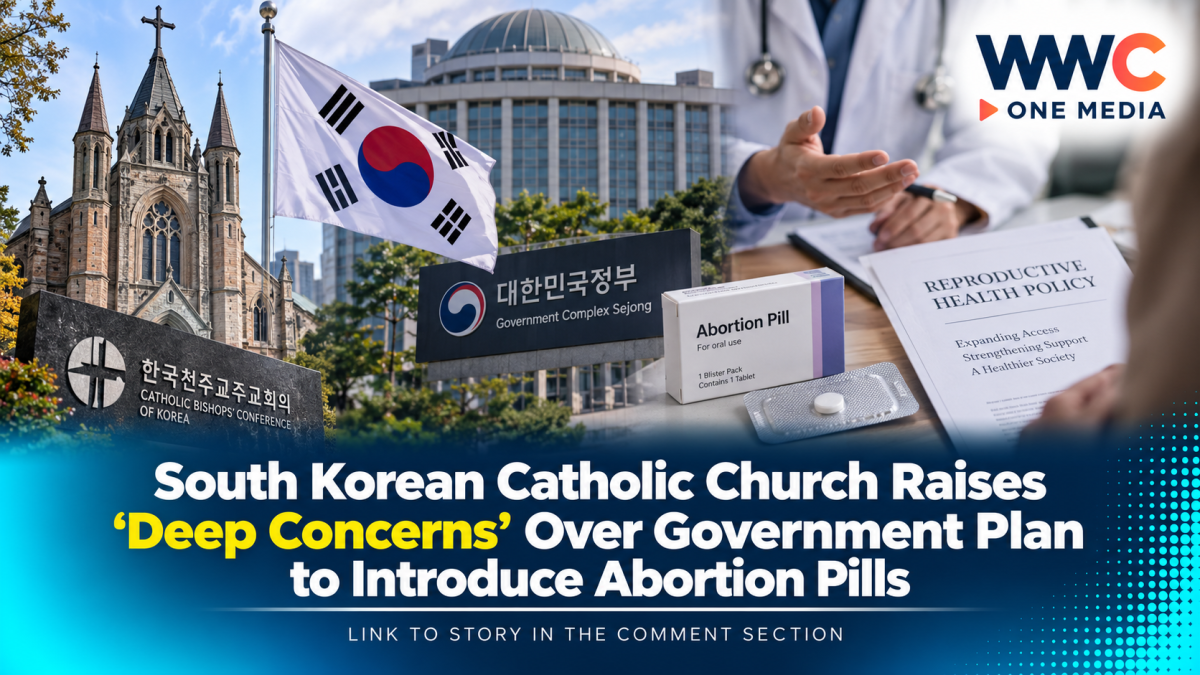
SEOUL — South Korea’s Catholic Church has voiced strong opposition to the government’s plan to formally introduce abortion medication, warning that the proposed system would institutionalize abortion without resolving the country’s broader debate over the protection of unborn life.
The Catholic Bishops’ Conference of Korea (CBCK) issued its latest criticism after the government announced plans to make abortion medication available for women up to nine weeks of pregnancy.
The government says the policy is intended to establish a formal, medically supervised system for abortion medication. The bishops, however, are urging authorities to reconsider the plan.
Government Moves Toward Formal Abortion-Medication System
South Korea has been dealing with a prolonged legal vacuum surrounding abortion since the Constitutional Court ruled in 2019 that the country’s criminalization of abortion was unconstitutional.
The latest government plan seeks to establish a formal pathway for abortion medication, with the Ministry of Food and Drug Safety working on approval and safety-management procedures.
According to Korean media reports, the government is targeting introduction of the medication as early as the first quarter of 2027, subject to the remaining regulatory procedures. The medication under consideration is Mifegyne, and the proposed eligibility would cover pregnancies of up to nine weeks.
The government has said that establishing an officially regulated system would address the reality that some women have sought abortion medication from overseas because an officially approved domestic option has not been available.
Catholic Bishops Call for Reconsideration
The CBCK said it has “deep concerns” about the government’s approach.
The bishops argue that establishing a formal system for abortion medication does not resolve what they regard as the fundamental ethical question surrounding abortion.
Their statement characterized the phased introduction of abortion medication as a pathway toward expanding access rather than a solution to the underlying issue.
The church’s position reflects its longstanding teaching that human life should be protected from conception. Its latest statement therefore represents a clear religious and ethical objection to the government’s proposed policy, rather than an assessment shared by all South Koreans or medical organizations.
The Debate Goes Beyond the Catholic Church
The controversy is part of a much larger legal and social debate that has continued since the Constitutional Court’s landmark 2019 decision.
The ruling required South Korea to replace its previous criminal restrictions on abortion with a new legal framework. But lawmakers and successive governments have struggled to establish comprehensive legislation, leaving significant questions over regulation, medical practice and access.
The Catholic bishops have previously criticized proposed amendments to South Korea’s maternal and child health legislation.
In 2025, the CBCK objected to proposed changes that would use the term “termination of pregnancy” and establish a legal framework for abortion, arguing that such language could alter how society understands the issue.
The latest dispute therefore builds on a debate that has been unfolding for years rather than representing an entirely new confrontation.
Why the Nine-Week Limit Matters
The government’s proposed nine-week threshold is one of the key details of the new plan.
According to the government’s announcement, women within that period would be able to access the medication under a regulated medical system.
Officials are still working through regulatory requirements, including approval procedures and safety-management measures.
Korean media reported that the Ministry of Food and Drug Safety is reviewing an application involving Mifegyne, while additional safeguards and implementation details remain under development.
That means the government announcement should not be interpreted as the immediate nationwide availability of the medication. Regulatory approval and implementation steps still have to be completed.
South Korea’s Abortion Debate Enters Another Critical Phase
The latest dispute illustrates the difficulty South Korea faces in translating the Constitutional Court’s 2019 ruling into a comprehensive legal and medical framework.
The government is attempting to establish a regulated pathway for abortion medication, while Catholic leaders are pressing authorities to reconsider the policy on ethical and religious grounds.
Other questions remain important as the government develops the system, including medical oversight, safety procedures, emergency care and the precise legal framework governing abortion.
For now, the proposed introduction of abortion medication has reopened a debate that South Korea has struggled to resolve since the Constitutional Court’s ruling.
What Happens Next?
The immediate focus will be on the regulatory process.
The Ministry of Food and Drug Safety must complete its review and establish the requirements governing the medication’s use. Other government ministries will also be involved in implementing the broader policy.
Meanwhile, the Catholic Bishops’ Conference of Korea is calling for the government to reconsider the approach and is expected to continue making its position known.
The dispute highlights a fundamental divide between the government’s effort to establish a formal medical framework and the Catholic Church’s ethical opposition to abortion.
FACT-CHECK / EDITORIAL NOTE
Confirmed: The South Korean government has announced plans to introduce abortion medication for pregnancies of up to nine weeks, with the earliest introduction targeted for the first quarter of 2027, subject to regulatory procedures.
Confirmed: The Catholic Bishops’ Conference of Korea has expressed “deep concerns” and urged the government to reconsider the plan.
Important clarification: The medication has not simply become immediately available nationwide following the announcement. Regulatory approval, safety-management measures and implementation procedures remain part of the process.
Context: South Korea’s current debate stems from the Constitutional Court’s 2019 ruling that the country’s criminalization of abortion was unconstitutional. A comprehensive replacement framework has remained politically and legally contested.
WWC ONE MEDIA G.A



Leave a Reply