
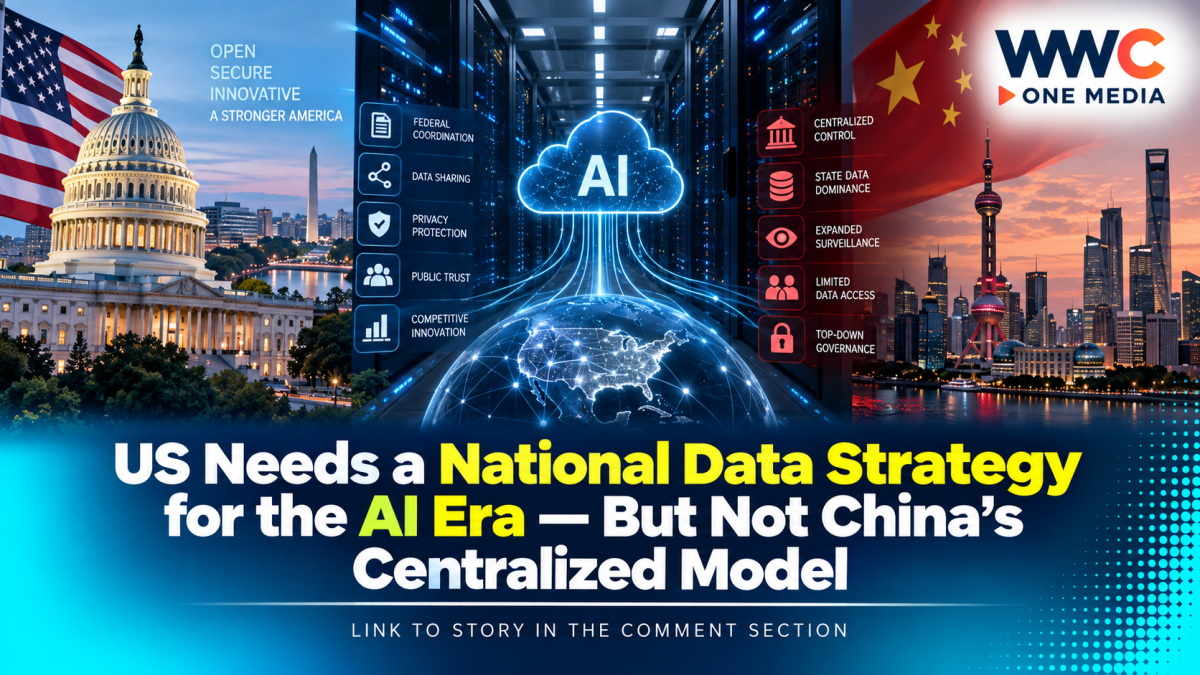
WASHINGTON — The United States may have an artificial-intelligence problem that has little to do with algorithms themselves: data.
A U.S. congressional advisory commission is calling for Washington to develop a national data strategy as China increasingly treats data as a strategic economic resource for powering artificial intelligence, advanced manufacturing, robotics and other technologies.
But the recommendation does not amount to a call for the United States to copy Beijing’s centralized approach.
Instead, the debate is increasingly about how the U.S. can make better use of its enormous data resources while maintaining a governance system compatible with American institutions, privacy protections and market competition.
Why Data Is Becoming AI’s New Strategic Resource
The U.S.-China Economic and Security Review Commission (USCC) said in an August report that China has been systematically collecting, organizing and commercializing data as a strategic national asset.
The commission said China’s approach could give Beijing an advantage in areas where AI requires large quantities of specialized real-world data, including manufacturing, autonomous vehicles, robotics and other systems that interact with the physical world.
That is different from simply collecting information from the open internet.
Industrial machines, factories, transportation systems and other physical operations generate proprietary data that cannot easily be obtained through web scraping. For AI developers building robotics and autonomous systems, access to that information can be particularly valuable.
The commission said China’s advanced manufacturing and industrial-robotics ecosystems provide large pools of this type of data.
China Has Made Data a National Economic Asset
Beijing has elevated data alongside traditional factors of production such as land, labor, capital and technology.
China established its National Data Administration in 2023, with responsibilities including nationwide data standardization and classification and efforts to develop a unified national data market.
Chinese companies have also begun listing proprietary datasets on regional data exchanges, including in Shanghai, Shenzhen and Beijing.
The USCC argues that this system allows China to consolidate, label, refine and distribute data at a scale that can support both commercial AI development and government objectives.
That creates a strategic challenge for Washington as the two countries compete across AI models, computing infrastructure, robotics, chips and industrial applications.
The US Has Data — But a Different System
The United States is hardly short of data.
American businesses, universities, hospitals, government agencies, manufacturers and technology companies generate enormous quantities of information every day.
The challenge is that much of it is fragmented across organizations, sectors and jurisdictions.
The USCC therefore recommended that Congress consider a national data strategy and treat data as an economic asset.
The proposal is less about putting all American data under one government-controlled system and more about creating a framework for making valuable data more usable for innovation while addressing security and privacy concerns.
Why Copying China Could Create a Different Problem
China’s data strategy benefits from a much more centralized political and regulatory structure.
The United States operates under a substantially different system, with private ownership, state and federal jurisdictions, sector-specific rules and stronger legal protections around individual rights and privacy.
Simply reproducing China’s model would therefore raise questions about privacy, government access to information, competition and the role of private companies.
The USCC itself highlights the risks faced by American companies operating under China’s strict data and cybersecurity requirements, particularly regarding cross-border data transfers and localization.
That leaves Washington with a more complicated task: build a national data strategy without turning data policy into a centralized control system.
AI Competition Is Moving Beyond Chatbots
The data debate is also changing because the AI competition is moving beyond large language models.
AI systems are increasingly being developed for:
- Industrial robotics
- Autonomous vehicles
- Manufacturing
- Healthcare
- Financial services
- Logistics
- Defense and security
- Scientific research
These applications require more than text scraped from the internet.
They need high-quality operational and physical-world data that reflects how machines, businesses and people actually interact.
The USCC argues that China’s industrial base could provide an important advantage in generating exactly this kind of information.
Washington Is Also Debating AI Safety
The data debate is unfolding alongside a separate argument over how much government oversight the U.S. AI industry needs.
Reuters reported this week that the United States currently has no comprehensive federal requirement for AI companies to report dangerous incidents such as models evading oversight or exhibiting deceptive behavior. Some lawmakers are considering legislation that would establish additional reporting and safety obligations.
At the same time, the Trump administration has pushed back against calls for broader federal AI regulation, arguing that existing government authorities are sufficient and warning that slowing American AI development could benefit China.
That creates a second policy question alongside data strategy: how can the United States encourage rapid AI development while establishing sufficient safeguards?
The US-China AI Gap Is Not Just About Technology
Analysts increasingly describe the competition between Washington and Beijing as a contest involving multiple layers of the AI ecosystem — including computing power, models, adoption, industrial integration and deployment.
Brookings has described the U.S.-China AI competition as extending across these multiple dimensions rather than being simply a race to produce the most advanced chatbot.
Data sits underneath many of those layers.
Better data can improve AI models. Industrial data can improve robotics. Transportation data can improve autonomous systems. Healthcare data can support medical AI.
That makes data policy increasingly intertwined with economic and technological strategy.
The Bigger Question: Who Controls the Data?
The emerging U.S. debate is therefore not simply about whether America should collect more data.
It is about who can access it, under what conditions, for which purposes and with what protections.
A U.S. strategy could potentially focus on improving data standards, interoperability, responsible data sharing and access to high-value datasets while maintaining privacy and security protections.
China’s approach demonstrates one possible model for mobilizing data at national scale.
It does not necessarily mean the United States must adopt the same political or regulatory structure.
What Happens Next?
The USCC’s recommendation puts data policy closer to the center of the U.S. AI debate.
For Washington, the challenge is now twofold: ensure American companies and researchers can access enough high-quality data to compete in advanced AI while determining how that access should be governed.
That means future policy discussions are likely to involve data ownership, privacy, cybersecurity, intellectual property, cross-border transfers, government datasets and access to industrial information.
The AI race may increasingly be decided not only by who builds the fastest models or owns the most powerful chips, but also by who can turn enormous amounts of information into reliable, usable and responsibly governed data.
FACT-CHECK / EDITORIAL NOTE
Confirmed: The U.S.-China Economic and Security Review Commission recommended that Congress consider developing a national U.S. data strategy and treating data as an economic asset.
Confirmed: The commission’s August 2026 report said China is systematically collecting, organizing and commercializing data to support AI and other strategic technologies.
Important clarification: The recommendation is not equivalent to saying the United States should copy China’s centralized data-governance system. The policy challenge is how to improve U.S. data availability and usability while operating within America’s different legal, economic and institutional framework.
Current context: The debate is occurring alongside separate disputes over AI safety regulation. Reuters reported Sept. 16 that the U.S. has no comprehensive federal requirement for AI companies to disclose dangerous AI incidents, while lawmakers are considering additional oversight measures.
WWC ONE MEDIA G.A




Leave a Reply