
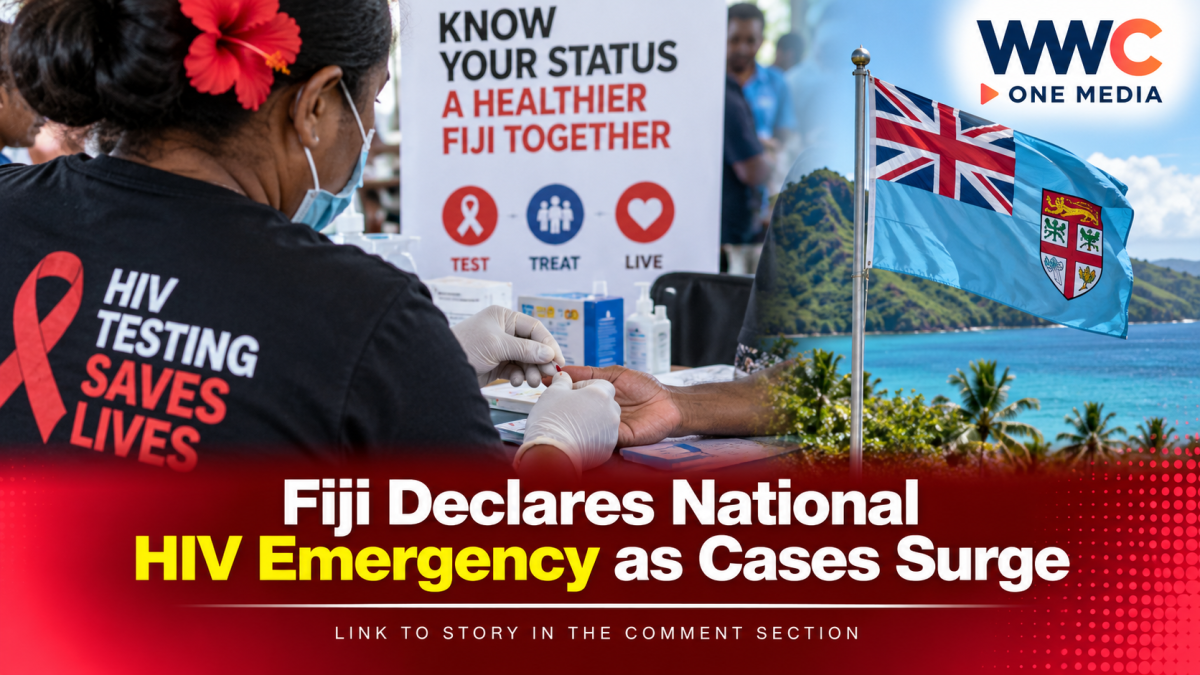
SUVA — Fiji Escalates Its Response to a Rapidly Growing HIV Epidemic
Fiji has formally declared HIV a national emergency, escalating its response after an extraordinary increase in infections pushed the Pacific island nation into one of the world’s fastest-growing HIV epidemics.
Health Minister Ratu Atonio Lalabalavu said the previous outbreak-level response was no longer enough and called for a coordinated effort involving government agencies, communities and international partners. Fiji’s Cabinet approved the national emergency declaration on September 9.
The declaration comes after years of rapidly increasing diagnoses. UNAIDS estimates that new HIV infections in Fiji increased 12-fold between 2010 and 2025, with approximately 9,100 people living with HIV in 2025. Only about 39% were estimated to know their HIV status, while 22% were accessing antiretroviral treatment.
One in 60 Adults Estimated to Be Living With HIV
The scale of the increase has alarmed health officials.
Fiji now estimates that approximately one in every 60 adults is living with HIV, compared with about one in 167 five years ago. Among pregnant women attending antenatal services, the reported prevalence is around 2% — roughly one in 50.
WHO previously reported 1,583 newly notified HIV cases in 2024, followed by another 1,226 cases during the first six months of 2025 alone.
Regional reporting also cited government figures showing more than 2,000 new diagnoses during 2025, illustrating how quickly the epidemic has accelerated.
Drug Use Emerges as a Major Driver
Health authorities and international organizations have identified injecting drug use as an important factor behind the surge, alongside sexual transmission.
UNAIDS said that among cases where the mode of transmission was known, more than half were linked to sexual transmission and more than 42% to injecting drug use.
WHO has also highlighted the connection between injecting drug use and the increase in HIV infections. The issue has become a major focus of Fiji’s expanded prevention strategy.
Government Plans Expanded Testing, Treatment and Prevention
The national response will include wider access to HIV testing, treatment and pre-exposure prophylaxis (PrEP), a medication used to prevent HIV infection.
Fiji also plans to introduce a formal needle and syringe programme as part of a broader harm-reduction strategy aimed at reducing transmission among people who inject drugs. Legislative changes are expected to support the programme.
A five-member Cabinet subcommittee has also been established to address policy and implementation barriers and accelerate the national response.
UNAIDS: The Declaration Is a Call for Action, Not Fear
UNAIDS welcomed Fiji’s decision, describing the country’s rise in HIV infections as one of the sharpest increases globally.
The organization stressed that the response should focus on prevention, treatment, community involvement and reducing stigma.
UNAIDS also emphasized an important public-health fact: HIV is not transmitted through everyday contact, and people receiving effective treatment who maintain an undetectable viral load do not sexually transmit HIV.
That message is significant as Fiji expands its response because stigma can discourage people from seeking testing and treatment.
Why the Situation Matters Beyond Fiji
Fiji is a regional hub for travel, business and transportation across the Pacific. UNAIDS says the country’s experience demonstrates how quickly an HIV epidemic can change and why health systems need to be prepared to respond rapidly.
Experts commenting through the Science Media Centre also stressed the need for community-based education, accessible testing and stronger efforts to prevent stigma from becoming another barrier to healthcare.
The government’s challenge now is turning the emergency declaration into measurable improvements in prevention, diagnosis and treatment.
A Race Against Time
Fiji’s declaration marks a significant escalation from the outbreak response introduced in January 2025.
With infections rising rapidly and many people still unaware of their HIV status, authorities are attempting to expand testing and treatment while tackling the factors contributing to transmission.
For Fiji, the emergency declaration is therefore not simply a warning about rising numbers. It is a signal that the country’s HIV response is entering a new phase — one in which speed, access to care and community support could determine whether the epidemic continues to accelerate or begins to turn around.
WWC ONE MEDIA G.A




Leave a Reply