
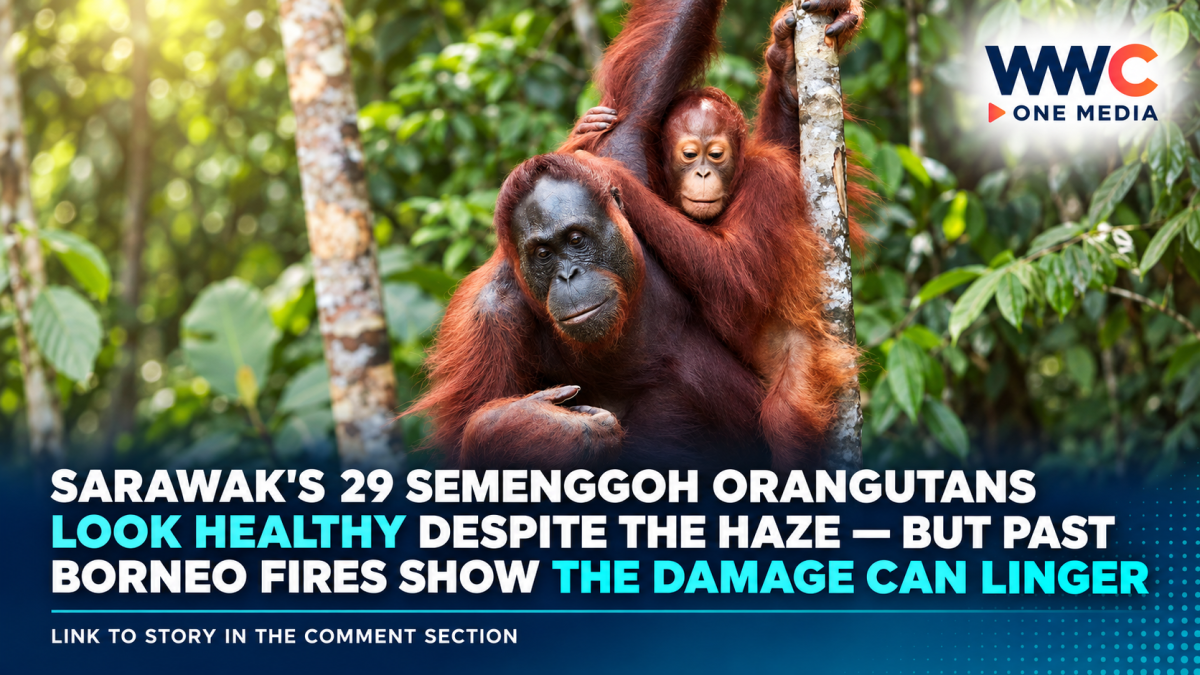
KUCHING, Sarawak — Deep inside a rainforest reserve just outside Kuching, rangers are watching 29 orangutans more closely than usual.
The animals at Semenggoh Wildlife Centre are still climbing, feeding and moving through the forest without obvious signs of distress despite weeks of oppressive heat and smoke hanging over parts of Malaysian Borneo.
But wildlife officers are not assuming that means the danger has passed.
Rangers have stepped up daily surveillance, including using drones to monitor fire hotspots, while keeping watch for changes in the orangutans’ health or behaviour as haze from widespread fires in neighbouring Indonesia continues to affect Sarawak.
The concern is not theoretical.
Scientific research from an earlier Borneo haze disaster found that wildfire smoke affected wild orangutans even after the skies cleared.
And this year’s regional fire season has become the worst Indonesia has experienced in more than a decade.
The good news: Semenggoh’s orangutans currently appear normal
CNA reported that Semenggoh’s more than 600-hectare forest is home to about 29 semi-wild orangutans ranging from three to 55 years old.
They are free to move through the forest rather than being confined like zoo animals.
Sarawak Forestry Corporation separately said orangutans at both Semenggoh and Matang Wildlife Centre had shown no symptoms or unusual behaviour associated with the haze when officials assessed them earlier this month.
Semenggoh ranger Chad Bready told CNA the haze and heat have been more intense this year but said conditions at the centre remained under control.
Rangers have observed the orangutans adapting behaviourally to hotter conditions by spending more time lower beneath the forest canopy during the day, where temperatures are cooler, before moving higher in the trees later.
That is encouraging.
It is not the same as proving there has been no physiological impact.
The rainforest canopy may be acting like a natural shield
One factor working in the animals’ favour is the forest itself.
Semenggoh’s dense canopy provides shade, keeps temperatures lower than exposed urban areas and can filter some airborne material before it reaches the forest floor.
CNA reported that officials believe those conditions may be giving the orangutans some protection from the worst of the heat and haze.
That could help explain why the animals have not shown the obvious distress reported elsewhere during severe fire events.
But the canopy is not an air purifier.
Fine smoke particles can still penetrate forest ecosystems, and orangutans spend much of their lives high in trees where exposure patterns may differ throughout the day.
That is why scientists studying previous Borneo fires looked beyond visible sickness.
They measured movement, metabolism and even the sound of orangutan calls.
Past research found orangutans rested more after heavy smoke
During the catastrophic 2015 Borneo fires, researchers followed adult male orangutans in Central Kalimantan before, during and after severe smoke exposure.
The results were striking.
A peer-reviewed study in Scientific Reports found that the animals increased the amount of time they spent resting, reduced travel time and distance, and showed increased fat metabolism after the smoke period.
Researchers suggested the metabolic change could have reflected additional energy costs associated with an immune response to smoke exposure.
The researchers were studying wild orangutans elsewhere in Borneo, not Semenggoh’s current population.
So those findings cannot be used to diagnose the Sarawak animals.
But they provide an important warning:
An orangutan does not necessarily have to look visibly sick for wildfire smoke to be affecting it.
Their voices changed too
Another study, published in 2023, examined the long calls of four adult male Bornean orangutans exposed to the 2015 haze.
During and after the fires, the animals called less frequently, while their calls became lower-pitched, harsher and more irregular.
Some vocal changes persisted for as long as two months after the heavy smoke had disappeared. Researchers said the changes were consistent with health effects from smoke exposure.
Again, that research does not establish that Semenggoh’s orangutans are currently experiencing the same problems.
It does explain why Sarawak’s decision to keep monitoring them after obvious behavioural changes fail to appear is scientifically sensible.
The visible haze can disappear before every biological consequence does.
This year’s Borneo fire crisis is unusually severe
The wider environmental backdrop is serious.
Indonesia is experiencing its worst wildfire season in 11 years, with severe fires across Kalimantan and Sumatra amid prolonged drought and exceptionally hot conditions.
Indonesia’s forestry minister warned this week that fires could continue until early November because the rainy season is expected to arrive later than previously anticipated.
Reuters reported that more than 12.5 million people across seven Indonesian provinces had been exposed to hazardous haze, while reported respiratory illnesses more than doubled from 50,891 on September 1 to over 113,000 by September 9.
Large parts of Borneo have been among the hardest hit.
Smoke from fires in West Kalimantan, directly across the international border from Sarawak, has drifted into East Malaysia.
And orangutans on the Indonesian side are facing an even more direct threat.
Some orangutans are confronting fire itself, not just smoke
The Guardian reported this week that fires had approached within roughly 200 metres of the Rangkong research station in Gunung Palung National Park, one of Borneo’s major long-term orangutan research areas.
Researchers and local residents have been fighting to stop the flames from entering forest habitat used by hundreds of orangutans, with some studied animals reportedly observed moving away from advancing fires.
That demonstrates the two different ways wildfire can threaten great apes.
Smoke can affect health even when their own forest does not burn.
Fire itself can destroy feeding trees, nesting habitat and entire sections of forest.
Semenggoh is currently dealing primarily with the first problem.
The situation elsewhere on Borneo shows how quickly that can become the second.
Sarawak briefly faced emergency-level air pollution
The haze has already produced extraordinary conditions on the Malaysian side of the border.
On September 4, authorities declared an emergency in Sarawak’s Serian division after the Air Pollutant Index climbed beyond 500.
CNA reported an API of 515 at 5pm, while other official and local reports put the day’s peak as high as 521 depending on monitoring time.
Under Malaysia’s system, readings above 300 are hazardous, while levels above 500 trigger emergency procedures under the national haze response framework.
The emergency was lifted on September 7 as conditions improved.
But “improved” did not mean clean air.
At 2pm that day, Serian was still recording an API of 245, classified as very unhealthy.
As recently as September 12, Serian remained in the very unhealthy band at 236, while Kuching stood at an unhealthy 174.
And the haze is not necessarily finished
Current Malaysian meteorological forecasts reinforce the need for continued monitoring.
MetMalaysia’s forecast for Serian shows haze remaining possible through several periods between September 18 and September 22, with daytime highs around 34°C to 35°C.
Rain and thunderstorms may offer temporary relief.
But regional fires remain active.
That is why Indonesia’s warning that the fire season could extend into November matters for Sarawak.
Air quality in Malaysian Borneo depends partly on what happens hundreds of kilometres away—and which direction the wind blows.
Semenggoh has been rescuing orangutans since 1975
The current monitoring effort is taking place at one of Sarawak’s most important wildlife sites.
Sarawak Forestry Corporation says Semenggoh Wildlife Centre was established in 1975 to care for animals that had been injured, orphaned or illegally kept as pets.
Its orangutan rehabilitation programme became so successful that the forest eventually reached its practical carrying capacity for rehabilitated animals, prompting rehabilitation work to shift toward Matang Wildlife Centre.
Semenggoh now focuses more heavily on orangutan biology, behaviour and providing a natural forest refuge for rehabilitated animals and their descendants.
That distinction is important.
The orangutans visitors see at Semenggoh are often described as “wild”, but semi-wild is more precise for many of them.
They roam the forest independently but can still return to supplementary feeding platforms.
Feeding happens twice a day—but appearances are never guaranteed
Staff place fruit and other food including bananas, coconuts, sweet potatoes and sugar cane at feeding platforms twice daily.
Visitors gather hoping that orangutans will emerge from the forest.
There is no guarantee they will.
That is part of Semenggoh’s appeal.
The animals are not performing on a schedule in an enclosure.
If natural food in the forest is abundant, some may simply choose not to appear for supplementary feeding.
Sarawak Forestry’s visitor information lists Semenggoh as a place to observe orangutans living in a largely natural forest setting approximately 24km from Kuching.
That makes the centre both a conservation site and one of Sarawak’s major ecotourism attractions.
Now the haze is hitting tourism too
The smoke is not only a wildlife issue.
CNA reported smaller crowds at Semenggoh as hot and hazy conditions discouraged some visitors.
Sarawak Tourism Minister Abdul Karim Rahman Hamzah separately acknowledged that tourism arrivals had declined amid the haze emergency, although publicly reported material did not provide a precise statewide visitor-loss figure.
That creates an unusual trade-off at Semenggoh.
Fewer tourists mean less disruption around the orangutans and potentially more space for the animals.
But sustained declines in tourism can hurt the wider ecotourism economy built around Sarawak’s forests and wildlife.
For Sarawak, orangutans are not simply an attraction.
They are one of the state’s most recognisable conservation symbols.
The Bornean orangutan is already under severe pressure
The haze arrives on top of much larger long-term threats.
Bornean orangutans depend on forests across Malaysian Borneo and Indonesian Kalimantan.
Their populations have been damaged by forest loss, agricultural conversion, fires, hunting and the illegal wildlife trade. Conservation assessments classify the species as facing a very high risk of extinction.
Estimates of the remaining population vary with methodology and year, but commonly cited assessments place the total wild Bornean orangutan population at roughly 100,000.
Those figures should be treated as population estimates, not a live headcount.
And Sarawak holds only part of that population.
For such a slow-reproducing animal, losses can be difficult to replace.
A female may wait seven or eight years between births
Sarawak Forestry says female orangutans typically reproduce only once every seven to eight years.
That is extraordinarily slow compared with many mammals.
An environmental shock that kills adults or reduces reproductive success therefore has consequences extending far beyond a single season.
The same biological characteristic that makes the bond between mother and infant so prolonged also makes orangutan populations vulnerable.
They cannot rapidly replace large numbers of animals lost to habitat destruction, hunting or repeated environmental disasters.
That makes preventive monitoring particularly important.
Heat is another pressure alongside smoke
The current concern is not haze alone.
Sarawak has also been dealing with persistent hot, dry conditions.
At Semenggoh, rangers say orangutans have responded by moving lower in the forest during hotter daytime periods.
Behavioural adjustments like seeking shade are normal ways animals cope with heat.
The concern rises when heat becomes prolonged or combines with drought, smoke and reduced food availability.
Fruit production in tropical forests is closely connected to rainfall and seasonal conditions.
Changes in food availability can affect how far orangutans must travel and how dependent semi-wild animals become on supplementary feeding.
CNA’s report does not show that the current weather has caused a food shortage at Semenggoh.
That should therefore not be assumed.
But prolonged drought is one more variable rangers need to watch.
Drones cannot diagnose an orangutan—but they can spot the next danger
The use of drones is one of the more significant developments in Semenggoh’s response.
They allow rangers to scan wider stretches of forest for hotspots and signs of fire without relying only on ground patrols.
That matters because a fire detected early is radically easier to contain than one already burning through the canopy.
Drones also help staff observe areas that are difficult to reach quickly on foot.
But they do not replace direct animal monitoring.
Rangers still need to watch feeding behaviour, movement, apparent respiratory problems and other changes in the orangutans themselves.
The technology expands what humans can see.
It does not eliminate the environmental threat.
The biggest warning comes from what happened nine years ago
For now, there is no reported orangutan health emergency at Semenggoh.
That should remain the headline fact.
The animals appear to be coping.
The forest canopy is offering some protection.
Rangers are monitoring them daily.
And Sarawak Forestry says it has not observed haze-related abnormalities.
But Borneo has been through this before.
Research from the 2015 fires showed orangutans moving less, resting more and displaying altered metabolism after smoke exposure.
Later analysis found changes in their vocalisations that continued even after the haze cleared.
Those findings do not prove that Semenggoh’s 29 orangutans are being harmed today.
They explain why officials cannot judge the situation solely by whether the animals still come down for bananas.
Right now, Semenggoh’s orangutans look healthy.
The reason rangers keep watching is that the most important effects of haze may not always be the easiest ones to see.




Leave a Reply