
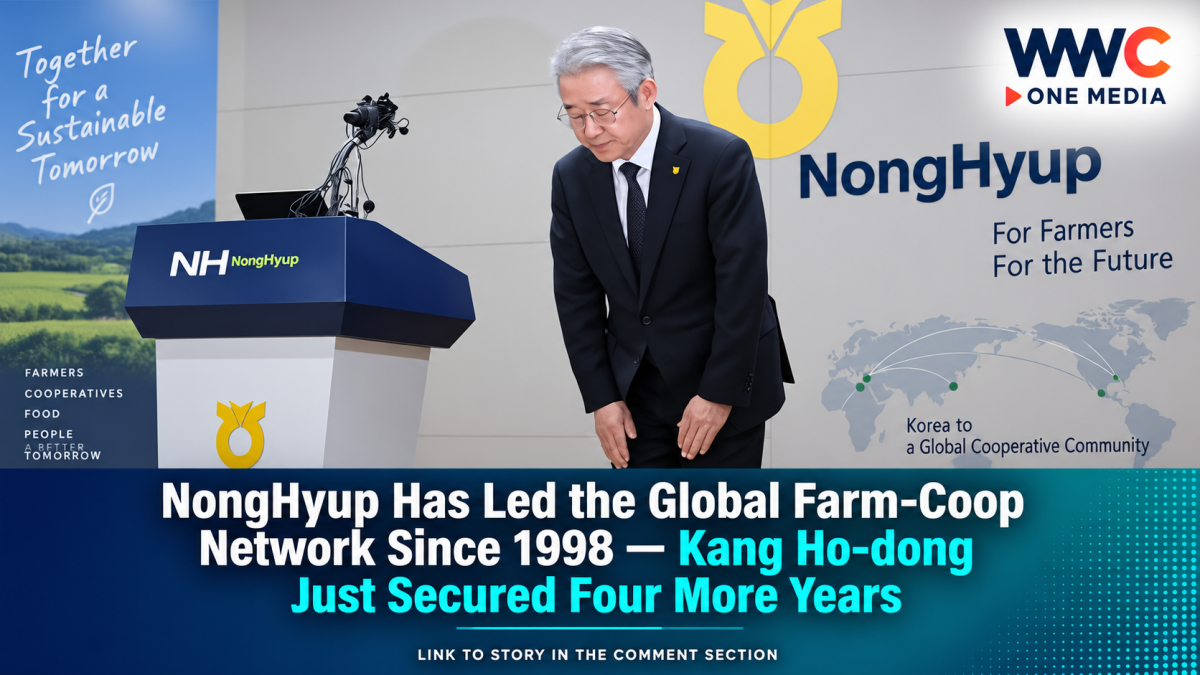
SEOUL/PANAMA CITY — South Korea’s NongHyup has extended an extraordinary run at the top of the international agricultural cooperative movement, with Chairman Kang Ho-dong reelected to another four-year term leading the International Cooperative Agricultural Organization.
Kang, chairman of South Korea’s National Agricultural Cooperative Federation, or NACF, won the new term at the ICAO General Assembly in Panama City on September 14.
His reelection also returns him to the board of the International Cooperative Alliance, the umbrella organization for cooperatives across sectors worldwide.
On the surface, it is another international appointment for the head of Korea’s powerful agricultural cooperative system.
But the longer history makes it more significant.
NongHyup chairmen have led ICAO continuously since 1998.
Kang’s new mandate effectively extends South Korea’s stewardship of the global agricultural cooperative organization into a fourth decade.
And he is taking the job at a difficult moment.
Food security, extreme weather, aging rural populations and the challenge of keeping young people in agriculture are becoming increasingly intertwined.
Kang’s second term will therefore be judged less by the title itself than by whether agricultural cooperatives can turn their enormous collective reach into practical responses.
Kang gets a fresh four-year mandate
The Korea Herald reported that Kang secured the new four-year term at ICAO’s General Assembly in Panama City.
NongHyup said his reelection reflected support from member organizations for his previous leadership.
There is an important detail behind that description.
ICAO’s official candidate announcement, published August 27, listed Kang as the sole candidate for president ahead of the September 14 election.
Separate candidates were listed for the organization’s four regional vice presidential positions covering Africa, the Americas, Asia-Pacific and Europe.
So this was not publicly presented as a competitive two-candidate presidential contest.
ICAO had established an election committee earlier in the year to oversee the process, with nominations closing in July and the vote scheduled during the Panama meeting.
He has actually been ICAO president only since 2024
Kang’s reelection can also sound more routine than it is.
He did not serve the full previous four-year term.
Kang became ICAO president in July 2024, after taking over the position associated with his role as NongHyup chairman and completing the remainder of his predecessor’s mandate.
The 2026 vote therefore gives him his own new four-year term.
ICAO’s official executive listing currently identifies Kang as president, with vice presidents from Japan, Uganda, Brazil and Poland.
Since taking the international role, Kang has also served within the ICA and its Asia-Pacific organization, giving NongHyup representation beyond the narrower agricultural body.
What exactly is ICAO?
The International Cooperative Agricultural Organization was established in 1951 and operates as a sectoral organization of the International Cooperative Alliance.
Its purpose includes representing agricultural cooperative organizations, researching developments in cooperative agriculture and encouraging economic collaboration between farm cooperatives and other types of cooperatives around the world.
The Korea Herald and recent Korean reports citing NongHyup say ICAO currently includes 45 agricultural cooperative institutions from 35 countries.
An ICAO page published earlier in 2026 listed 42 member organizations in 35 countries, indicating that the membership figure has either since changed or that the organization’s public pages have not all been updated simultaneously.
ICAO should also not be confused with the much larger International Cooperative Alliance, or ICA.
The ICA spans cooperative sectors globally—not just agriculture.
According to the alliance, there are roughly 3 million cooperative enterprises worldwide with around 1 billion members, employing about 10% of the world’s working population.
Kang does not personally “lead one billion cooperative members.”
Rather, his ICAO presidency gives him leadership of the agricultural sector organization and a seat on the broader ICA board.
That distinction matters.
Korea has held the chair since 1998
Perhaps the most striking number in the announcement is not four years.
It is 28 years.
NongHyup has served as ICAO’s chair organization since 1998, and ICAO’s secretariat is hosted by the Korean federation in Seoul.
That gives South Korea unusual continuity inside the international farm-cooperative movement.
During that period, NongHyup has promoted its own cooperative development model to overseas counterparts through training, exchange programs and technical cooperation.
ICAO itself has highlighted Korea’s transformation from a country that once relied heavily on development assistance into a major cooperative economy whose agricultural model is studied by institutions abroad.
For NongHyup, that international platform offers both prestige and influence.
For foreign agricultural cooperatives, Korea offers an example of a system that connects local farmer-owned cooperatives to banking, insurance, distribution, retailing and agricultural marketing.
NongHyup itself represents more than 2 million Korean farmers
Kang is not arriving at ICAO from a small trade group.
NongHyup sits at the center of one of South Korea’s largest cooperative networks.
As of September 1, 2026, the National Agricultural Cooperative Federation said it represented 1,106 agricultural and livestock cooperatives with a combined 2.02 million farmer members.
Those member organizations include local agricultural cooperatives, livestock cooperatives, commodity-specific cooperatives and ginseng cooperatives.
The wider NongHyup system also encompasses agricultural businesses and a substantial financial group.
That scale helps explain why the Korean federation has retained influence within international cooperative bodies for so long.
NongHyup is not simply representing farmers in policy meetings.
It operates across agricultural purchasing, distribution, finance and services, giving it experience with many of the problems agricultural cooperatives elsewhere are trying to solve.
Kang came up through the cooperative system
Kang’s own career has been rooted in that network.
ICAO’s official biography says he led the Yulgok Agricultural Cooperative from 2006 until 2024, served as president of Korea’s National Strawberry Producers’ Organization from 2010 to 2024 and sat on the NACF board from 2016 to 2020.
He became chairman of NACF in 2024.
That background gives him a different profile from an agricultural minister or diplomat.
His international role comes through the cooperative movement rather than through a government appointment.
That matters because cooperatives operate on a different structure from conventional corporations.
Their members are generally both users and owners, with cooperative governance built around member participation rather than purely investor ownership.
Last year’s Seoul Declaration set the agenda
Kang’s first period as ICAO president produced one particularly visible outcome.
During the 2025 United Nations International Year of Cooperatives, ICAO held its General Assembly in Seoul and adopted what became known as the Seoul Declaration.
The agenda highlighted several major priorities:
food security, climate-change response, greater support for young and female farmers, recognition of agriculture’s social value, protection of farmers’ rights and wider use of advanced agricultural technologies.
The declaration also called for stronger cooperation between agricultural cooperatives in building a more sustainable global food system.
Those objectives closely mirrored the broader rationale behind the UN’s 2025 International Year of Cooperatives.
The United Nations designated 2025 as only the second International Year of Cooperatives in history, with the theme “Cooperatives Build a Better World.”
The ICA used the year to promote cooperative businesses as tools for sustainable development, economic participation and community resilience.
Now comes the harder part: turning declarations into programs
ICAO itself has acknowledged that the challenge after 2025 is implementation.
In its review of the International Year of Cooperatives, the organization said its priorities going forward include capacity building, greater support for regional projects, stronger partnerships and increased use of digital technologies to connect member organizations.
That is where Kang’s new term becomes more consequential.
Declarations on climate resilience and food security are relatively easy to adopt.
Turning them into programs that alter how farmers finance crops, access markets, adapt to extreme weather or adopt new technology is much harder.
ICAO is not a world government and cannot impose agricultural policy on member countries.
Its influence comes primarily through coordination, information sharing, training and cooperative networks.
That means success will depend on whether member institutions actually use those networks.
Food security has become a much bigger challenge
Kang highlighted climate change and food insecurity immediately after his reelection.
Those concerns are not simply rhetorical.
Agricultural systems worldwide are being pressured simultaneously by extreme weather, rising input costs, geopolitical disruptions and demographic change.
Cooperatives can potentially give small and midsized farmers more bargaining power by pooling purchasing, processing, financing and distribution.
They can also help spread technologies or agricultural practices that would be difficult for individual farmers to acquire independently.
But cooperatives face their own problems.
Many rural regions are aging.
Young people frequently leave agriculture for urban employment.
Climate adaptation requires capital.
And farmers often have limited ability to pass rapidly rising costs to buyers.
Those are exactly the types of problems behind the Seoul Declaration’s focus on young farmers, women, technology and farmer rights.
Kang is also exporting NongHyup’s philosophy
Kang has spent part of his international tenure promoting what NongHyup calls the “Nongsim Cheonsim” movement.
The Korean phrase conveys the idea that the aspirations of farmers should be treated with the highest respect.
NongHyup has promoted the concept domestically while ICAO-related programs have introduced it to international cooperative representatives.
At the same time, NongHyup has continued training and global-leadership programs aimed at sharing Korea’s cooperative-development experience with overseas organizations.
For Korea, that amounts to a form of agricultural soft power.
Instead of exporting only food, machinery or farm technology, it is also exporting an institutional model for organizing farmers.
The ICA board seat could matter beyond agriculture
Kang’s ICAO reelection automatically carries another important consequence: continued representation on the International Cooperative Alliance’s board.
ICA records show that Kang joined the ICA board as ICAO’s representative after replacing former NongHyup chairman Lee Sung-hee.
That creates a channel for agricultural concerns within a global organization covering many types of cooperative enterprises.
The ICA’s reach is enormous.
It says the global cooperative economy includes about three million cooperative businesses and roughly one billion members worldwide.
That does not give Kang authority over all of them.
But it does give the Korean agricultural cooperative movement a seat in discussions that stretch far beyond farming.
Four more years — but the real test is measurable results
Kang says his next term will use the Seoul Declaration as a foundation for confronting climate and food-security challenges while building more sustainable agricultural communities.
The ambition is substantial.
But the measurable questions will be more practical.
Will ICAO expand training programs?
Will more young farmers enter cooperative agriculture?
Will member organizations share climate-resilient technologies?
Will small farmers gain better access to finance and overseas markets?
And can the cooperative model give producers enough scale to withstand increasingly volatile food and commodity markets?
Those outcomes will matter more than the title.
NongHyup has already held ICAO’s leadership position since 1998.
Kang now has another four years to show what that continuity can actually deliver.
South Korea has spent nearly three decades helping lead the global agricultural cooperative network. The next challenge is proving that the network can help farmers survive a world that is becoming harder to farm in.

Leave a Reply