
SEOUL — South Korea is preparing to export something more ambitious than ramyeon, kimchi or ice cream to Central Asia. It wants to export the infrastructure behind an entire food industry.
The Korea Food Industry Cluster Promotion Agency has signed a memorandum of understanding with Kazakhstan’s Shin-Line Group to help develop a food-industry cluster in Kazakhstan, while opening potential new distribution channels for Korean food companies.
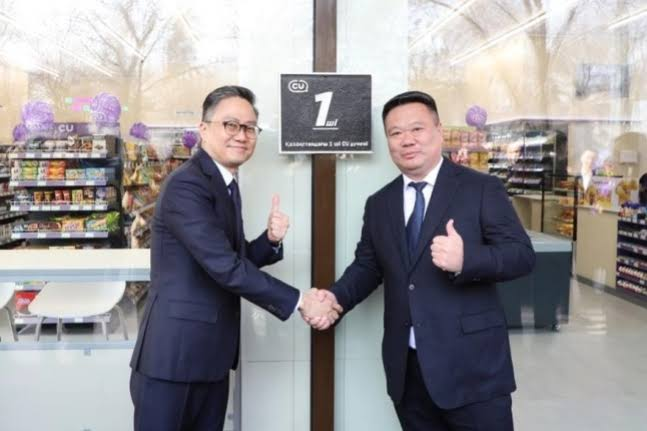
The agreement was signed September 15 at the Four Seasons Hotel in Seoul during the Korea-Kazakhstan Business Roundtable by agency Chairman Kim Deok-ho and Shin-Line Chairman Andrei Shin.
On paper, the MOU covers consulting, advice on building and operating the proposed cluster, corporate-support systems and efforts to help Korean and Kazakh food companies enter each other’s markets.
But one detail makes this much more interesting than a conventional cooperation agreement.
Shin-Line already controls something Korean food exporters desperately need when they enter a new country:
shelves.
The Kazakh company currently operates roughly 70 CU convenience stores across Kazakhstan, according to the Korean food-industry agency and local Korean reporting. Those stores could eventually become a ready-made sales channel for products made by companies based inside South Korea’s National Food Cluster.
And if CU’s longer-term expansion plans in Kazakhstan materialize, 70 stores may only be the beginning.
This is not yet a giant construction contract
The first thing to clarify is what was actually signed.
This is a memorandum of understanding—not a completed investment agreement establishing the final size, cost or construction timetable of a new Kazakhstan food complex.
The Korea Herald and additional Korean reports say the two organizations will cooperate on developing the cluster, devising operational strategies and creating support programs for participating food companies.
They will also exchange information about government and institutional assistance programs and encourage direct business ties between Korean and Kazakh companies.
No publicly disclosed investment figure accompanied the announcement.
Nor was a final list of companies committed to factories inside the project announced.
That distinction matters.
The agreement creates a framework through which a much larger food-manufacturing ecosystem could develop.
It does not mean every proposed factory, tenant or retail expansion has already been secured.
Korea is selling its Foodpolis model
What South Korea brings to the partnership is not principally capital.
It is experience.
The Korea Food Industry Cluster Promotion Agency operates the National Food Cluster in Iksan, North Jeolla Province, commonly marketed internationally as Foodpolis.
The cluster was designed as an R&D- and export-oriented industrial ecosystem dedicated specifically to food manufacturers, combining production sites with research facilities, commercialization support and corporate assistance.
The agency describes Foodpolis as a platform intended to help companies develop higher-value products, commercialize food technology and access international markets.
Under the Kazakhstan MOU, that institutional experience can now be used as a blueprint.
Instead of Kazakhstan simply importing more Korean food, the idea is potentially to build a local ecosystem where companies can manufacture, develop, distribute and eventually export products from Central Asia itself.
That could make the arrangement far more durable than simply shipping additional boxes of Korean noodles into Almaty.
Why Shin-Line matters
Shin-Line is a particularly powerful local partner because it is already deeply embedded in food manufacturing and distribution.
The company describes itself as Central Asia’s No. 1 ice-cream producer.
It says it produced about 37,000 tonnes of products in 2025, exported roughly 15,000 tonnes and supplies around 130,000 points of sale through a network that includes 16 branches and 100 distributors.
About 40% of its production is exported, according to company figures.
Shin-Line’s businesses extend beyond ice cream.
It also makes frozen foods and instant noodles and has increasingly positioned itself as a platform for bringing overseas food concepts into Kazakhstan.
Earlier this month, for example, Shin-Line announced an agreement with Japanese ramen company Shigemitsu Industry to establish an Ajisen Ramen joint venture targeting as many as 50 restaurants in Kazakhstan and surrounding Eurasian markets between 2027 and 2031.
The Korean partnership fits that broader strategy.
But Shin-Line’s most important asset for K-food companies may be neither its ice-cream factories nor its restaurant plans.
It may be CU.
CU gives the deal an immediate retail network
South Korea’s CU convenience-store chain entered Kazakhstan in March 2024 through a partnership between BGF Retail and Shin-Line.
The concept has expanded quickly.
By the end of April 2026, CU had 59 stores in Kazakhstan, according to BGF Retail figures reported by Seoul Economic Daily.
The latest September reports put the network at roughly 70 locations.
That means the food-cluster agreement does not have to wait for a completely new retail ecosystem to be invented.
One already exists.
The Korean agency and Shin-Line specifically discussed using Shin-Line’s distribution network to help Foodpolis companies place their products into Kazakh stores and widen their local sales channels.
That is potentially valuable because overseas expansion often breaks down after production.
Making a product is one challenge.
Getting it through customs, into distribution centers, onto shelves, correctly priced and in front of consumers is another.
CU gives participating Korean companies a possible path around part of that problem.
And CU has much bigger plans
The existing network could eventually become far larger.
CU Central Asia has publicly described a plan to build 500 stores in Kazakhstan within five years, while BGF Retail has previously targeted around 500 Kazakh locations by 2029.
Those targets are ambitions, not guarantees.
Retail expansion depends on store economics, financing, consumer demand, franchise development and supply-chain execution.
But CU’s trajectory is already notable.
In May 2025, Shin told Forbes Kazakhstan that the business originally contemplated hundreds of stores across Kazakhstan, Uzbekistan and Kyrgyzstan before becoming even more ambitious about Kazakhstan itself.
CU Central Asia has also invested in local kitchens because many Korean-style convenience foods cannot realistically be imported from Korea with extremely short shelf lives.
That is another clue about where the food-cluster strategy could eventually lead.
The opportunity is not necessarily just to import Korean food.
It is to manufacture Korean-style products locally.
A Kazakhstan food cluster was already taking shape
The new Korean MOU is also not appearing from nowhere.
Forbes Kazakhstan reported in May 2025 that Shin-Line was already developing a large food cluster around its facilities in Baiserke, near Almaty, where the company had built new production capacity.
Shin said at the time that he wanted to attract about 50 food manufacturers and had held discussions with around 100 companies, including suppliers linked to BGF Retail.
One prospective Korean participant discussed at the time was Daesang, one of South Korea’s major food manufacturers.
The new agreement with Korea’s Food Industry Cluster Promotion Agency adds institutional expertise to an industrial concept Shin-Line was already pursuing.
However, the September MOU announcement does not explicitly confirm that every element described in earlier private-sector plans has now been finalized under the new cooperation framework.
That makes the next round of announcements important.
Investors and food companies will want to see exactly where the cluster will be developed, which companies sign binding agreements and how much capital ultimately gets committed.
K-food has a reason to look beyond its traditional markets
For South Korea, Kazakhstan also offers something strategically useful: diversification.
Korean food exports have been booming.
South Korea’s combined exports of food and agriculture-related products reached a record $13.62 billion in 2025, up 5.1% from the previous year.
Agricultural and food products alone reached about $10.41 billion, with exports rising for a 10th consecutive year.
Ramyeon exports reached about $1.5 billion, rising 21.9%.
Ice-cream exports jumped 21.6% to roughly $111 million, while sauces, strawberries, grapes and other categories also posted record or strong results.
But Korean food exports remain heavily concentrated.
The United States, China and Japan together accounted for roughly 45.6% of South Korea’s agricultural and food exports in 2025.
That concentration gives Korean policymakers and companies a reason to cultivate markets where K-food penetration remains less mature.
Central Asia is one such region.
A successful Kazakhstan hub could theoretically do more than serve Kazakhstan alone.
It could become a manufacturing and logistics bridge into neighboring Eurasian markets.
Shin-Line already thinks regionally
Shin-Line’s own business model supports that possibility.
The company says its products already reach markets including Kyrgyzstan, Uzbekistan, Tajikistan, Turkmenistan, Azerbaijan, Georgia, China and Mongolia.
Its existing export operation therefore gives potential Korean partners access to experience navigating markets beyond Kazakhstan itself.
Its Ajisen Ramen partnership is similarly framed around expansion throughout Kazakhstan and wider Eurasia rather than a single city.
And its CU business has been developed with local production and logistics infrastructure rather than relying entirely on imports from Korea.
That makes Shin-Line less like a simple distributor and more like a potential regional operating partner.
For smaller Korean food companies without their own Central Asian subsidiaries, that distinction could be crucial.
Korea-Kazakhstan trade is already growing
The agreement also arrives during a broader push to deepen economic ties between Seoul and Astana.
Official Kazakh data show bilateral trade reached about $3.17 billion in 2025, up from $3.13 billion in 2024.
Trade totaled approximately $1.3 billion during the first half of 2026, while Kazakhstan’s exports to South Korea rose 17.2%, according to Kazakhstan’s Ministry of Trade and Integration.
The food-cluster MOU was signed alongside a broader Korea-Kazakhstan business roundtable during Kazakh President Kassym-Jomart Tokayev’s visit to Seoul.
The countries were simultaneously expanding cooperation in areas including energy, critical minerals, technology and nuclear energy.
Food is therefore only one component of a much wider commercial relationship.
But it may be one of the easiest for ordinary consumers to actually see.
A lithium or nuclear-energy agreement remains largely invisible to shoppers.
A Korean snack appearing at the CU around the corner does not.
Localization could matter more than imports
One of the most important lessons from CU’s Kazakhstan expansion is that the Korean model cannot simply be copied and pasted.
Local production matters.
Shin told Forbes Kazakhstan in 2025 that some fresh foods sold through CU had shelf lives of only about 36 hours, making imports from South Korea impractical.
CU Central Asia therefore established its own kitchen facilities to make items such as gimbap, salads, corn dogs and other ready-to-eat products locally.
In that interview, Shin said roughly 40% of products on CU shelves were locally produced and around 60% came from South Korea at that stage.
Those proportions may change as the chain expands.
But they demonstrate why a food cluster could be commercially useful.
Instead of merely shipping finished Korean products thousands of kilometers, companies could potentially produce adapted versions closer to the consumer.
That reduces logistics problems and can make pricing more competitive.
It also creates room for Korean recipes, brands and production technology to combine with Kazakh ingredients, workers and distribution.
The next question is who actually joins
That is where the MOU moves from an interesting announcement to a test of execution.
The Korea Food Industry Cluster Promotion Agency can provide operational expertise.
Shin-Line can provide manufacturing experience and distribution.
CU can provide consumer access.
But the model still needs food manufacturers willing to invest, license products, export goods or establish local production.
The September announcement did not identify a final roster of participating Korean Foodpolis companies.
Nor did it specify how many products would enter CU stores or when the first new products tied directly to the agreement would launch.
Those will be the metrics worth watching.
A memorandum creates opportunity.
Store listings, factories and sales determine whether it worked.
This is bigger than 70 stores
The easiest way to view the agreement is as a project to help Kazakhstan build a food-industry cluster using Korean know-how.
But commercially, the more intriguing possibility runs in the opposite direction.
Kazakhstan could become a platform through which Korean food companies gain a deeper foothold in Central Asia.
Shin-Line already has factories.
It already has a large distribution network.
CU already has roughly 70 stores.
Korean food exports are at record levels.
And CU’s Kazakh network has ambitions to become several times larger.
That combination is why the MOU matters.
South Korea is not simply trying to sell Kazakhstan more food.
It is helping build the system that can manufacture, distribute and sell food locally.
And if even part of CU’s expansion target is achieved, Korean companies participating in that system may eventually gain something far more valuable than one export contract:
a permanent shelf in one of Central Asia’s fastest-developing consumer markets.


Leave a Reply