
SEOUL — South Korea’s stock market began Wednesday almost perfectly flat, caught between booming semiconductor shares and a combination investors have not had to confront in years: oil above $100, U.S. Treasury yields around 5% and the prospect of another Federal Reserve rate hike.
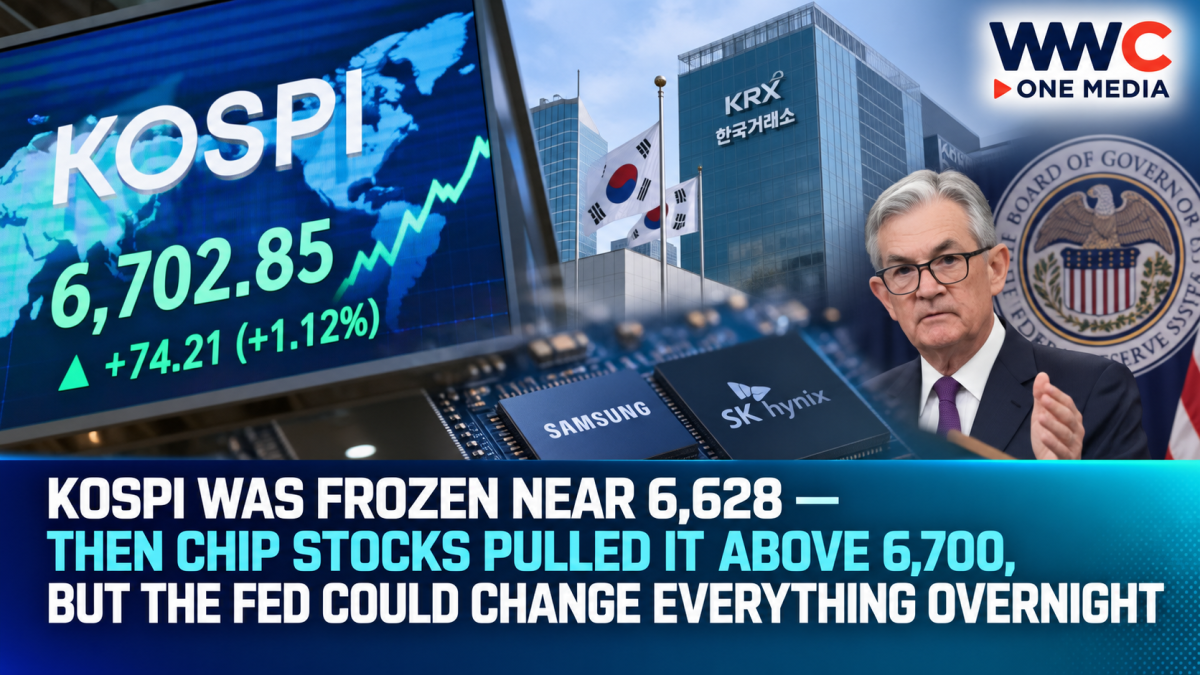
The benchmark KOSPI was just 0.01% higher at 6,627.95 at 9:15 a.m. on September 16, after initially opening lower.
But the quiet opening did not last.
By early afternoon, institutional buying pushed the index sharply higher. The KOSPI briefly climbed above 6,700, touching an intraday high of about 6,714.75, as Samsung Electronics and SK hynix rallied.
The rebound offered relief after four consecutive losing sessions.
But the bigger question was still waiting outside Korea.
What happens when the Federal Reserve delivers its next interest-rate decision while oil remains near $108 a barrel and the world’s most important bond yield hovers around 5%?
That combination could determine whether Korea’s rebound develops into something stronger—or becomes another temporary bounce in an increasingly volatile market.
KOSPI opened almost exactly where it finished the previous day
Wednesday began with hesitation.
The KOSPI had closed Tuesday at 6,627.26, down 57.11 points or 0.85%, extending its losing streak to four sessions.
Foreign and institutional investors had sold a combined roughly 2.48 trillion won of shares during Tuesday’s session, while retail investors bought about 833 billion won.
At 9:15 Wednesday, the index was only 0.69 point higher at 6,627.95.
That is about as close to unchanged as a major stock market can get.
The reason was straightforward.
Investors had several reasons to buy Korean stocks—and several very large reasons not to.
Semiconductor shares remained supported by extraordinary AI-related demand.
But global markets were facing rising oil prices, higher bond yields, renewed Middle East supply risks and a potentially tighter Federal Reserve.
The result was a market unwilling to commit strongly in either direction.
Then Samsung and SK hynix took over
As trading progressed, Korea’s semiconductor giants began pulling the index higher.
By 11:20 a.m., Samsung Electronics was up about 0.6%, while SK hynix had gained around 1.45%. The KOSPI had moved to 6,640.47.
The rally accelerated during the afternoon.
At around 1:39 p.m., Samsung Electronics was up roughly 1.5%, while SK hynix had climbed almost 3%.
The KOSPI reached as high as 6,714.75 before easing somewhat. Institutions had purchased more than 1.1 trillion won of shares by that point.
Seoul Economic Daily separately reported heavy institutional demand led by pension funds, with chip stocks at the center of the buying.
That matters because Korea’s benchmark is heavily influenced by its largest semiconductor companies.
When Samsung and SK hynix move together, they can overpower weakness across numerous smaller sectors.
AI is still Korea’s biggest market engine
There is a fundamental reason investors keep returning to Korean chip stocks despite repeated market corrections.
AI demand has transformed South Korea’s export economy.
Reuters reported earlier this month that South Korean exports had already reached about $709.4 billion in 2026, surpassing the previous full-year record unusually early.
Semiconductors accounted for approximately 41% of total exports, while chip exports between January and August had surged nearly 170% year over year.
Samsung Electronics and SK hynix sit directly at the center of that boom.
Demand for DRAM, NAND and especially high-bandwidth memory used in AI accelerators has generated enormous earnings and cash flow.
Samsung and SK hynix have announced combined shareholder-return programs worth more than 130 trillion won for 2026, according to Reuters.
That explains why investors still see Korean technology stocks as attractive even while the macro environment worsens.
But it also creates vulnerability.
When AI sentiment turns negative, Korea can fall extremely quickly.
Investors saw exactly that two days earlier
On September 14, the KOSPI plunged about 3.3% as investors reacted to concerns over interest rates, oil prices and questions about the pace of future AI development.
Samsung Electronics fell more than 4%, while SK hynix lost over 6%.
Reuters reported that global technology stocks came under pressure after renewed debate about slowing the pace of AI development, contributing to sharp losses in Korea and other technology-heavy markets.
That selloff illustrated the other side of Korea’s AI boom.
The same semiconductor concentration that can drive the KOSPI rapidly upward can magnify losses when investors suddenly become more cautious about artificial intelligence spending.
Wednesday’s chip-led rebound therefore does not erase the volatility.
It demonstrates it.
But the biggest immediate issue is the Federal Reserve
Global markets are now focused on the U.S. central bank.
Reuters reported Wednesday that futures markets were pricing roughly a 93% probability of a 25-basis-point Federal Reserve rate increase.
If delivered, it would be the Fed’s first rate hike in more than three years.
The reason is inflation.
The United States is again confronting strong price pressure, with energy costs playing an increasingly important role.
Markets therefore face an unusual reversal.
For much of the previous cycle, investors debated when central banks would cut rates.
Now they are preparing for the possibility of renewed tightening.
That shift matters enormously for Korea.
Higher U.S. interest rates can strengthen the dollar, lift global borrowing costs, put pressure on emerging-market currencies and make investors more reluctant to own riskier assets.
The 10-year Treasury yield crossed a line investors have not seen since 2007
Another warning signal is coming from the bond market.
The yield on the benchmark 10-year U.S. Treasury briefly moved above 5%, reaching a level not seen since July 2007, according to the Korea Herald and Yonhap.
Reuters reported that it subsequently eased back slightly to around 4.99%, but the psychological threshold had already been breached.
Why does 5% matter?
Because government bonds compete directly with stocks for investor money.
If investors can earn around 5% from highly liquid U.S. government debt, the expected returns needed to justify buying expensive equities become much higher.
That is particularly relevant for technology stocks whose valuations often depend heavily on profits expected years into the future.
Higher interest rates reduce the present value of those future earnings.
So Samsung and SK hynix may be enjoying extraordinary AI demand while simultaneously trading in a global financial environment that places greater pressure on equity valuations.
Then there is $108 oil
Energy prices are adding another layer of difficulty.
Brent crude surged above $108 per barrel after attacks disrupted Saudi energy infrastructure.
The Korea Herald reported that a major Saudi pipeline was knocked out of service as regional tensions escalated.
Reuters reported Wednesday that Brent later eased to around $107.53 a barrel, while West Texas Intermediate fell to approximately $104.19 after data showed an unexpected increase in U.S. crude inventories.
But the decline offered only limited comfort.
Supply risks remain substantial following disruptions to Saudi Arabia’s East-West pipeline and oil-loading operations at Yanbu.
Global shipping flows through the Strait of Hormuz have also been disrupted by the wider Middle East conflict.
For South Korea, that is particularly important.
Korea imports most of the energy it consumes.
A prolonged oil-price shock raises costs across transportation, manufacturing, chemicals, aviation and household spending.
And because energy is priced globally in dollars, a weaker won can make the problem even worse.
The won is also under pressure
At the original 9:15 a.m. snapshot, the Korean won was trading around 1,365.8 per U.S. dollar.
By 11:20 a.m., it had weakened further to around 1,369.75 won per dollar, according to Yonhap.
Currency movements matter for Korean companies in different ways.
Exporters may benefit when overseas earnings translate back into more won.
But businesses importing fuel, raw materials and components face higher costs.
For consumers, a weaker currency can also amplify inflation by making imported products more expensive.
This is one reason the Bank of Korea is watching global rates and commodity prices closely.
Korea has already started raising rates again
The Fed is not the only central bank confronting inflation.
The Bank of Korea has already raised its own policy rate in back-to-back moves from 2.50% to 3.00%.
Its September Monetary Policy Report says inflation is expected to remain above target for a prolonged period, even as economic growth remains robust.
The BOK says strong exports, investment and improving consumption continue to support the economy.
But it is simultaneously watching accelerating housing prices in Seoul and surrounding areas as well as faster household-credit growth.
That creates a difficult balancing act.
Higher rates can restrain inflation, housing speculation and debt growth.
But they also increase borrowing costs for companies and households.
If the Federal Reserve tightens further, the BOK may face even more pressure to keep Korean rates sufficiently competitive.
Foreign investors are already pulling money out
Another warning sign appeared in Wednesday’s trading flows.
Yonhap reported that foreign investors had become net sellers of KOSPI shares for a sixth consecutive session by the morning of September 16.
They sold about 878 billion won by late morning, while institutional investors were buying.
As the session developed, foreign selling exceeded 1 trillion won, according to local market reports.
That means the index’s rebound was not being driven by an enthusiastic return of overseas investors.
Domestic institutional buying was doing much of the work.
That distinction matters.
Foreign flows have enormous influence over Korean equities and the won.
A sustained reversal back into foreign buying would provide stronger confirmation that global investors were becoming comfortable with Korea’s risk-reward profile again.
For now, that confirmation is missing.
The market is balancing two completely different Korea stories
This is what makes the KOSPI particularly interesting now.
The corporate story is extremely strong in important areas.
AI chips are booming.
Exports are hitting records.
Samsung and SK hynix are producing extraordinary cash flows.
Korea’s broader economy is showing stronger growth.
But the macro story is becoming increasingly difficult.
Oil is above $100.
U.S. yields are around 5%.
The Federal Reserve may hike.
The Bank of Korea has already tightened.
The won remains volatile.
Middle East risks are threatening energy supplies.
Those two forces are colliding every day on the Seoul exchange.
Wall Street is sending its own warning
U.S. equities declined before Wednesday’s Asian session.
The Dow Jones Industrial Average fell 0.63%, the S&P 500 lost 0.45% and the Nasdaq Composite dropped 0.78% as investors reacted to higher oil prices and Treasury yields.
Energy was the only S&P sector to finish higher.
That is a classic sign of an oil-driven risk-off session: energy producers benefit from higher crude prices while many other sectors worry about inflation and higher costs.
For Korea, Wall Street weakness often matters disproportionately because of the close relationship between U.S. technology sentiment and Korean semiconductor shares.
A Nasdaq selloff can quickly become a Samsung and SK hynix selloff the following morning.
Asia nevertheless stabilized Wednesday
There was some regional relief.
Reuters reported that MSCI’s broad Asia-Pacific index outside Japan gained around 0.5%, ending a four-day losing run, while Korea and Taiwan helped lead the rebound.
Japan’s Nikkei also edged higher.
AP similarly reported that Asian markets were broadly firmer as investors positioned themselves ahead of the Fed decision.
The modest rebound suggests investors are not abandoning Asian risk assets completely.
But they are clearly unwilling to make large commitments before knowing what the Fed says.
The headline number is no longer 6,628
That is the most important update to the original opening report.
At 9:15 a.m., Korea’s market looked frozen.
The KOSPI was at 6,627.95, up just 0.01%.
A few hours later, it had broken through 6,700 intraday.
The reason was not that the risks disappeared.
Oil remained above $100.
U.S. bond yields remained historically high.
Foreign investors were still selling Korean equities.
The Fed decision was still ahead.
Instead, domestic institutions saw enough value in major chipmakers to overpower those concerns—at least temporarily.
That makes Wednesday’s rally more interesting than a routine rebound.
It is a test of how much investors are willing to pay for Korea’s AI boom while the global financial environment becomes less forgiving.
The next move may be decided in Washington, not Seoul
Samsung Electronics can sell more AI memory.
SK hynix can continue benefiting from tight global chip supply.
South Korean exports can keep breaking records.
But none of those companies controls U.S. interest rates, Middle East oil infrastructure or global bond yields.
That is why the KOSPI’s move above 6,700 does not settle the market’s direction.
It only establishes the starting point for the next test.
Korean chip stocks pulled the market back from a four-day slide—but with Brent crude near $108, Treasury yields around 5% and the Federal Reserve preparing its next move, Seoul’s biggest market catalyst may now be thousands of kilometers away in Washington.


Leave a Reply