
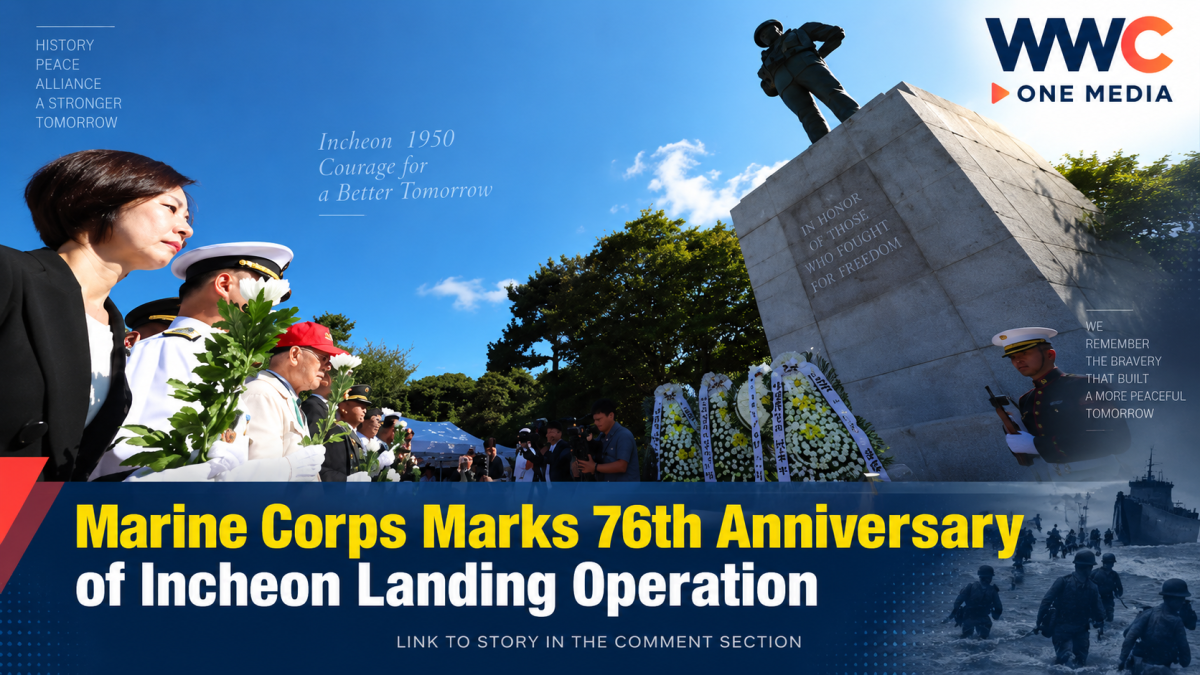
INCHON, SOUTH KOREA — A Historic Landing Remembered
South Korea’s Marine Corps and the city of Incheon have marked the 76th anniversary of the Incheon Landing Operation, commemorating one of the most consequential military operations of the Korean War.
The anniversary was observed on September 15, 2026, exactly 76 years after United Nations forces launched the amphibious assault at Incheon in 1950. The operation, code-named Operation Chromite, is widely regarded as a major turning point that helped reverse the course of the war.
The 2026 commemoration formed part of a series of events organized by the Republic of Korea Marine Corps and Incheon Metropolitan City, with activities running from September 10 through September 15.
The Operation That Changed the War
The Incheon landing took place on September 15, 1950, roughly three months after North Korean forces invaded South Korea.
At the time, United Nations and South Korean forces were fighting to hold the Pusan Perimeter in the southeastern corner of the peninsula. The Incheon operation was designed to strike far behind North Korean lines, disrupt supply routes and open a path toward Seoul.
The landing was particularly risky because Incheon presented enormous geographical challenges, including extreme tides, mudflats and narrow approaches to the harbor. Those same difficulties, however, also helped make the location an unexpected target.
The assault involved U.S. Marines, U.S. Army forces, South Korean Marines and other United Nations personnel.
The operation ultimately allowed UN forces to push inland toward Seoul, which was recaptured later that month.
More Than a U.S. Military Story
While U.S. Marine forces are prominently associated with the operation, historians have emphasized that South Korean personnel also played important roles.
South Korean Marines participated directly in the assault, while Korean personnel were also integrated into U.S. formations during the campaign. Intelligence cooperation between South Korean and American personnel before the landing helped provide information about local conditions and possible approaches.
That history has become an important part of modern commemorations, particularly as the Republic of Korea and United States continue their longstanding military alliance.
The U.S. Marine Corps’ Korea-based command has also participated in previous anniversary events, including the 75th-anniversary commemoration in 2025, which featured a floral tribute honoring Korean and United Nations forces who fought in the operation.
Why Incheon Still Matters 76 Years Later
The significance of the Incheon landing extends beyond its immediate battlefield success.
The operation demonstrated how an unexpected amphibious assault could disrupt an opponent’s position and dramatically alter the strategic situation. Historical accounts describe the landing as a decisive blow against North Korean forces and a key step toward the recapture of Seoul.
But historians also point to a more complicated legacy.
The success at Incheon generated confidence among UN commanders and political leaders and contributed to the decision to push the war farther north. That escalation eventually encountered Chinese intervention and helped turn the conflict into a much longer and more destructive war.
That makes the anniversary more than a celebration of battlefield strategy. It is also an opportunity to examine the consequences of major military decisions and the enormous human and political costs that followed.
Incheon Today: From Battlefield to Global City
The modern city of Incheon bears little resemblance to the wartime battlefield.
The city has developed into one of South Korea’s major international economic and transportation centers, with its history increasingly presented alongside its transformation into a global city. Earlier anniversary commemorations have connected the landing’s history with Incheon’s modern development and international outlook.
This year’s 76th-anniversary events therefore carry two messages: remembering those who served during the Korean War and preserving the historical memory of an operation that changed the direction of the conflict.
A Legacy That Still Shapes Korea
Seventy-six years after the landing, the Incheon coast remains a powerful reminder of how quickly the Korean War’s fortunes could change.
The anniversary brings together military personnel, government officials, veterans and citizens to remember the operation and those who participated in it.
For South Korea and its allies, the Incheon Landing remains both a symbol of military cooperation and a reminder that the decisions made during wartime can shape generations long after the battlefield falls silent.




Leave a Reply