
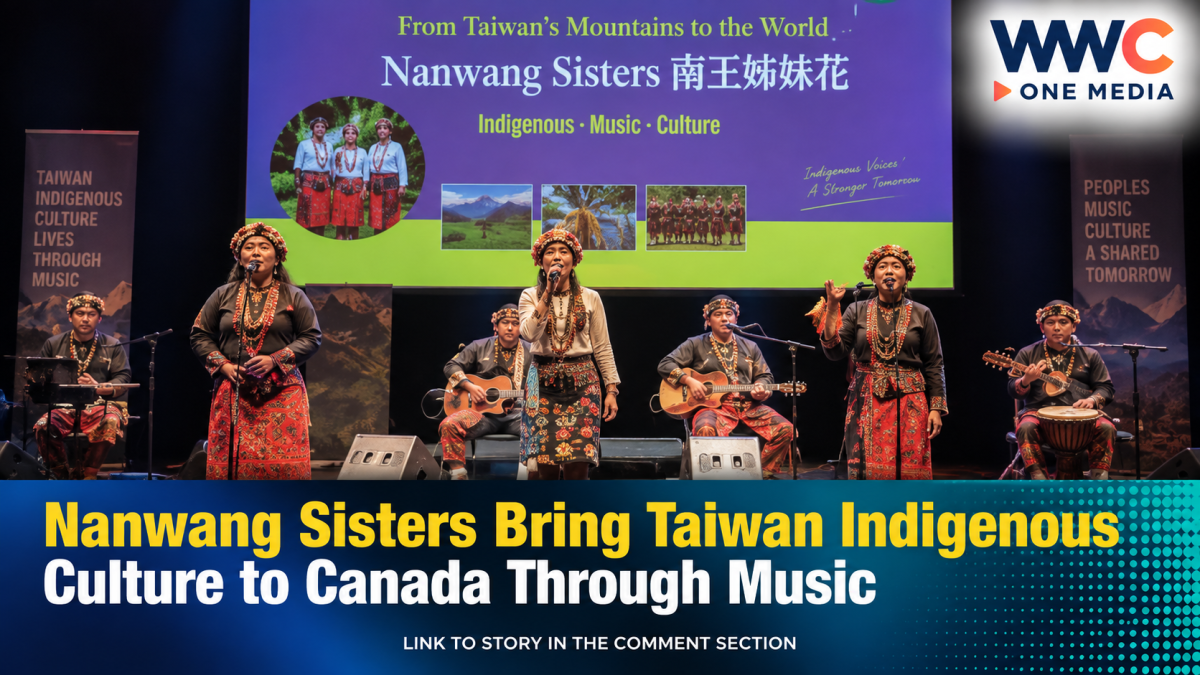
TORONTO/VANCOUVER, Canada — The voices of Taiwan’s Indigenous communities are resonating across Canada as the Nanwang Sisters, a celebrated Pinuyumayan music group from Taitung, showcase their culture, language and history through a series of performances and cultural exchanges.
The group recently appeared in Toronto and Vancouver as part of cultural programs connected to TAIWANfest, introducing Canadian audiences to the musical traditions of the Pinuyumayan people while connecting with Indigenous communities in Canada. The exchanges were supported by Taiwan’s Council of Indigenous Peoples and the Canada Council for the Arts.
More than a performance: music as cultural memory
The Nanwang Sisters—Samingad, Lavaus and I hua—are known for using their voices to preserve Pinuyumayan culture and language.
Rather than treating traditional music simply as heritage entertainment, the group has used singing as a way to carry memories, identity and stories between generations. Their performances combine traditional Pinuyumayan vocal rhythms with contemporary musical arrangements, giving Indigenous traditions a modern stage without losing their cultural roots.
Their Toronto TAIWANfest program, titled “When the Mountains Sing,” invited audiences to hear songs connected to the mountains and communities of Taitung. Organizers also arranged for a Canadian Indigenous guest artist to join the program, creating a direct cultural exchange between Indigenous musicians from Taiwan and Canada.
A bridge between Taiwan and Canadian Indigenous communities
One of the most meaningful aspects of the Canadian visit was the opportunity for Indigenous artists from Taiwan and Canada to meet and share experiences.
The Nanwang Sisters reunited in Toronto with Aysanabee, a Canadian Indigenous musician they had previously encountered during his visit to Taiwan. According to Taiwan News’ report, guitarist Wang Chih-po said the encounter highlighted similarities in the historical experiences of Indigenous peoples in the two places.
Aysanabee also pointed to the importance of Indigenous peoples being able to reclaim their languages, identities and stories after periods when those identities were suppressed or discouraged.
That exchange gave the Canadian performances a broader meaning: the concerts became opportunities for Indigenous communities separated by geography to recognize shared experiences while maintaining their distinct histories.
The Golden Melody-winning group behind the music
The Nanwang Sisters have played an important role in Taiwan’s contemporary Indigenous music scene.
Their 2009 self-titled album earned three Golden Melody Awards, including Best Vocal Group and Best Indigenous Language Album, marking a significant moment for Indigenous-language music within Taiwan’s mainstream music industry.
The group later continued developing music that combines Indigenous cultural memory with contemporary performance. Their work has helped demonstrate that Indigenous-language music can reach audiences beyond the communities where those traditions originated.
Keeping a mother tongue alive through song
For Indigenous communities, language preservation can be closely connected to cultural survival.
Programs accompanying the Nanwang Sisters’ Canadian appearances have emphasized how songs can preserve history and memories in communities where oral traditions have traditionally played an important role.
At the University of British Columbia’s Museum of Anthropology, the group’s Vancouver-area programming described their music as a way to preserve their mother tongue, honor cultural memory and explore music as a form of cultural continuity.
The Vancouver TAIWANfest program also featured a lecture-concert with guitarist and cultural advocate Ipo Demaladas, who discussed how the Nanwang Sisters use music to preserve Pinuyumayan culture and pass stories between generations.
From Taitung to an international audience
The Nanwang Sisters’ journey reflects the growing international visibility of Taiwan’s Indigenous arts.
Their Canadian appearances brought Pinuyumayan music to audiences in Toronto and Vancouver while creating opportunities for dialogue with Indigenous artists and cultural organizations in Canada.
The broader TAIWANfest program has increasingly positioned music, language, migration and Indigenous identity as ways of connecting Taiwan and Canada.
For the Nanwang Sisters, however, the message goes beyond simply introducing audiences to traditional songs.
Their performances demonstrate how music can preserve a language, carry collective memory and create connections across borders.
As their voices travel farther from Taiwan, the Nanwang Sisters are showing that Indigenous culture does not have to remain confined to the past—it can continue evolving, crossing oceans and reaching entirely new audiences.



Leave a Reply