
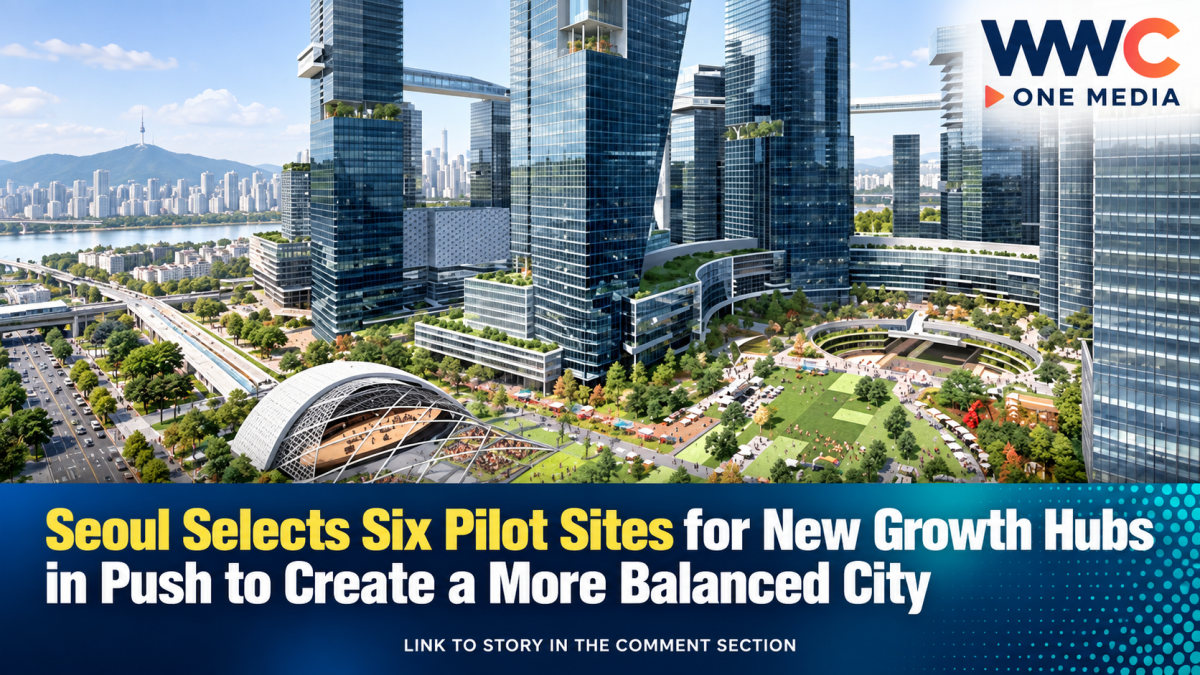
SEOUL, South Korea — Seoul is moving to reshape its economic geography, selecting six pilot sites for major development as the city accelerates a strategy aimed at creating multiple growth centers instead of concentrating jobs, investment and high-density development in a handful of established districts.
The Seoul Metropolitan Government announced the six sites on September 15 as part of its broader “polycentric city” strategy, which seeks to develop new economic and urban hubs across different parts of the capital.
The initiative forms part of Mayor Oh Se-hoon’s “G3 Seoul Plan,” which includes the goal of developing a “NEXT Economy” through growth hubs in Seoul’s northeast, northwest, downtown, southeast and southwest areas.
Seoul wants growth beyond the traditional core
For decades, Seoul’s strongest economic activity has been heavily concentrated in areas such as Gangnam and the central business districts.
The new strategy seeks to change that pattern by encouraging large-scale development in locations that can become self-sustaining centers for jobs, business, housing and services.
Seoul’s government describes the broader vision as a move toward a polycentric city, where residents can find employment and essential services closer to where they live rather than having to travel toward a small number of dominant business districts.
The city has separately outlined a plan to develop dozens of growth and lifestyle hubs, with the six newly selected locations serving as an initial test of the approach.
Six sites become the first test
The six locations selected by Seoul are being treated as pilot projects, meaning the city will use them to demonstrate how its new development model can work before potentially expanding the approach.
The projects are expected to focus on high-density, mixed-use development and stronger links between employment, housing and urban infrastructure.
Some of the selected sites are already controlled by major corporations, developers or asset-management companies, according to Korean business media. That could make implementation easier because the projects have access to significant development resources and established land ownership.
But it could also raise questions about whether the benefits of Seoul’s new growth strategy will be distributed broadly enough among residents and smaller businesses.
High-density development could transform key districts
Among the locations highlighted in reports are Yeoksam-dong in Gangnam-gu and Jayang-dong in Gwangjin-gu, where Seoul envisions high-density mixed-use development as part of the new growth-hub strategy.
The goal is not simply to build more towers.
The city wants these areas to function as economic centers where companies, workers, residents, transportation networks and public facilities interact within the same urban ecosystem.
That approach could reduce pressure on Seoul’s established business districts while creating new opportunities in areas that have historically been less dominant economically.
A strategy aimed at Seoul’s next economic era
The growth-hub initiative comes as Seoul faces major structural challenges, including housing affordability, long commuting times, uneven development between districts and the need to create new sources of economic growth.
Mayor Oh’s broader G3 Seoul Plan places economic competitiveness alongside quality of life and aims to position Seoul as one of the world’s leading cities. The plan also includes making Seoul more supportive of artificial intelligence and developing new future-growth industries.
That economic ambition is increasingly important as South Korea prepares for a technology-driven growth cycle.
The national government is simultaneously pushing investment in semiconductors, artificial intelligence and AI data centers, while the country’s electricity demand is expected to rise sharply as those industries expand. Reuters reported that South Korea expects AI-related chip manufacturing and data-center development to add roughly 25–30 gigawatts of electricity demand.
Seoul’s urban-development strategy therefore comes at a time when the capital is preparing for potentially significant changes in where businesses, workers and infrastructure are concentrated.
The challenge: turning plans into real hubs
Selecting six sites is only the beginning.
The real test will be whether these locations can attract businesses, create quality jobs and provide the housing, transportation and public services needed to support growing populations.
There is also a question of who ultimately benefits from the redevelopment.
Because several selected locations are already associated with major corporate or development interests, Seoul will need to balance its desire for rapid investment with concerns about land values, neighborhood change and equitable access to the economic opportunities created by redevelopment.
If successful, however, the strategy could fundamentally change how Seoul functions.
Instead of one dominant metropolitan core surrounded by commuter districts, the city could evolve into a network of interconnected economic centers.
The six pilot sites are Seoul’s first major test of that vision—and their success could determine whether the capital’s next growth story is concentrated in a few familiar districts or spread across the entire city.



Leave a Reply