
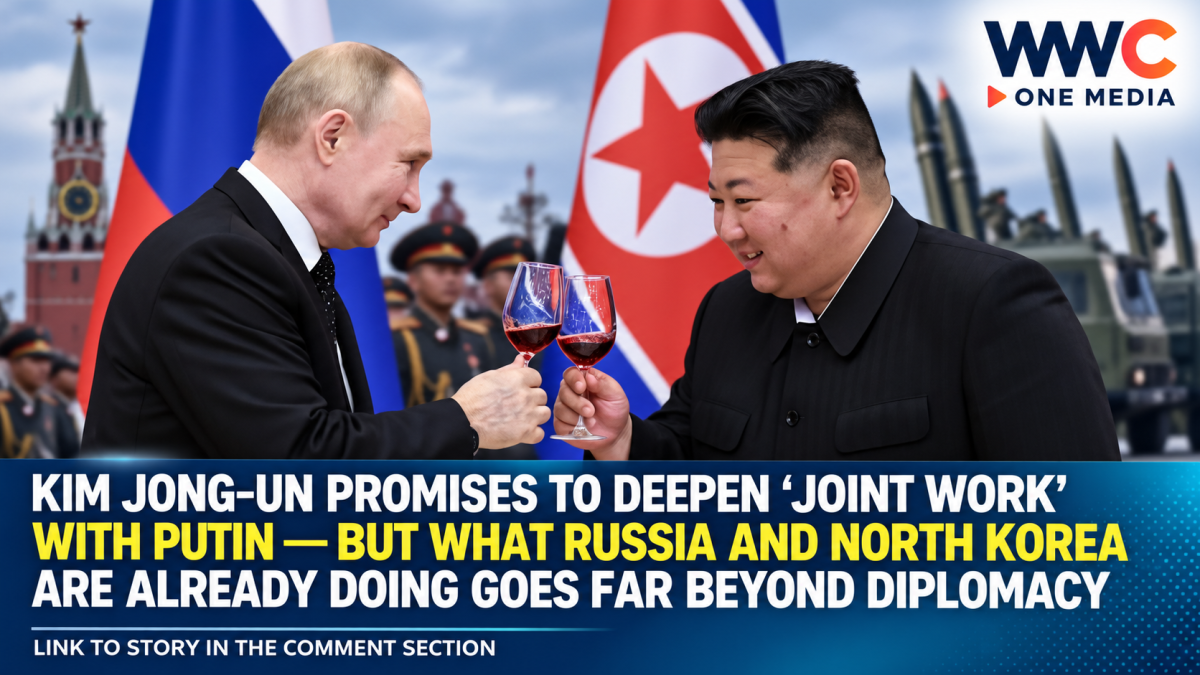
SEOUL — North Korean leader Kim Jong-un has promised Vladimir Putin that Pyongyang will expand and deepen its “joint work” with Russia, using language that would once have sounded like diplomatic ceremony but now carries a very different weight.
North Korea is no longer merely offering political support to Moscow.
Its soldiers have fought alongside Russian forces, its weapons have been used in the Ukraine war, a mutual-defense treaty now formally binds the two governments, thousands more North Korean personnel have been earmarked for work in Russia, and the neighbors opened their first dedicated road bridge just days before Kim sent his latest message.
That is why one unanswered phrase in Kim’s letter matters:
What exactly does “joint work” mean now?
Kim’s message went much further than a thank-you note
According to the Korean Central News Agency, Kim sent the message in reply to Putin’s congratulations marking the 78th anniversary of North Korea’s founding on September 9.
Kim said Pyongyang’s determination was “firm” to broaden cooperation comprehensively with the Russian Federation, invoking what he called the countries’ tradition of friendship, good-neighborliness, mutual assistance and their increasingly explicit alliance.
He also said North Korea and Russia were writing a new history of their alliance while facing what KCNA rendered as a turbulent historical period.
Most significantly, Kim again pledged unwavering support for Russia in its war against Ukraine, describing Moscow’s campaign in ideological terms as a struggle North Korea intends to continue backing. Reuters separately reported Kim expressing support for Russian victory in what he characterized as a “sacred war.”
Those are North Korea’s and Kim’s characterizations of the conflict. Russia launched its full-scale invasion of Ukraine in February 2022, and Ukraine and its Western partners reject Moscow’s justification for the war.
Putin had already sent his own signal six days earlier
Kim’s reply followed Putin’s September 9 anniversary message, in which the Russian president pledged continued close cooperation with Pyongyang.
Putin said he wanted the two sides to deepen their comprehensive strategic partnership and argued that stronger Russia–North Korea ties contribute to regional stability and what Moscow describes as a fairer multipolar international order.
Chinese President Xi Jinping also sent Kim an anniversary message emphasizing stronger strategic guidance and continued development of China–North Korea ties.
That matters because North Korea is not simply replacing China with Russia.
Pyongyang appears increasingly interested in maintaining powerful relationships with both neighbors while extracting diplomatic, economic and strategic advantages from each.
The alliance stopped being symbolic in June 2024
The fundamental change in Russia–North Korea relations came when Putin traveled to Pyongyang in June 2024.
Putin and Kim signed a Treaty on Comprehensive Strategic Partnership containing a mutual-defense commitment strikingly stronger than the agreements that had governed their relationship in previous decades.
Article 4 says that if either country enters a state of war because of armed aggression, the other is to provide military and other assistance “without delay” using the means available to it.
The treaty formally entered into force on December 4, 2024, after ratification documents were exchanged in Moscow.
That transformed the relationship from increasingly close cooperation into something resembling a formal military alliance.
And within months, the treaty’s implications were no longer theoretical.
North Korean troops actually went to war for Russia
North Korea initially denied or avoided publicly acknowledging reports that its soldiers had been deployed to Russia.
That changed in 2025, when Moscow and Pyongyang openly confirmed that North Korean forces had participated alongside Russian troops in operations in Russia’s Kursk region, where Ukrainian forces had mounted a cross-border incursion.
By September 2026, Western and South Korean officials estimated that North Korea had deployed around 14,000 to 15,000 troops since late 2024.
South Korean officials estimated roughly 6,000 casualties among those forces by February 2026. “Casualties” includes both killed and wounded and should not be reported as 6,000 deaths.
North Korea has increasingly celebrated those soldiers publicly rather than hiding them.
Kim praised troops involved in “overseas military operations” during the country’s founding-anniversary events this month. Earlier this year, North Korea even opened a new housing district in Pyongyang for families of soldiers killed while fighting alongside Russia.
That represents a remarkable shift for one of the world’s most secretive governments.
Foreign military intervention has effectively become part of Kim’s domestic political narrative.
And Pyongyang is sending more than combat troops
The manpower relationship has expanded beyond battlefield units.
In June 2025, Russian Security Council Secretary Sergei Shoigu said Kim had agreed to send another 6,000 North Korean personnel to Russia’s Kursk region.
That package consisted of about 1,000 military engineers and demining specialists and 5,000 military construction workers intended to remove mines and help rebuild damaged infrastructure.
The move is significant because it creates another form of North Korean military presence in Russia even as the conventional battlefield situation changes.
It also broadens the meaning of bilateral defense cooperation from fighting to reconstruction, engineering and logistics.
So when Kim now promises more “joint work,” there is already a large menu of activities that phrase could encompass.
Ukraine says another much larger deployment could still be coming
There are also claims of further expansion that remain less certain.
Ukrainian President Volodymyr Zelenskyy said in July that Russia was preparing to receive as many as 30,000 additional North Korean troops.
He said preparations were underway in Russia and also warned that North Korea could supply additional missile launchers.
That figure has not been independently confirmed as an actual completed deployment.
It should therefore be presented as a Ukrainian assessment rather than as established fact.
South Korea’s Defense Ministry said in September that Pyongyang continued preparations related to possible additional deployments but that no immediate movement had been confirmed as of late August.
That distinction is especially important given the vague language in Kim’s new letter.
His promise to expand cooperation should not automatically be treated as confirmation of the 30,000-troop claim.
Weapons may be just as important as soldiers
North Korea’s contribution to Moscow extends well beyond manpower.
Western, Ukrainian and South Korean officials have accused Pyongyang of supplying Russia with millions of artillery and mortar rounds, ballistic missiles and other military equipment.
Reuters reported in August that North Korea had sent hundreds of ballistic missiles as well as large quantities of ammunition and heavy weapons, citing intelligence and official assessments.
Ukraine said in July that a North Korean missile was likely used in a Russian strike near Kryvyi Rih that killed five members of one family.
Ukrainian authorities identified the weapon as probably a KN-23 or KN-24 after examining the attack, though Reuters noted that analysis of fragments was continuing.
Russia and North Korea have not publicly detailed the full quantity or terms of their arms arrangements.
That means precise claims about how many shells or missiles Moscow has received must remain attributed to intelligence agencies, governments or research organizations rather than stated as uncontested fact.
What does North Korea get back?
That may be the most consequential question for South Korea, Japan and the United States.
Seoul has assessed that Pyongyang is receiving economic assistance, energy supplies and potentially military or technical help from Russia in exchange for supporting Moscow’s war effort.
Exactly which sensitive technologies have been transferred remains difficult to verify publicly.
South Korean and Western officials have repeatedly expressed concern that Russia could assist North Korea in areas connected with satellites, missiles, air defense or other advanced defense capabilities.
But public evidence is not sufficient to claim every suspected transfer has occurred.
What is much easier to see is the economic and logistical infrastructure now being built between the two countries.
Eight days before Kim’s message, Russia and North Korea opened something they had never had before
On September 7, Moscow and Pyongyang opened their first proper road bridge across their narrow shared border.
The approximately one-kilometre, two-lane bridge over the Tumen River links Russia’s Primorsky region with North Korea and supplements existing air and rail connections.
Russian Prime Minister Mikhail Mishustin and North Korean Premier Pak Thae-song joined the opening ceremony remotely as the first flag-covered trucks crossed.
Russian officials say the bridge can eventually handle roughly 300 vehicles per day, with cargo traffic beginning immediately and passenger movement potentially following.
North Korean state media said the project would support not only trade but also tourism, personnel exchanges and broader economic cooperation.
That makes the latest Kim-Putin exchange more tangible.
Their alliance is literally being paved into the border.
The bridge changes the economics of a previously awkward frontier
Russia and North Korea share only a very short land border.
Until this month, transportation infrastructure was surprisingly limited.
Rail provided the main established crossing, and vehicles could only be moved across under awkward arrangements involving the railway bridge.
The new road connection gives both sides a dedicated channel for trucks and eventually potentially passengers.
Officially, Moscow and Pyongyang describe that as an economic-development project.
Analysts and Ukrainian officials worry the same route could make movement of sanctioned goods, labor or military supplies easier.
There is no public evidence that the newly opened bridge is already being used to transfer specific weapons shipments, so that possibility should not be presented as fact.
But strategically, infrastructure matters because closer political relations are much easier to translate into trade and logistics when there is an actual road connecting the countries.
The relationship has also become personal
Kim and Putin have repeatedly emphasized personal loyalty alongside state interests.
When they met in Beijing on September 3, 2025, Kim told Putin that helping Russia was a “fraternal duty” and said he would do everything he could to assist Moscow.
Putin thanked North Korea for the role of its soldiers and later invited Kim to Russia.
Their meeting lasted about two and a half hours.
That encounter was particularly striking because Kim and Putin had just appeared alongside Chinese President Xi Jinping at Beijing’s massive World War II anniversary military parade.
It was the first public gathering of the three leaders in that format in decades.
For Kim, the optics were powerful.
The leader of a heavily sanctioned state was standing beside the presidents of Russia and China rather than appearing internationally isolated.
Yet China is becoming important again too
Russia’s rise in North Korea’s foreign policy initially generated questions over whether Moscow was replacing Beijing as Pyongyang’s principal external partner.
Recent developments suggest the answer is more complicated.
China and North Korea have been repairing and expanding ties after several cooler years.
This month, satellite analysis showed North Korea rapidly completing infrastructure on its side of the long-delayed New Yalu River bridge connecting Sinuiju with China’s Dandong.
Xi’s anniversary message to Kim likewise promised continued strategic coordination.
So Pyongyang appears to be improving transportation links in both directions:
toward China in the west,
and toward Russia in the northeast.
That potentially gives Kim more room to maneuver economically and diplomatically rather than becoming completely dependent on either neighbor.
The timing is also notable because North Korea keeps testing weapons
The latest diplomatic exchange came only days after another North Korean weapons exercise.
On September 12, North Korea conducted a large joint firepower drill involving ballistic missiles, tactical cruise missiles, attack drones, artillery and large-caliber rocket launchers.
South Korea’s military said several ballistic missiles flew about 250 kilometers toward waters off North Korea’s east coast.
The exercise followed U.S.-South Korea-Japan trilateral drills.
Pyongyang portrayed its operation as a demonstration of integrated battlefield strike capability and has continued to criticize allied military exercises as hostile.
The timing reinforces why South Korean officials view Russia–North Korea cooperation as more than a European security problem.
Any technology, resources or operational experience flowing back to Pyongyang could potentially influence the military balance on the Korean Peninsula.
Combat experience may itself be one of Russia’s biggest gifts
Even without a sophisticated technology transfer, North Korean troops have gained something the Korean People’s Army rarely receives:
experience in a large, modern war involving drones, electronic warfare, artillery saturation, precision missiles and heavily fortified positions.
North Korea has not fought a major sustained conventional conflict since the Korean War ended in an armistice in 1953.
Its operations alongside Russia therefore expose troops and commanders to conditions that cannot be fully reproduced during domestic exercises.
Reuters described the deployment as North Korea’s most extensive overseas military engagement since the Korean War.
That battlefield learning could eventually be incorporated into North Korean training, doctrine and weapons development.
For Seoul, that may be one of the least visible but longest-lasting consequences of the alliance.
There is also a sanctions problem
North Korea remains subject to extensive United Nations sanctions connected with its nuclear and ballistic-missile programs.
Those measures include restrictions affecting arms transfers and many forms of commercial exchange.
Russia, once a participant in enforcing those restrictions as a permanent member of the UN Security Council, has moved steadily closer to Pyongyang as its war with Ukraine has continued.
That shift has weakened international efforts to isolate North Korea and has given Kim something extremely valuable:
a powerful UN Security Council member willing to develop an openly strategic relationship with his government.
For Pyongyang, Russia offers more than money or military cooperation.
It offers diplomatic space.
Kim’s latest wording therefore matters more than it would have three years ago
If Kim had promised to “deepen joint work” with Russia before the Ukraine war transformed the relationship, the phrase might have been dismissed as ceremonial diplomacy.
Today it sits on top of an alliance that already includes:
North Korean soldiers on Russian territory,
a mutual-defense treaty,
military construction and demining deployments,
alleged large-scale arms supplies,
expanding trade and tourism links,
and a new road bridge.
That changes how even vague language should be interpreted.
It does not tell us exactly what comes next.
But it tells us neither side is signaling that the relationship has reached its ceiling.
The biggest unanswered question is whether the alliance outlives the Ukraine war in its current form
Much of the extraordinary acceleration in Russia–North Korea cooperation has been driven by complementary wartime needs.
Russia needed manpower, artillery ammunition and other military supplies.
North Korea needed money, resources, political support and potentially technology.
That produces an unusually strong transaction.
But Moscow and Pyongyang increasingly describe their partnership as something much bigger than a wartime bargain.
The 2024 treaty is open-ended.
The new road bridge is permanent infrastructure.
Political contacts continue at the highest level.
And Kim’s latest message explicitly talks about comprehensively expanding cooperation rather than scaling it down once battlefield needs ease.
If that rhetoric accurately reflects both governments’ plans, Seoul, Washington and Tokyo may need to think about the Russia–North Korea relationship not as a temporary side effect of Ukraine, but as a durable security alignment in Northeast Asia.
And that is what makes two vague words worth watching
Kim did not announce another division of troops.
He did not disclose a new missile contract.
He did not unveil another defense agreement.
He simply promised to deepen “joint work.”
But unlike diplomatic language in isolation, those words now arrive after soldiers have fought, weapons have moved, infrastructure has opened and a mutual-defense treaty has taken effect.
The mystery is no longer whether Russia and North Korea are becoming allies.
They already describe themselves that way.
The real question is how much further they intend to take the alliance — and what Moscow is prepared to give Pyongyang in return.



Leave a Reply