
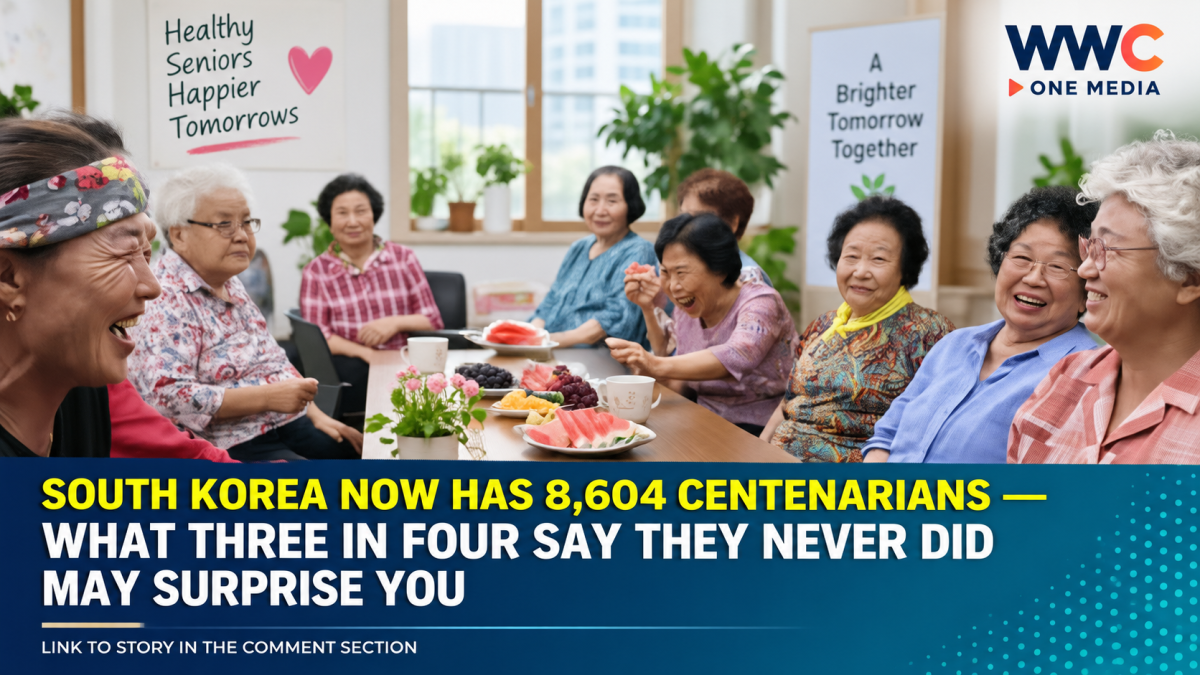
SEOUL — Living to 100 is still extraordinary. In South Korea, however, it is becoming considerably less rare.
The country counted 8,604 people aged 100 or older as of Nov. 1, 2025, according to the latest nationwide census data — nearly three times the 3,159 centenarians recorded in 2015.
That is an increase of 5,445 people, or 172.4%, in only a decade. The number of centenarians per 100,000 residents rose from 6.4 in 2015 to 17.3 in 2025.
The figures underline one of the most dramatic demographic transformations taking place in Asia.
South Koreans are living longer, medical care has improved and living conditions have advanced. But the milestone also poses a much harder question for one of the world’s fastest-aging countries:
Who will care for a rapidly growing population that is living not just into its 80s and 90s — but beyond 100?
Women overwhelmingly dominate the 100-plus population
Of Korea’s 8,604 centenarians, 7,176 — 83.4% — were women.
Men numbered only 1,428, or 16.6%.
That still represents a significant change.
The male centenarian population has actually been increasing more rapidly than the female population. Over the decade, the number of men aged 100 or older rose about 3.3 times, while the number of women increased roughly 2.6 times.
The oldest individual confirmed through the field survey was 116 years old, although officials stressed that the census finding may not necessarily match the oldest age recorded in administrative registration databases.
The gender imbalance is consistent with Korea’s wider longevity statistics.
Life expectancy for babies born in South Korea in 2024 reached a record 83.7 years — 86.6 for women and 80.8 for men.
Where Korea’s centenarians live
In absolute numbers, Gyeonggi Province — the populous region surrounding Seoul — had the most centenarians, with 2,052.
Seoul followed with 1,268, while North Gyeongsang Province had 559.
But the map looks very different when population size is taken into account.
South Jeolla Province recorded 31.8 centenarians per 100,000 residents, the highest provincial rate in the country.
Jeju followed at 30.4, while Gangwon recorded 28.6.
At the city and county level, Goyang in Gyeonggi Province had the largest absolute population of centenarians, at 188.
But Goheung County in South Jeolla stood far above the rest on a per-capita basis, with 91.8 centenarians for every 100,000 residents. Yeongyang and Bonghwa counties in North Gyeongsang followed.
Those regional differences do not necessarily prove that one area possesses a special formula for longevity. Population structure, migration patterns, nursing facilities and the concentration of older residents can all affect the figures.
What do people who reach 100 say kept them alive?
This is where the survey becomes particularly fascinating.
Officials conducted a more detailed interview survey involving 4,280 centenarians living outside long-term institutional facilities.
Asked what they believed contributed to their longevity, 59.7% cited a restrained diet, including eating smaller portions.
Another 44.5% pointed to maintaining a regular lifestyle, while 32.1% cited genetics or coming from a long-lived family. Respondents could identify more than one factor.
Their smoking and drinking histories are even more striking.
About 86.9% said they had never smoked, while 79.6% said they had never consumed alcohol.
Roughly 75.8% — about three in four — reported doing neither throughout their lives.
That does not prove that abstaining from alcohol and cigarettes guarantees a 100-year lifespan. The survey records the habits of people who survived to 100; it is not a controlled scientific experiment establishing the causes of their longevity.
Genetics, health care, socioeconomic circumstances, diet, physical activity and countless other factors can contribute.
Still, the pattern is notable.
Living to 100 doesn’t necessarily mean living without disease
There is another side to Korea’s longevity story.
Among the community-dwelling centenarians surveyed, roughly 90% had at least one chronic illness.
High blood pressure was reported by 56.7%, arthritis by 39.9%, dementia by 29.1% and diabetes by 15.7%.
Some 81.8% used assistive equipment of some kind.
That distinction matters because longevity and healthy longevity are not the same thing.
Modern medicine can help people survive diseases and conditions that might once have shortened their lives dramatically. But living longer can also mean spending more years requiring medical treatment, mobility support or daily assistance.
That is rapidly becoming one of Korea’s biggest public-policy challenges.
One in five surveyed centenarians lived alone
Perhaps the most socially significant finding concerns their living arrangements.
Among the 4,280 centenarians surveyed while living in the community, 20.7% lived alone.
About 75.1% lived with family members.
Children and their spouses remained central to the care system.
They were identified as caregivers by 73.5% of respondents, while professional paid caregivers such as care workers and nursing aides were cited by 35.6%. Because respondents could have multiple caregivers, those percentages should not be added together as parts of a single total.
The findings expose an issue that is likely to become increasingly difficult.
Traditional Korean families historically provided much of the care required by elderly parents.
But families themselves are getting smaller.
South Korea has spent years struggling with extremely low birthrates, meaning future generations will contain fewer children available to provide care for a rapidly expanding elderly population.
So the country is experiencing two demographic changes at once:
People are living longer.
And there are fewer younger people behind them.
Most still don’t want to enter nursing facilities
Another finding illustrates the scale of the challenge.
Among community-dwelling centenarians, 70.7% said they had no intention of entering a residential care facility even if their health worsened or they needed additional care.
Yet 47.9% said the structure or facilities of their current homes were inconvenient.
That creates a difficult policy equation.
If older Koreans overwhelmingly want to remain in their own homes, Seoul and local governments may need to expand home-based nursing, visiting medical services, emergency-response systems, accessible housing and community care rather than relying predominantly on institutional facilities.
And if one in five extremely old people living at home are already alone, the need for those systems becomes even more urgent.
Korea is already a ‘super-aged society’
The centenarian boom is not happening in isolation.
South Korea officially crossed the threshold into a super-aged society in late 2024, when residents aged 65 or older reached 20% of the population.
By 2025, the number of residents aged 65 and above had climbed to roughly 10.84 million, or 21.21% of the population.
The Bank of Korea has warned that aging will accelerate sharply in the decades ahead. The share of people aged 65 or older is projected to approach 30% around 2035 and exceed 40% by 2050.
That has implications far beyond hospitals and nursing homes.
A rapidly aging population affects pension finances, government health spending, the labor force, economic growth, housing demand and taxation.
It can also increase pressure on working-age adults who must simultaneously support children, elderly parents and public welfare systems.
Korea’s longevity achievement comes with an uncomfortable paradox
From one perspective, 8,604 centenarians are evidence of remarkable progress.
South Korean life expectancy was just 62.3 years in 1970. By 2024, it had reached 83.7 years.
Medical treatment is better.
Infant mortality has fallen.
Living standards have risen dramatically.
People survive diseases and injuries that once routinely proved fatal.
Yet longevity itself generates new challenges that earlier generations never had to confront at this scale.
How does a country design apartments for people in their 100s?
Who checks on a 103-year-old who lives alone?
How should home care be financed?
Can families continue carrying most of the burden when there are fewer children?
And how can governments focus not simply on adding years to life, but preserving independence and health within those additional years?
Those questions could become considerably more important because officials expect the centenarian population to continue growing.
The number to watch may not be 8,604
The most attention-grabbing figure is obvious.
8,604 Koreans have already crossed the 100-year mark.
That is nearly three times as many as a decade earlier.
But the most consequential numbers may be buried deeper in the survey: 90% of those surveyed at home had chronic illnesses, roughly one in five lived alone, and almost three-quarters depended on children or their spouses for care.
South Korea has become remarkably successful at helping people live longer.
Its next challenge is considerably harder:
If reaching 100 becomes increasingly common, can the country build a society capable of supporting people for all of those extra years?




Leave a Reply