
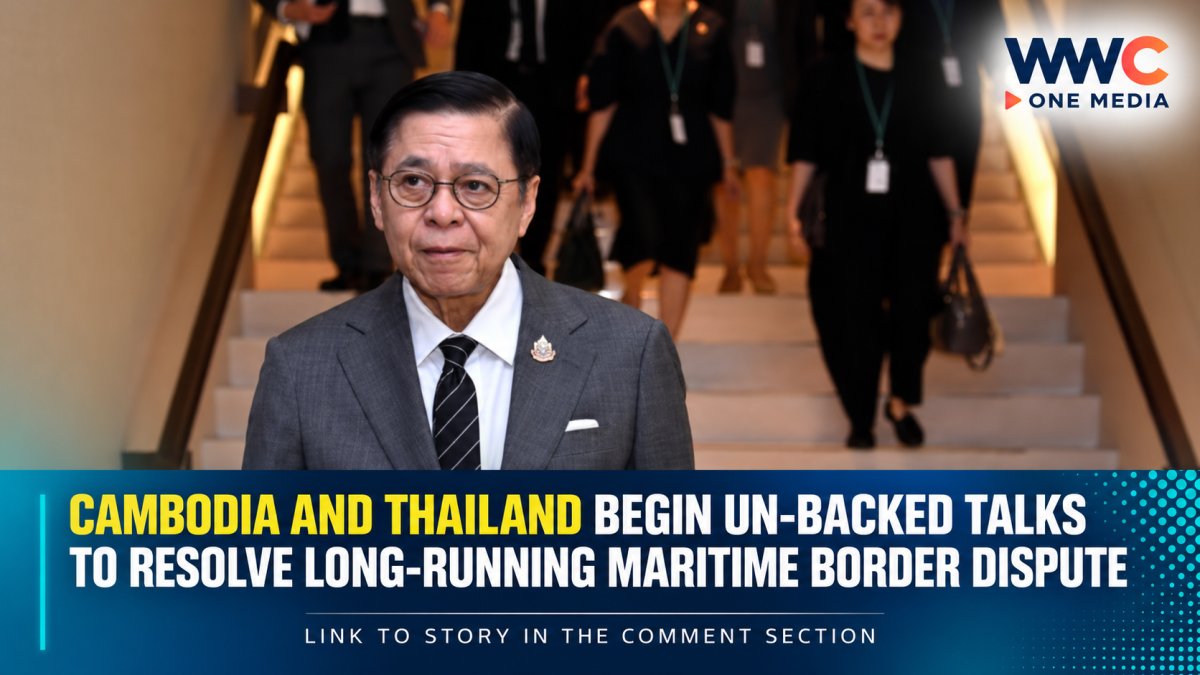
Cambodia and Thailand have begun a formal international process to settle a long-running maritime border dispute in the Gulf of Thailand, opening a new diplomatic channel between the two Southeast Asian neighbours after years of stalled negotiations.
The first meeting of the compulsory conciliation process took place in Singapore on Sept 15, with the foreign ministers of both countries delivering opening statements before a five-member conciliation commission.
The process is being conducted under the United Nations Convention on the Law of the Sea, or UNCLOS, and represents Cambodia’s effort to move the dispute into an international legal framework after bilateral negotiations failed to make meaningful progress.
Cambodian Foreign Minister Prak Sokhonn described the process as an opportunity to resolve the disagreement peacefully and through international law.
Thailand, however, has maintained that the maritime dispute should be handled through bilateral mechanisms rather than internationalising the issue.
The disagreement centres on overlapping maritime claims in the Gulf of Thailand, including waters believed to contain potentially valuable oil and gas resources.
The two countries have been unable to agree on where their maritime boundary should be drawn, despite signing a memorandum of understanding in 2001 that created a framework for negotiations and possible joint development of the disputed area.
Progress under that arrangement has repeatedly stalled.
The dispute has also become politically sensitive because Cambodia’s claims overlap with waters surrounding Thailand’s Koh Kood, a popular island destination in Trat province.
Thailand regards Koh Kood as unquestionably part of its territory, while Cambodia’s broader maritime claims extend into waters near the island.
The maritime disagreement is separate from the land-border disputes that have repeatedly brought Cambodian and Thai forces into confrontation.
The two countries have a long history of territorial disagreements dating back to boundaries established during the French colonial period. The most prominent land dispute involved the Preah Vihear temple, which the International Court of Justice ruled in Cambodia’s favour in 1962.
Although the maritime issue has not produced the same level of military confrontation, it has become increasingly important because of its potential economic and strategic implications.
Oil and gas exploration in the Gulf of Thailand could generate significant revenue for either country, while an agreed maritime boundary could provide greater certainty for energy companies and other commercial activities.
Cambodia initiated the compulsory conciliation procedure earlier this year after Thailand withdrew from the bilateral framework governing the maritime negotiations.
Under UNCLOS, compulsory conciliation is designed to help countries reach an agreement through a structured process facilitated by an independent commission.
Unlike a binding court judgment, the conciliation process is primarily intended to bring the two sides toward a negotiated settlement.
That distinction could be important for Thailand, which has been reluctant to submit the maritime question to an international adjudication process that could result in a binding ruling.
The opening meeting therefore marks a diplomatic breakthrough, but not a final settlement.
The commission will hear the positions of both governments and work to identify areas where the two sides can compromise. Any eventual agreement would still require acceptance by Cambodia and Thailand.
The renewed talks also come after relations between the neighbours were severely tested by broader border tensions.
The two countries have spent years balancing economic ties and cross-border trade against territorial and nationalist disputes, making the maritime negotiations particularly sensitive.
A successful settlement could unlock opportunities for joint energy development and reduce another source of friction between the two governments.
Failure, however, could deepen mistrust and leave overlapping claims unresolved for years.
For Southeast Asia, the process is being closely watched because it demonstrates how a difficult territorial dispute can be moved from confrontation toward an international diplomatic mechanism.
The immediate goal is not to determine a winner, but to prevent the maritime dispute from becoming another trigger for confrontation while giving both countries a structured path toward a negotiated solution.
The first meeting is therefore only the beginning. The real test will be whether Cambodia and Thailand can translate the new international process into an agreement over where their maritime boundary should ultimately lie.




Leave a Reply