
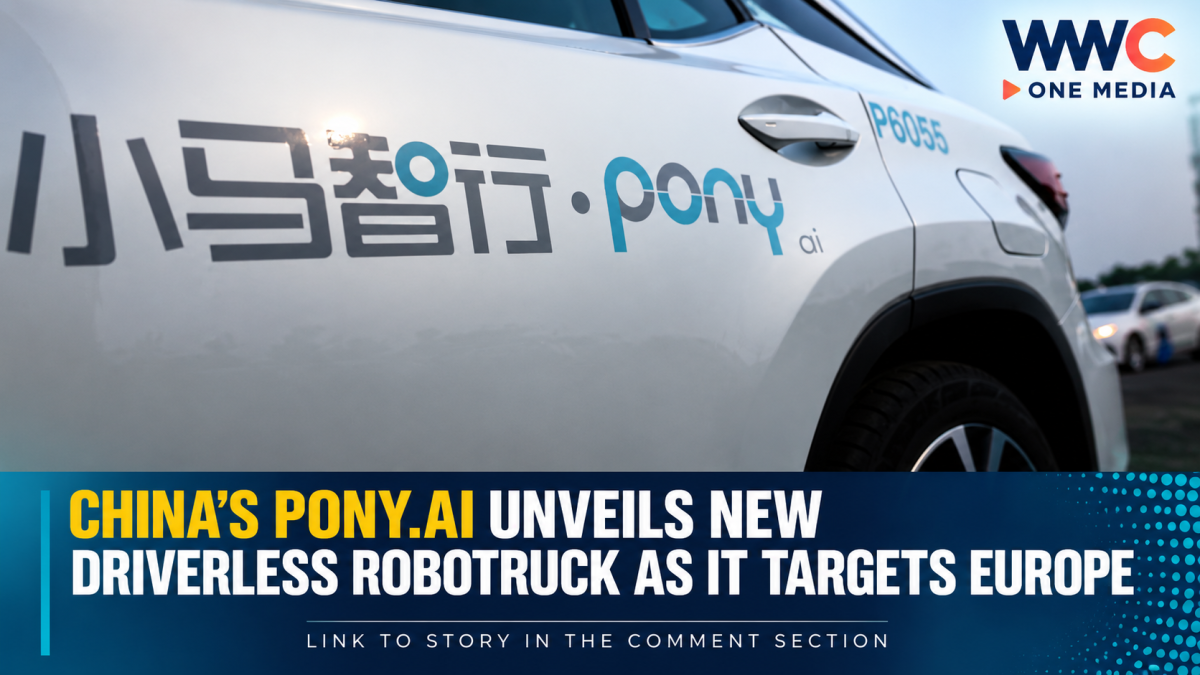
Chinese autonomous-driving company Pony.ai has unveiled a new generation of driverless heavy-duty trucks as it prepares to take its robotruck business into Europe and other international markets.
The company introduced its new Gen-4 Level 4 autonomous truck at the IAA Transportation trade fair in Hanover, Germany, marking a major step in its push to commercialise self-driving freight vehicles outside China.
Developed with Guangzhou Automobile Group’s commercial-vehicle unit, the new electric robotruck is designed for long-haul transport, dedicated logistics routes and port operations.
Pony.ai plans to begin mass production of the vehicle later this year.
Level 4 autonomy means the vehicle can perform the entire driving task without human input within defined operating conditions. That makes the technology significantly more advanced than driver-assistance systems that still require a human driver to remain responsible for the vehicle.
Pony.ai already operates hundreds of autonomous trucks in China, with some able to run without a human driver inside the vehicle.
The company now wants to bring that experience to Europe, where trucking companies are facing high labour costs, driver shortages and growing pressure to reduce emissions.
Pony.ai said it is in discussions with European governments and ports about obtaining permission to test its autonomous trucks.
The company plans to expand its robotruck business into Europe and the Middle East within the next two years.
Europe is becoming an increasingly important battleground for Chinese electric and autonomous truck makers.
Other Chinese manufacturers, including BYD, Farizon, Sany, Sinotruk, Windrose and SuperPanther, are also seeking opportunities in the European commercial-vehicle market.
Pony.ai’s European ambitions also extend beyond trucks.
The company has already begun deploying autonomous robotaxis in Europe. In Zagreb, Croatia, Pony.ai technology is being used in a commercial autonomous ride service operated with local partner Verne and booked through Uber.
The expansion marks a broader transformation for Pony.ai, which was founded in 2016 and initially focused heavily on developing autonomous-driving technology in China and the United States.
Its robotruck strategy is particularly significant because freight transportation could provide a clearer commercial use case for autonomous driving than passenger vehicles.
Trucks spend long periods travelling predictable routes, while ports, logistics hubs and dedicated freight corridors can provide controlled environments in which autonomous systems can be deployed more easily.
The economic incentive is also substantial.
A shortage of truck drivers across parts of Europe has increased pressure on logistics operators to improve efficiency, while labour costs remain a major component of freight transportation.
Autonomous trucks could eventually allow companies to reduce the need for drivers on suitable routes, although regulatory requirements, safety supervision and liability rules remain major hurdles.
Europe is simultaneously pushing the trucking industry toward lower emissions.
The region is expanding charging infrastructure and encouraging the adoption of zero-emission heavy vehicles, although truck manufacturers have warned that high energy costs and insufficient charging networks could make the transition difficult.
Pony.ai’s new robotruck therefore sits at the intersection of two major changes in transportation: electrification and automation.
But the company’s European ambitions will face significant regulatory scrutiny.
Authorities will need to determine where autonomous heavy trucks can operate, how they should be tested, who remains legally responsible in the event of an accident and what level of human supervision is required.
Cross-border freight could add another layer of complexity because autonomous vehicles would have to comply with different national regulations and road conditions.
For Pony.ai, the European launch is nevertheless an important test of whether technology developed and deployed at scale in China can compete in highly regulated overseas markets.
The company is betting that its experience with Level 4 autonomous driving, combined with the growing demand for cleaner and more efficient freight transportation, will give it an opening.
If the European expansion succeeds, Pony.ai could become one of the first Chinese autonomous-driving companies to establish a significant presence not only in robotaxis but also in the much larger commercial freight market.




Leave a Reply