
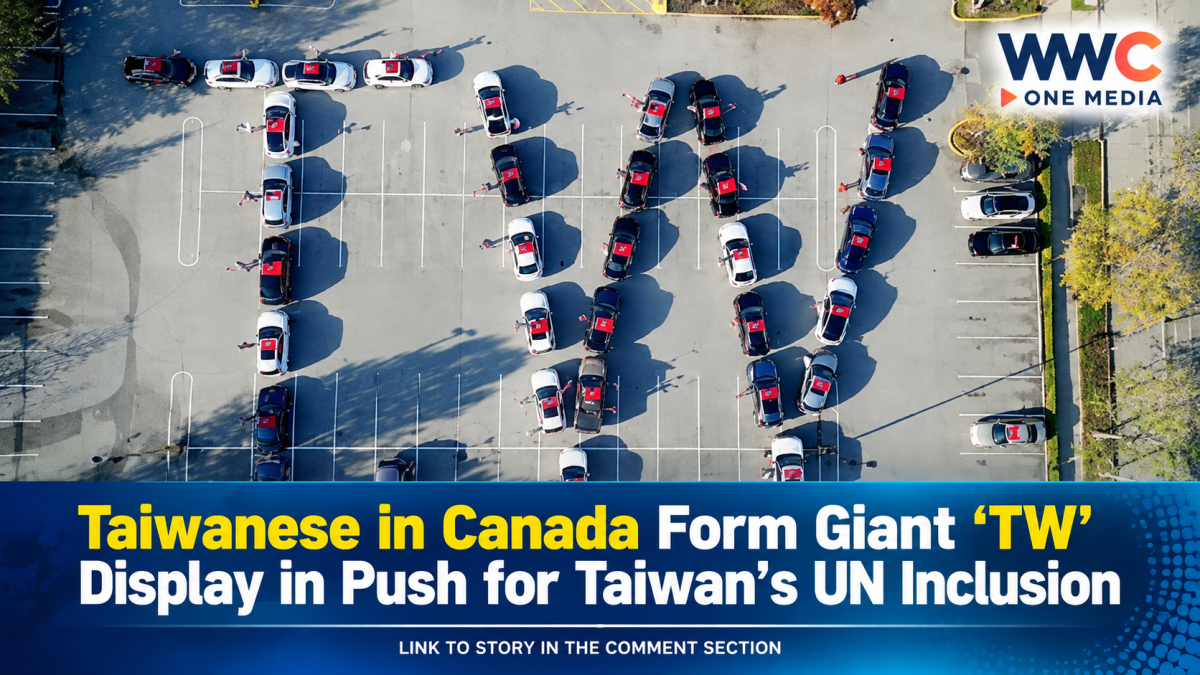
VANCOUVER, Canada — Taiwanese community members in Canada have taken their campaign for Taiwan’s international inclusion to a new level, using dozens of vehicles to create a massive “TW” formation visible from the air ahead of the upcoming session of the United Nations General Assembly.
A total of 45 vehicles gathered near Vancouver to spell out the letters “TW” as part of this year’s “UN for Taiwan” campaign, a grassroots effort calling for greater international participation for Taiwan.
Each vehicle displayed the flag of the Republic of China (ROC), while participants wore Taiwan-themed clothing, waved flags and held signs carrying the message: “Chip in with Taiwan.”
45 Cars, One Powerful Message: Taiwan Wants a Bigger Global Role
The unusual aerial display was organized by members of the Taiwanese community in Greater Vancouver as supporters sought to draw international attention to Taiwan’s limited participation in the United Nations system.
Organizers said the event was designed to demonstrate that distance has not weakened the overseas Taiwanese community’s connection to Taiwan.
Event organizer Chang Chien-hung said vehicles participating in the rally featured custom license plates with references including “TAIWAN,” “TAIPEI,” “NEW TPE” and “TW88.”
“Although we are in Canada, our hearts are always with Taiwan,” Chang said, expressing support for Taiwan’s inclusion in the UN system.
Taiwan’s Semiconductor Power Takes Center Stage
The campaign also connected Taiwan’s push for international participation with its increasingly important role in the global technology industry.
Liu Yung-chiang, co-chair of the Metro Vancouver Overseas Taiwanese Society, said Taiwan’s semiconductor industry plays a critical role in supporting the global economy and the rapid growth of artificial intelligence.
Taiwan is home to some of the world’s most important semiconductor companies and manufacturing capabilities, making the island central to global supply chains.
At the same time, Taiwan has been seeking to strengthen international partnerships through what officials and industry leaders increasingly describe as technology and semiconductor diplomacy.
Recent reporting from Reuters highlighted Taiwan’s efforts to leverage its role in the global AI and semiconductor industry to strengthen ties with international partners, even as it faces diplomatic pressure from Beijing.
Why Taiwan Is Not a UN Member
Taiwan’s status in the United Nations remains one of the most politically sensitive issues surrounding its international position.
The People’s Republic of China holds China’s seat at the United Nations and opposes Taiwan’s participation in organizations that Beijing considers limited to sovereign states.
Beijing claims Taiwan as part of its territory and opposes any international activity it believes could suggest Taiwan is a separate sovereign state.
Taiwan’s government rejects Beijing’s sovereignty claims and argues that the island’s democratically elected government represents its people.
The disagreement has left Taiwan with limited participation in many international organizations, despite Taiwan maintaining extensive economic, cultural and unofficial relationships with countries around the world.
Overseas Taiwanese Communities Keep Pressure on International Institutions
The Vancouver campaign demonstrates the increasingly visible role overseas Taiwanese communities are playing in efforts to expand Taiwan’s international space.
From North America and Europe to countries across the Asia-Pacific region, Taiwanese organizations have continued to organize campaigns calling for Taiwan’s participation in international bodies.
Supporters argue that Taiwan’s exclusion can affect global cooperation in areas such as:
- Public health
- Aviation safety
- Climate change
- Technology
- Artificial intelligence
- Semiconductor supply chains
- Disaster response
- International security
The campaign’s slogan, “Chip in with Taiwan,” also reflects Taiwan’s growing use of its semiconductor expertise as a symbol of its contribution to the international community.
Taiwan Faces Growing Diplomatic Pressure From China
The campaign comes as Taiwan faces continued diplomatic and political pressure from Beijing.
China has intensified efforts to limit Taiwan’s participation in international forums and has also expanded its diplomatic influence around the world.
Taiwanese officials have accused Beijing of attempting to shrink Taiwan’s international space through political and diplomatic pressure.
The issue was highlighted again during the recent Pacific Islands Forum in Palau, where Taiwan’s Foreign Minister Lin Chia-lung accused China of using aggressive diplomatic tactics and attempting to undermine Taiwan’s participation and regional unity. China rejected the allegations.
Taiwan Turns Technology Into Diplomacy
Taiwan’s importance to the global technology industry is becoming an increasingly significant part of its international strategy.
The island remains a major center for advanced semiconductor manufacturing, with Taiwanese companies playing key roles in supplying chips used in smartphones, artificial intelligence systems, data centers, automobiles and advanced defense technology.
Taiwanese leaders have increasingly emphasized that the island wants to use its technological strengths to build partnerships rather than political confrontation.
At recent international semiconductor events, Taiwanese officials and industry representatives highlighted the country’s role as a reliable technology partner for democratic economies and global supply chains.
A Symbolic Campaign With a Global Message
The giant “TW” formation in Canada may have lasted only a short time, but its message is part of a much larger debate over Taiwan’s future role in the international community.
For the participants gathered near Vancouver, the campaign was not simply about Taiwan’s membership in the United Nations.
It was also about visibility.
Taiwan has become one of the world’s most strategically important technology centers while remaining diplomatically isolated from many international institutions.
That contradiction continues to drive campaigns by Taiwanese communities around the world.
What Happens Next?
As the 81st session of the UN General Assembly begins, Taiwan’s supporters are expected to continue calling for greater international participation and engagement.
However, any major change to Taiwan’s formal UN status would face enormous political obstacles because of China’s position as a permanent member of the UN Security Council and Beijing’s longstanding opposition to Taiwan’s separate international representation.
For now, Taiwan’s overseas communities are focusing on keeping the issue visible.
And in a Vancouver parking lot, 45 vehicles spelling out two simple letters — “TW” — delivered a message that organizers hope the world will not ignore.
Taiwan may have limited space at some of the world’s biggest international institutions, but its supporters are determined to make sure its voice is still seen — from the ground and even from the sky.
WWC ONE MEDIA J.M.D



Leave a Reply