
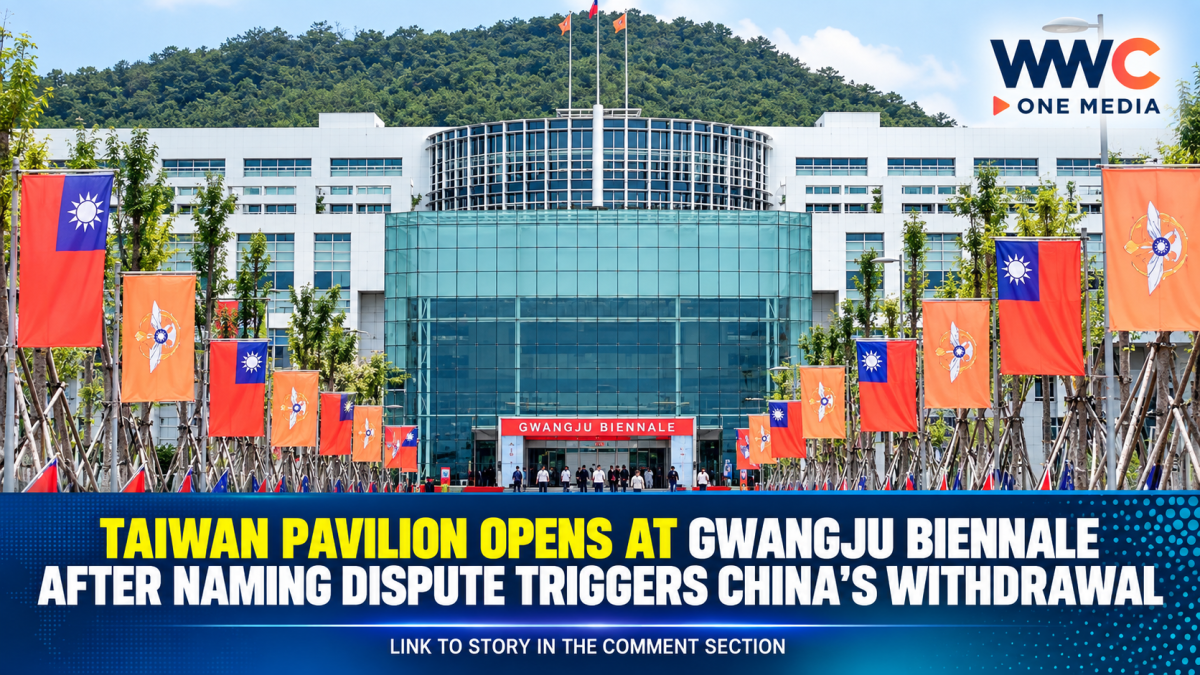
GWANGJU, South Korea — Taiwan’s artists and curators have celebrated the opening of the “Taiwan Pavilion” at the prestigious Gwangju Biennale after a tense naming dispute sparked accusations of political censorship and ultimately led China’s curatorial team to withdraw from the event.
The controversy centered on whether Taiwan’s exhibition space could officially use the name “Taiwan Pavilion.”
After weeks of negotiations, pressure from artists and growing support from the local and international art community, organizers restored the name — marking a major victory for Taiwan’s cultural representatives.
But the decision came at a cost.
China’s curatorial team later announced that it would withdraw from the Pavilion Project, objecting to Taiwan’s participation under a name Beijing said was inconsistent with its political position.
Taiwan Pavilion Finally Opens After Weeks of Controversy
Taiwanese artists and curators welcomed the opening on Saturday after what officials described as an exhausting battle to ensure the exhibition could appear under the name “Taiwan Pavilion.”
Chen Kuang-yi, director of Taiwan’s National Taiwan Museum of Fine Arts, which curated the pavilion, said the process involved constant discussions with the Gwangju Biennale Foundation.
She said new problems and possible solutions appeared almost every day, with numerous letters exchanged between Taiwan’s museum and the event organizers.
The foundation had initially promoted the exhibition as “The NTMoFA Pavilion,” using the acronym for the National Taiwan Museum of Fine Arts instead of the name “Taiwan Pavilion.”
The decision triggered criticism from Taiwanese artists and government officials, who argued that removing Taiwan’s name amounted to political censorship.
On Aug. 26, the Gwangju Biennale Foundation agreed to allow the exhibition to officially use “Taiwan Pavilion.”
Artists Unite: ‘Give Us Our Name Back’
Taiwanese artists involved in the exhibition said the controversy brought them together.
Artist Chen Ting-ting said she believed the final decision was strongly influenced by support from people in Gwangju and artists from around the world.
Another artist, Su Hui-yu, was reportedly the first Taiwanese artist to notice that the words “Taiwan Pavilion” had disappeared from promotional materials.
He said Taiwan’s participating artists stood together and made their position clear:
If the pavilion could not use its proper name, they would rather not participate.
For the artists, the eventual restoration of the name became about more than branding.
It became a test of artistic freedom and whether cultural institutions could resist political pressure.
Su described the experience as a powerful reminder of the influence art can have beyond borders and politics.
China Withdraws From the Biennale Project
The naming dispute took an even more dramatic turn last week.
China’s curatorial team announced that it would withdraw from the Pavilion Project, according to Chinese state media.
The Chinese side objected to Taiwan’s participation under the name “Taiwan Pavilion,” referring instead to Taiwan as a region of China and arguing that the designation did not match Beijing’s political position.
The Gwangju Biennale Foundation responded by saying it had followed its administrative procedures and designation standards.
The foundation also expressed hope that China’s pavilion could eventually resume participation.
The withdrawal highlighted how disputes over Taiwan’s name and international representation continue to extend beyond diplomacy and politics — reaching global cultural events, sporting organizations, academic institutions and international forums.
Why the Name ‘Taiwan’ Remains Politically Sensitive
The dispute reflects one of the most sensitive issues in Taiwan’s international relations.
China claims Taiwan as part of its territory and strongly opposes language or participation that Beijing believes could imply Taiwan is a separate sovereign state.
Taiwan’s democratically elected government rejects Beijing’s sovereignty claims and maintains that Taiwan’s future must be decided by its people.
The disagreement frequently creates disputes over Taiwan’s name at international events.
Taiwan has faced restrictions on its official name and participation in a wide range of organizations and events.
The Gwangju Biennale controversy shows that these disputes can now emerge even within the international art world.
Art Meets Politics at One of Asia’s Biggest Cultural Events
The Gwangju Biennale is one of Asia’s most important contemporary art events and attracts artists, curators and visitors from around the world.
This year’s Pavilion Project was intended to provide an international platform for cultural exchange.
Instead, the Taiwan naming controversy transformed part of the event into a broader debate about political influence, identity and artistic freedom.
For Taiwan’s artists, the ability to exhibit under the name “Taiwan Pavilion” became a symbolic victory.
For China, the same designation represented an unacceptable political issue.
The result was an unusual cultural standoff in which the dispute over a name became as significant as the art itself.
Taiwan’s Cultural Presence Gains International Attention
The controversy comes as Taiwan seeks to expand its international presence not only through diplomacy and trade, but also through technology, culture and people-to-people exchanges.
Taiwan has increasingly promoted its democratic values and cultural identity internationally while facing diplomatic pressure from Beijing.
The country’s technology industry has also become an important part of this broader international strategy.
Taiwan recently emphasized its importance as a reliable technology and semiconductor partner for democratic economies, particularly as artificial intelligence drives growing global demand for advanced chips.
That growing global importance has created a striking contrast:
Taiwan plays a critical role in the world’s technology supply chains, yet its name and international representation remain subjects of intense political disputes.
A Victory Beyond the Exhibition
For Taiwan’s curators and artists, the opening of the pavilion was about more than a successful exhibition.
It represented the result of weeks of resistance, negotiation and solidarity.
Chen Kuang-yi said she was delighted that the exhibition could finally open properly after the effort to resolve the naming dispute through official channels.
The support from artists and the local community in Gwangju also played an important role in the final outcome.
The message from Taiwan’s participating artists was clear:
Art should be able to cross borders — even when politics attempts to define them.
What Happens Next?
The Gwangju Biennale is scheduled to continue through Nov. 15, giving Taiwan’s artists an opportunity to showcase their work to an international audience under the restored “Taiwan Pavilion” name.
It remains unclear whether China’s curatorial team will return to the Pavilion Project.
However, the controversy has already become a significant example of how political tensions surrounding Taiwan can influence cultural institutions far beyond the Taiwan Strait.
For Taiwan’s artists, the pavilion’s opening represents a victory.
For the international art community, it raises a larger question:
Should political pressure determine how artists, cultures and communities are identified on the global stage?
WWC ONE MEDIA J.M.D




Leave a Reply