
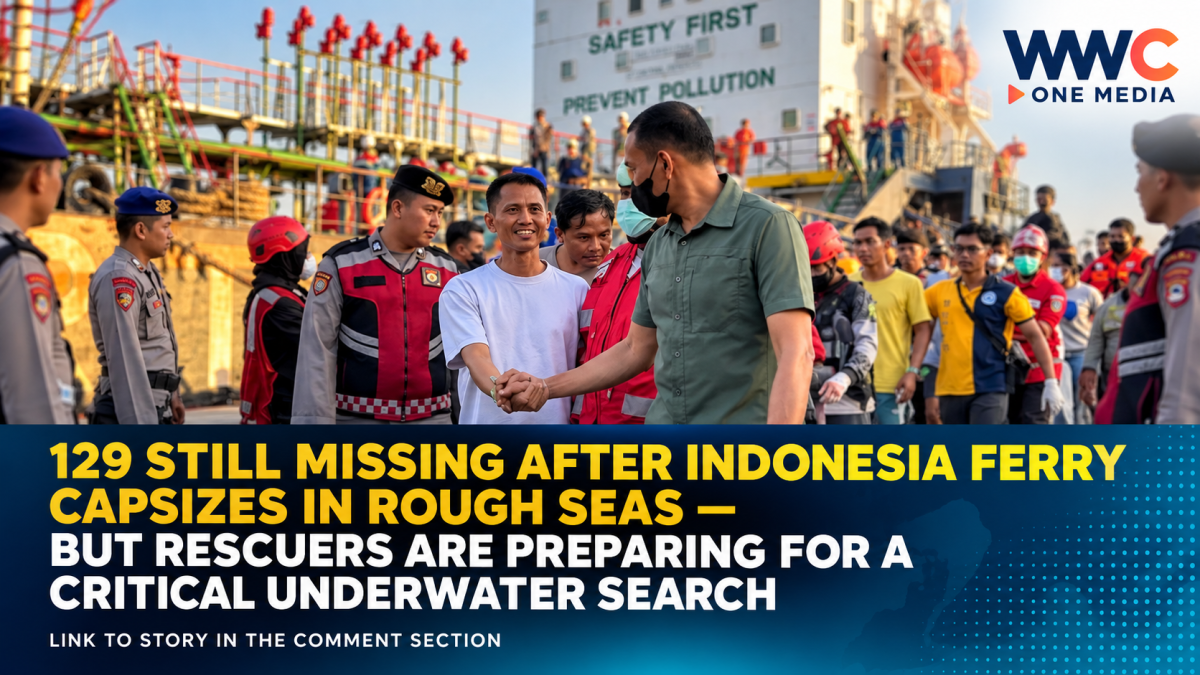
BANJARMASIN, Indonesia — Indonesia has intensified a massive search-and-rescue operation for 129 people still missing after the passenger ferry Virgo Transport 8 capsized in the Java Sea, with dangerous sea conditions preventing rescuers from fully searching the vessel.
The ferry, carrying 243 people, was traveling from Surabaya in East Java to Banjarmasin in South Kalimantan when it encountered severe weather early Sunday, September 13. Authorities said the vessel began listing before losing contact with its operator and later capsizing in the waters around Masalembo.
As of Tuesday, authorities had confirmed six deaths and 108 survivors, leaving 129 people still unaccounted for. The figures have remained the focus of a rapidly expanding rescue operation involving Indonesian naval, maritime, police and search-and-rescue personnel.
Rough seas are now the biggest obstacle
Rescuers are facing another major challenge: the weather.
Reuters reported Tuesday that waves in the search area were still around 1.75 to 2.5 metres high, preventing divers from safely beginning an underwater operation. Authorities are currently concentrating on searches from the air and sea surface while waiting for conditions to improve.
The Indonesian authorities are preparing specialized equipment for the next phase of the operation, including Navy divers, underwater drones, a multibeam echo-sounder and remotely operated vehicles.
The ferry is believed to be lying at a depth of approximately 30 metres, making an underwater search particularly dangerous. Officials have warned that rescuers could face risks from the vessel’s unstable structure, trapped air and sudden changes in pressure.
More than 1,000 personnel join the operation
The scale of the operation has grown significantly.
Reuters reported that about 1,100 personnel, 10 aircraft and helicopters, and 17 ships were involved in Tuesday’s search. Earlier operations had already involved more than 600 rescuers and multiple naval vessels.
Indonesia’s Navy has also prepared the KRI Canopus for the underwater phase, while specialized teams including Navy divers and Basarnas personnel are being positioned to enter the wreck when conditions become safe enough.
Authorities have also expanded the search area. Basarnas said its second-day operation covered a large area around the accident site and was divided into six sectors to coordinate air and sea searches more efficiently.
What caused the ferry to capsize?
The precise cause remains under investigation.
Initial accounts indicate that strong waves struck the vessel’s starboard side, causing it to list heavily before it overturned. Survivors and rescue officials described difficult sea conditions, with waves reaching around three metres at the height of the incident.
There had also been speculation that the ferry may have been overloaded.
Indonesia’s Transportation Minister Dudy Purwagandhi, however, said the vessel was carrying 243 people and was operating below its stated passenger capacity of 500. He said investigators would determine the actual cause of the accident.
That means overloading has not been established as the cause of the disaster.
The ferry was carrying vehicles as well as passengers
The Virgo Transport 8 was a roll-on/roll-off passenger vessel and was carrying 89 vehicles when the accident occurred, according to Indonesian reports.
The ship had departed Surabaya before heading toward Banjarmasin. Indonesian authorities said it had been operating below its passenger capacity when it encountered the dangerous weather.
Reports from Indonesian media also indicate that the vessel was built in Japan in 1987, making it nearly four decades old at the time of the accident.
Families wait for answers
While rescue crews continue searching at sea, families of passengers have gathered at ports in Banjarmasin awaiting information about their relatives.
The disaster has again highlighted Indonesia’s dependence on maritime transportation. With thousands of islands spread across the archipelago, ferries remain an important and affordable way for people and goods to travel between communities. But repeated maritime accidents have also raised continuing questions about vessel safety and enforcement.
For now, rescuers are racing against time and weather.
The immediate priority is to determine whether anyone remains trapped inside or around the overturned ferry and to recover those still missing. But with rough seas delaying the underwater operation, the next window of calmer weather could become the most critical moment yet in the search for the 129 people who remain unaccounted for.
Latest confirmed figures: 243 people aboard | 108 rescued | 6 dead | 129 missing.



Leave a Reply