
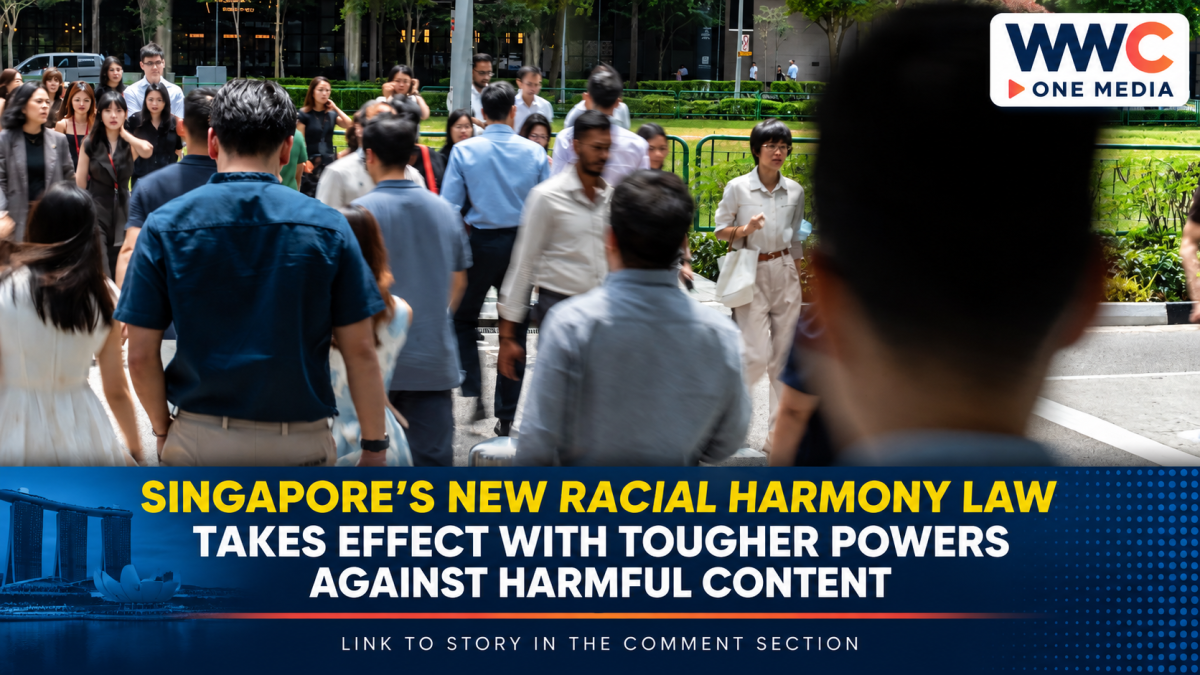
Singapore’s new Maintenance of Racial Harmony Act takes effect on Sept. 15, giving the government stronger powers to respond to content and activities that could threaten racial harmony in the multiracial city-state.
The legislation, passed unanimously by Parliament in February 2025, creates a dedicated legal framework for protecting racial harmony and introduces new measures covering online content, foreign influence and organisations representing racial communities.
The law also establishes a new Presidential Council for Racial and Religious Harmony, which begins its first three-year term on the same day.
New powers to restrict inflammatory racial content
One of the most significant changes is the introduction of racial content restraining orders.
The Minister for Home Affairs can issue an order against a person who communicates, produces or distributes content that prejudices the maintenance of racial harmony.
Once served, the order takes immediate effect.
Depending on the circumstances, a restraining order can prohibit a person from communicating or distributing specified material, require content to be removed from public access in Singapore, or restrict the person from addressing a particular audience about a specified subject.
It can also prevent an individual from printing, editing or contributing to a specified publication, or from holding an editorial position in one.
Failure to comply with a restraining order is an offence.
The government has argued that such powers are necessary because inflammatory racial material can spread rapidly online and cause damage to social cohesion before conventional enforcement measures can take effect.
President gets a role in reviewing restraining orders
The new system also introduces constitutional safeguards involving the President.
Racial restraining orders will be considered by the new Presidential Council for Racial and Religious Harmony, which will make recommendations to the President.
If the council’s recommendation differs from the Cabinet’s advice, the President will have discretion to confirm, cancel or vary the order.
This mechanism is intended to provide an additional layer of review when the government’s powers are used to address threats to racial harmony.
New council replaces religious harmony body
The Presidential Council for Racial and Religious Harmony replaces the existing Presidential Council for Religious Harmony.
Its members will include representatives from Singapore’s major racial and religious communities, as well as people with experience in public service and community relations.
Retired Supreme Court judge Choo Han Teck has been appointed chairman.
The council will consider restraining orders made under both the new racial-harmony law and the existing Maintenance of Religious Harmony Act.
It can also consider issues affecting racial or religious harmony that are referred to it by the Minister for Home Affairs or Parliament.
New offences cover racial insults and calls for violence
The Act also updates Singapore’s existing legal provisions dealing with race-related offences.
Certain provisions under the Penal Code will be replaced by new offences under the Maintenance of Racial Harmony Act.
The legislation covers conduct that incites enmity, hatred, ill-will or hostility against a racial group.
It also addresses conduct that insults, vilifies, denigrates, threatens or abuses another person because of race.
Urging violence against a racial group or on the basis of race will also be an offence.
The law contains certain defences, including provisions covering private or domestic conduct and circumstances where matters are raised in good faith to bring about their removal.
Some offenders may be given a chance to make amends
The Act introduces a Community Remedial Initiative for certain less serious cases.
Instead of automatically proceeding with criminal prosecution, authorities may allow an individual involved in conduct prejudicial to racial harmony to participate in a programme aimed at repairing the harm caused.
Successful completion can be taken into account when prosecutors decide whether formal proceedings should be initiated.
The programme is not intended for serious cases, including conduct involving incitement to violence or behaviour that severely undermines social cohesion.
Such cases can still be pursued through criminal prosecution.
Government moves to guard against foreign influence
Another major component of the legislation concerns foreign influence.
The government can designate certain race-based organisations and require them to disclose information relating to foreign and anonymous donations, foreign affiliations and their leadership.
The Minister for Home Affairs can also impose additional restrictions, including orders preventing designated entities from accepting certain foreign or anonymous donations.
The government says these measures are intended to prevent foreign actors from using community organisations to influence Singapore’s domestic affairs or undermine racial harmony.
Authorities will engage affected organisations before designating them and provide guidance on their reporting obligations.
The first reporting obligation for designated race-based entities is scheduled for April 2028.
Why Singapore is tightening its racial-harmony laws
Singapore has long regarded racial and religious harmony as a fundamental part of its national stability.
The country is home to Chinese, Malay, Indian and other ethnic communities, alongside followers of multiple major religions.
Past episodes of communal violence have shaped Singapore’s approach to race and religion, with successive governments maintaining that tensions must be addressed before they escalate.
The rise of social media has added another dimension to the challenge.
A provocative post, video or statement can now reach thousands or even millions of people within hours, potentially turning an isolated incident into a wider source of tension.
The new legislation is therefore designed to give authorities tools to intervene earlier.
A broader framework for social cohesion
The Maintenance of Racial Harmony Act represents a significant expansion of Singapore’s legal framework.
Previously, specific legislation focused heavily on religious harmony, while race-related offences were dealt with through other parts of the law.
The new Act brings racial harmony under a dedicated framework and introduces a combination of preventive powers, criminal offences, community-based remedies and safeguards against foreign influence.
At the same time, the government says legislation alone cannot maintain harmony.
Community engagement, trust between different groups and efforts to strengthen understanding across racial and religious lines remain central to Singapore’s approach.
With the new law now in force, the focus will turn to how these expanded powers are used and how Singapore balances rapid intervention against racial tensions with the need for careful and proportionate enforcement.




Leave a Reply