
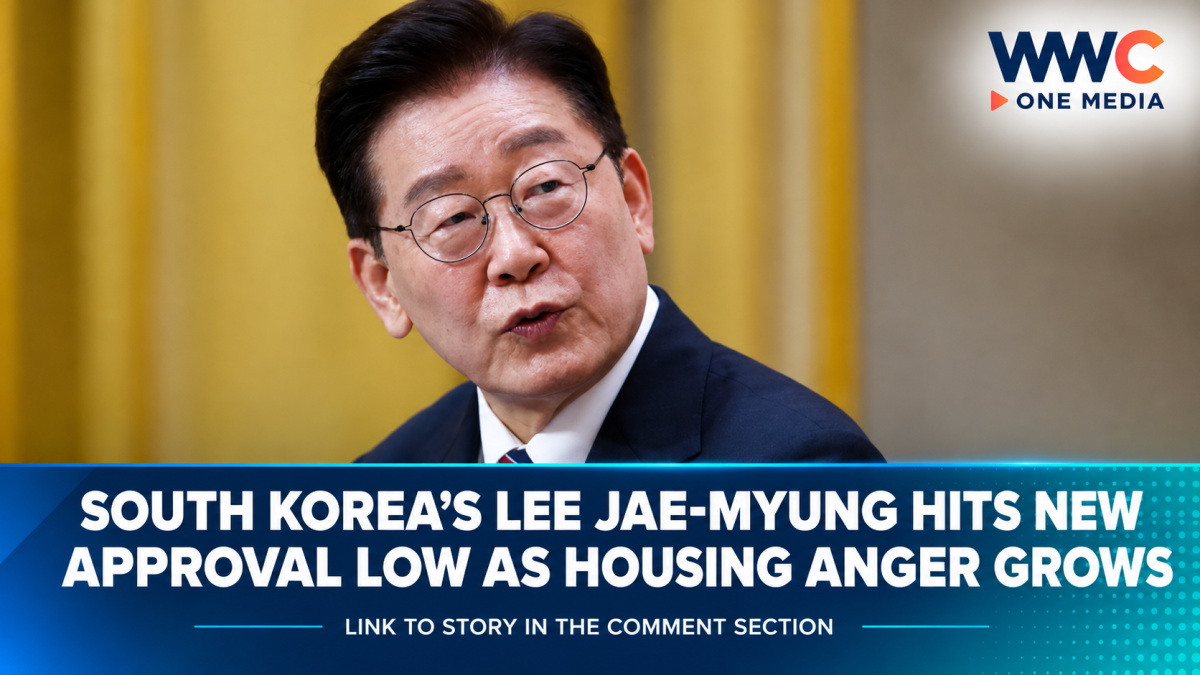
South Korean President Lee Jae-myung’s approval rating has fallen to a new low, with growing public frustration over housing policies emerging as one of the biggest challenges facing his government.
A Realmeter survey released on Sept 14 found that only 33.8 per cent of respondents approved of Lee’s performance, while 63.3 per cent disapproved.
The result marks a sharp deterioration in support as Lee enters the second year of his five-year presidency.
Housing becomes a major political headache
Housing policy has emerged as one of the main sources of dissatisfaction with Lee’s administration.
The government has introduced tougher measures aimed at curbing property speculation, including higher taxes and stricter borrowing requirements.
But the policies have also fuelled criticism from people who say they have made it harder for ordinary households to buy homes, particularly in Seoul and other expensive urban areas.
The government is now facing the difficult task of trying to cool speculative demand without further worsening affordability for people who are already struggling to enter the housing market.
Seoul property prices remain a sensitive issue
Housing is particularly politically sensitive in South Korea because property ownership has long been closely linked to household wealth and financial security.
Seoul’s limited supply and high demand have contributed to elevated housing prices, making home ownership increasingly difficult for younger Koreans and middle-income families.
Attempts to restrict borrowing and speculative purchases can slow price growth, but they can also reduce the ability of legitimate buyers to secure financing.
That tension has become increasingly visible as Lee’s administration attempts to stabilise the property market.
Yongsan development adds to controversy
Another source of public debate is the government’s plans for a large-scale development project in Seoul’s Yongsan district.
The project involves about 2,800 acres of land and includes plans for a major green space described as a potential “Central Park for Korea”.
The development has created a political dilemma for the government.
On one hand, increasing housing supply is seen as essential to improving affordability. On the other, plans to build on or redevelop valuable land have raised concerns about preserving green space and ensuring that development benefits the wider public.
The debate has added to broader frustration over how the government is handling Seoul’s housing crisis.
Cabinet controversies deepen pressure
Housing is not the only issue weighing on Lee’s approval ratings.
Controversies surrounding government appointments have also contributed to the decline.
A nominee for gender equality minister withdrew from consideration, while the nominee for justice minister faced allegations involving ethical violations.
The controversies have added to concerns about the government’s personnel choices and provided additional ammunition for political opponents.
The combination of housing dissatisfaction and cabinet controversies has therefore created a difficult political environment for Lee as he enters the second year of his presidency.
Lee says results matter more than approval ratings
Lee has previously indicated that he is less concerned about short-term approval numbers than the eventual results of his presidency.
He has argued that what ultimately matters is where his administration stands at the end of its five-year term.
That approach gives the president room to continue unpopular policies if he believes they will eventually produce better economic and social outcomes.
But sustained declines in public support can make it harder for a government to build consensus around difficult reforms.
Government promises to listen
The presidential office has acknowledged the growing public dissatisfaction and said it is taking citizens’ concerns seriously.
Officials have emphasised the need to listen more closely to voters and address the problems driving frustration.
Housing is likely to remain a central priority because dissatisfaction over property prices affects a wide range of voters, from young adults struggling to purchase their first homes to existing homeowners concerned about taxes and market uncertainty.
A difficult road ahead
Lee’s declining approval rating comes at a challenging moment for his administration.
His government must simultaneously manage housing affordability, economic growth, household debt and political controversies while trying to maintain public confidence.
The housing issue is particularly difficult because there is no simple solution.
Measures that restrict speculation can help contain prices but may also create new problems for genuine buyers. Meanwhile, increasing supply can take years to have a meaningful effect and can trigger opposition over land use and development.
For Lee, the political challenge is now to convince South Koreans that his housing policies will eventually make homes more accessible rather than simply impose additional restrictions.
With approval falling to 33.8 per cent and disapproval exceeding 60 per cent, the pressure on the president to deliver visible results is growing rapidly.




Leave a Reply