
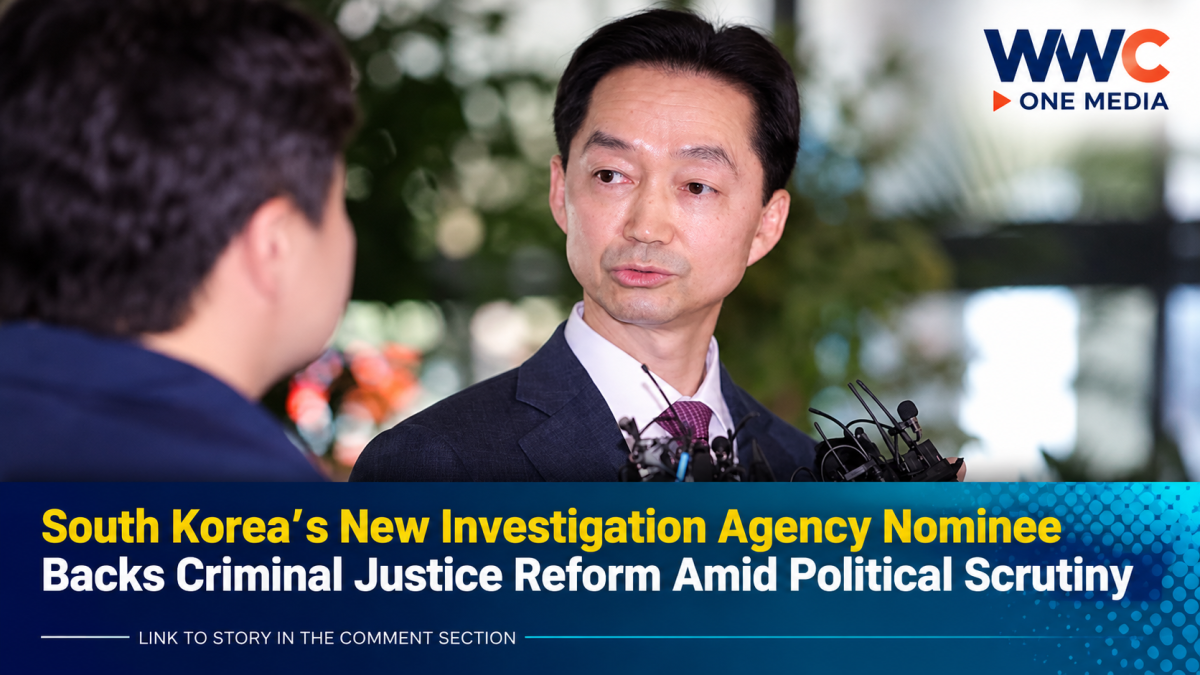
SEOUL — Kim Ji-yong, the nominee to become the first chief of South Korea’s planned Serious Crimes Investigation Agency (SCIA), has publicly endorsed the country’s sweeping criminal justice overhaul, despite facing political scrutiny over his previous views on prosecution reform.
Speaking to reporters on September 14, Kim said he supports the fundamental principle of separating criminal investigations from prosecutions, a central feature of the new system scheduled to take effect next month.
Kim, a former senior prosecutor, was nominated by President Lee Jae Myung last week to lead the new agency, which is scheduled to launch on October 2.
Kim addresses past opposition to prosecution reform
Kim’s nomination has sparked controversy because of his previous position on efforts to strip prosecutors of their investigative powers.
Some members of the ruling Democratic Party and the minor Rebuilding Korea Party have questioned whether Kim is the right person to lead an agency created as part of the very reforms he previously criticized.
Kim defended his earlier position, saying his support for allowing prosecutors to conduct supplementary investigations was motivated by concerns about protecting crime victims, rather than by an attempt to preserve the prosecution’s institutional power.
He also said he recognizes that the National Assembly has now amended the Criminal Procedure Act through a democratic legislative process and that the priority should be making the new system work effectively.
“I fully endorse the fundamental principle of criminal justice reform, which is the separation of investigation and prosecution,” Kim said, according to Yonhap.
A major overhaul begins October 2
Kim’s nomination comes as South Korea prepares for one of the biggest changes to its criminal justice system in decades.
Under the revised Criminal Procedure Act, prosecutors will lose their existing investigative powers, with investigative authority transferred largely to other agencies. The SCIA is being established to handle major criminal investigations under the new structure.
The agency is expected to investigate major offenses across seven broad categories, including corruption, economic crimes, defense-acquisition crimes, drug offenses, crimes involving national security, cybercrime and offenses involving the distortion of the law.
The government has described the restructuring as a way to create a clearer separation between investigation and prosecution.
Kim faces a difficult first test
If appointed, Kim will inherit an agency that is still being built from the ground up.
Reports indicate that the SCIA faces significant challenges involving staffing, organization and investigative infrastructure before its October launch. Asia Business Daily reported that the agency has 2,874 authorized positions, while more than 1,000 positions still need to be filled through recruitment from police, lawyers and other outside professionals.
The agency must also integrate personnel from different professional backgrounds and establish new procedures for handling serious criminal cases.
That makes organizational stability one of Kim’s biggest immediate challenges.
President Lee orders additional scrutiny
The political controversy surrounding Kim has also prompted additional scrutiny from the presidential office.
Yonhap reported that President Lee has instructed officials to conduct an additional review of Kim’s nomination, with the president seeking further verification of relevant facts.
Kim has rejected suggestions that he was politically aligned with a particular faction during his prosecutorial career.
He said he was demoted during the first round of prosecution appointments after the Yoon Suk Yeol administration took office and retired from the prosecution service in September 2023. He also denied receiving special benefits because of political connections.
The bigger question: Can the new system avoid an investigative gap?
The SCIA is being created at a particularly sensitive moment.
Supporters of the reform argue that separating investigative and prosecutorial powers can strengthen checks and balances and reduce the concentration of authority within the prosecution.
Critics, however, have raised concerns about whether the new agency will be adequately staffed and equipped when it begins operating.
A recent Korea Herald editorial, republished by Yonhap, highlighted staffing shortages and concerns about investigative equipment and organizational readiness ahead of the October launch.
That means Kim’s potential appointment will be judged on more than his position on prosecution reform.
He will also face the practical challenge of proving that the new agency can investigate serious crimes effectively while maintaining fairness, neutrality and procedural justice.
Kim has previously said those principles are essential to the agency’s credibility.
A pivotal moment for South Korea’s justice system
Kim Ji-yong now stands at the center of a dramatic transition in South Korea’s criminal justice system.
His nomination represents an unusual twist: a former senior prosecutor could become the first leader of an agency created to operate under a system that significantly reduces the investigative role of prosecutors.
For Kim, publicly embracing the separation of investigations and prosecutions may be an effort to demonstrate that he is prepared to lead the new system rather than defend the old one.
But his confirmation process—and the agency’s ability to launch successfully on October 2—could determine whether South Korea’s ambitious criminal justice overhaul gains public confidence or faces deeper political and operational challenges




Leave a Reply