
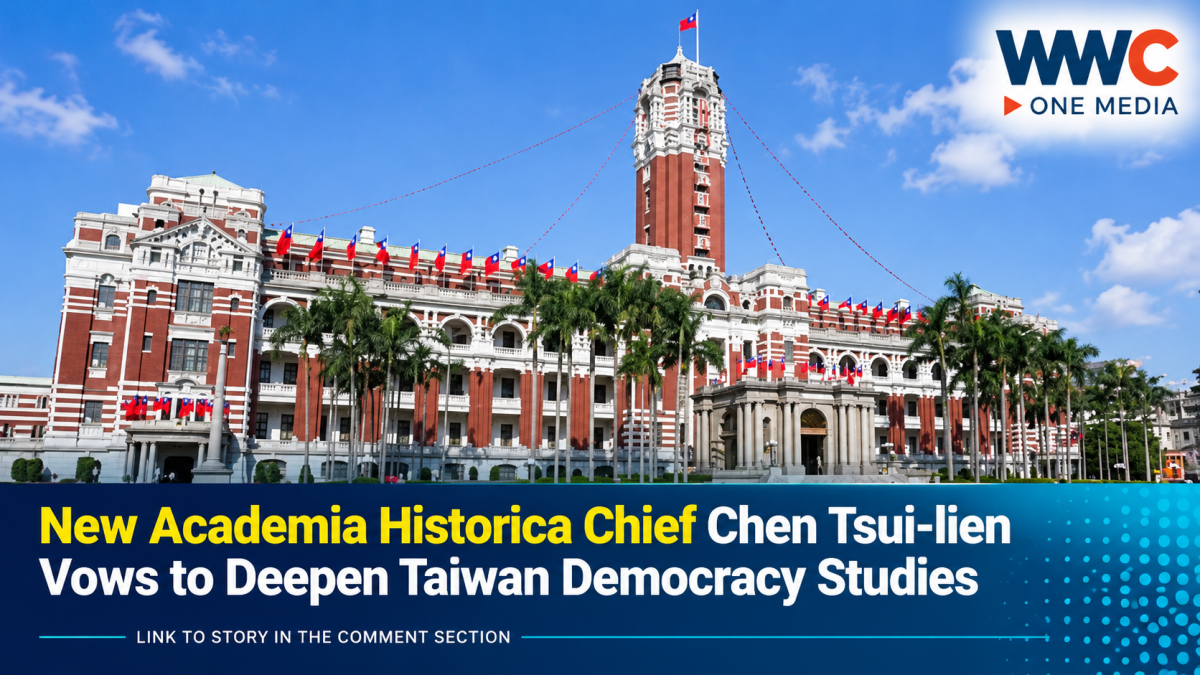
TAIPEI — Taiwan’s newly appointed Academia Historica director Chen Tsui-lien has pledged to deepen research into the island’s democratization, authoritarian past and difficult historical issues, saying a clearer understanding of history is essential to protecting Taiwan’s democratic system.
Chen formally took office on September 14, succeeding Chen Yi-shen, and immediately outlined historical research and public understanding of Taiwan’s democratic development as major priorities for her tenure.
The historian said her work will include a closer examination of authoritarian and dictatorial rule, including how such systems affected Taiwanese society. She said the goal is not simply to revisit the past but to help people understand the difficult struggle for democracy and freedom and appreciate the institutions established through that process.
Chen warns against distortion of Taiwan’s political history
Chen also raised concerns about what she described as increasingly serious conceptual distortions in political and media discourse.
According to CNA, she argued that elected governments operating under checks and balances have at times been labeled “authoritarian” or “dictatorial” in ways she believes can blur the meaning of those terms and potentially weaken public confidence in democracy.
Her comments come as Taiwan continues to debate its political identity, democratic institutions and the legacy of decades of authoritarian rule.
Chen said that accurately remembering and explaining history is therefore important to maintaining public understanding of democratic values.
Who is Chen Tsui-lien?
Chen is a longtime scholar of Taiwan’s political history and a distinguished professor at National Taiwan University.
Before taking over Academia Historica, she taught and researched Taiwan’s political history and participated in work related to transitional justice. Taiwan’s Presidential Office said she had also served as an adviser to Academia Historica, the National Human Rights Museum and the management committee for the Transitional Justice Commission’s related fund.
She holds a doctorate in political science from National Taiwan University and has spent decades studying Taiwan’s political development.
Chen previously worked in journalism before entering academia, giving her experience both in historical research and in observing Taiwan’s political and constitutional development.
Archives could reshape how Taiwan understands its past
One of the major challenges facing Academia Historica is how to handle the growing body of documents from Taiwan’s authoritarian era.
Chen said the increasing availability of political surveillance and other historical archives has opened new opportunities for research. But she cautioned that simply releasing documents without sufficient historical analysis and context could create new misunderstandings.
She argued that archives need to be carefully researched and contextualized so that the legacy of authoritarian-era intelligence organizations does not continue to divide society.
That approach places historical archives at the center of a broader debate over transitional justice, democratic memory and national identity.
Outgoing chief stresses the battle over historical truth
The leadership transition also comes with a warning from Chen’s predecessor, Chen Yi-shen.
Speaking at the handover ceremony, the outgoing director said Taiwan needs to establish a historical understanding grounded in evidence and universal democratic values in order to counter what he described as cognitive warfare from Beijing.
Chen Yi-shen, who led Academia Historica from 2019 until September 2026, highlighted the growing availability of documents concerning Taiwan’s political persecution and the White Terror period. He also advocated establishing libraries or dedicated archival systems for Taiwan’s former presidents so that their historical records can be preserved and studied systematically.
His comments underline the increasingly strategic role that historical research plays in Taiwan’s public debate.
A new chapter for Taiwan’s national archives
Academia Historica, Taiwan’s national historical research institution, was originally established in Nanjing in 1947 and reopened in Taiwan in 1957. Its responsibilities include preserving, compiling and researching important historical records concerning the Republic of China and Taiwan.
The institution has increasingly dealt with records related to Taiwan’s authoritarian period, political persecution and democratization.
That mission is particularly significant in 2026, three decades after Taiwan held its first direct presidential election in 1996, a landmark event in the island’s transition to democracy.
For Chen Tsui-lien, the challenge now goes beyond preserving old documents.
It is about determining how Taiwan’s history is researched, explained and remembered—and whether that history can help bridge the political divisions that continue to shape Taiwanese society.
Her appointment therefore arrives at a moment when Taiwan’s past is becoming increasingly central to arguments about its democratic future.



Leave a Reply