
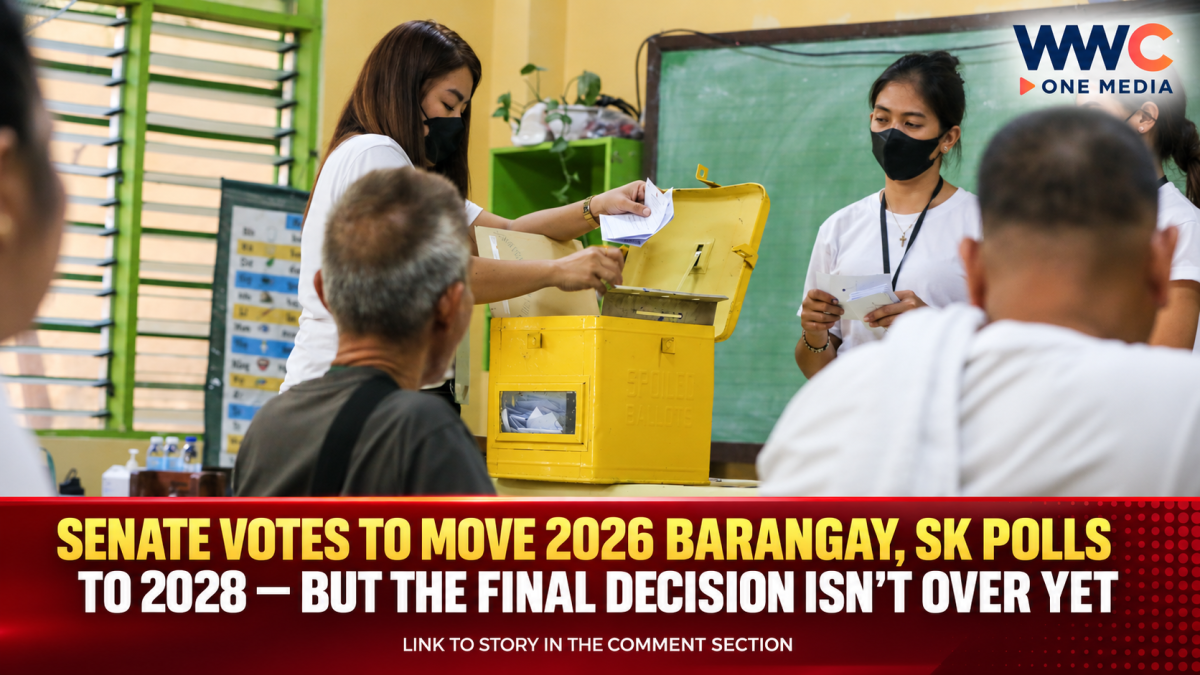
MANILA, Philippines — The Senate has approved a measure that could push the country’s next Barangay and Sangguniang Kabataan (SK) elections from November 2026 to 2028, while also extending the term of incumbent barangay and SK officials from four years to five.
Senate Bill No. 2387, principally sponsored by Senate President Pro Tempore Francis “Chiz” Escudero, was approved on third and final reading on September 14 by a 13-5 vote, with no abstentions. The measure effectively resets the upcoming Barangay and SK Elections (BSKE), which are currently scheduled for November 2, 2026.
But despite the Senate vote, the 2026 elections have not yet been formally canceled or postponed.
The Senate measure must still be reconciled with the House version through a bicameral conference committee. Both chambers would then have to ratify the final version before it can be sent to President Ferdinand Marcos Jr. for possible signing into law.
Senate Vote Sparks Debate Over Democracy and Local Leadership
The measure was approved despite opposition from five senators: Tito Sotto, Bam Aquino, Kiko Pangilinan, Risa Hontiveros and Joel Villanueva.
Opponents argued that repeatedly delaying barangay and SK elections raises serious questions about voters’ constitutional right to choose their local leaders.
Pangilinan, for instance, argued that postponing an election weakens democratic participation, particularly for young Filipinos seeking positions in the SK.
Sotto had also questioned the constitutional basis for another postponement, arguing that voters should be allowed to exercise their right to elect new barangay and youth officials rather than having incumbent officials remain in office.
The controversy is particularly significant because the barangay is the country’s most basic local government unit, while the SK provides young Filipinos with a formal avenue for participation in local governance.
Why Congress Wants a Five-Year Term
Supporters of Senate Bill 2387 argue that the proposal is not simply about delaying the 2026 elections.
Instead, the measure seeks to establish a fixed five-year term for barangay and SK officials and create a more predictable election cycle.
Escudero has argued that the current four-year arrangement has repeatedly created scheduling conflicts with national and local elections, which in turn have contributed to calls for postponement.
Under the proposed arrangement, the next BSKE would take place in November 2028, followed by elections every five years.
The House of Representatives has already approved a similar measure, House Bill No. 10971, by 211 votes in favor, 13 against and one abstention. The House version likewise proposes moving the 2026 BSKE to the second Monday of November 2028 and establishing five-year terms thereafter.
Supporters say the longer, fixed cycle could reduce the possibility of Congress repeatedly changing the election calendar.
The Commission on Elections has also previously acknowledged that a five-year cycle could help avoid recurring overlaps with national and local elections.
Comelec Already Spent Billions Preparing for the 2026 Polls
One of the biggest issues surrounding the proposed postponement is the amount of money and resources already committed to the 2026 elections.
Comelec Chairman George Erwin Garcia previously said the poll body had already spent approximately P8 billion out of its roughly P19.57-billion budget for preparations for the November 2 elections.
Preparations have included election materials, ballots and other logistical requirements.
Comelec officials have also said that the poll body was continuing preparations while Congress debated whether to change the election schedule.
In the Ilocos Region, for example, Comelec officials were still inspecting voting centers, identifying teachers who could serve on electoral boards and completing ballot printing as lawmakers considered the postponement.
The House of Representatives likewise reported that Comelec was already prepared for the November 2 elections, including having printed ballots and procured ballot boxes and other election materials.
What Happens to the Election Materials?
A postponement would not necessarily mean that all election materials already purchased would simply be thrown away.
Comelec officials have explained that some materials, including ballots already printed for the 2026 elections, could potentially be used for the succeeding BSKE under an appropriate Comelec resolution.
However, some expenses — particularly training and other preparations that cannot be recovered — could still become additional costs if the elections are moved.
Garcia previously warned that another election schedule could also require additional voter registration and preparations, potentially increasing costs.
The Bigger Question: When Will Filipinos Finally Vote?
The latest Senate action has therefore created a new political and legal crossroads.
If the final version of the legislation is approved by both chambers and signed into law, the November 2, 2026 BSKE would be replaced by a 2028 election, with barangay and SK officials operating under a five-year term framework.
If the measure fails during the remaining legislative steps, however, the November 2, 2026 elections could remain on the calendar.
For now, Comelec continues to prepare for the scheduled polls while Congress works on the proposed changes. The poll body has repeatedly said it will follow whatever election schedule is ultimately established by law.
That leaves Filipino voters with one major question: Will 2026 finally be the year they choose new barangay and SK leaders — or will the election calendar shift once again?
The answer now depends on what happens next in the bicameral conference committee, congressional ratification and Malacañang.




Leave a Reply