
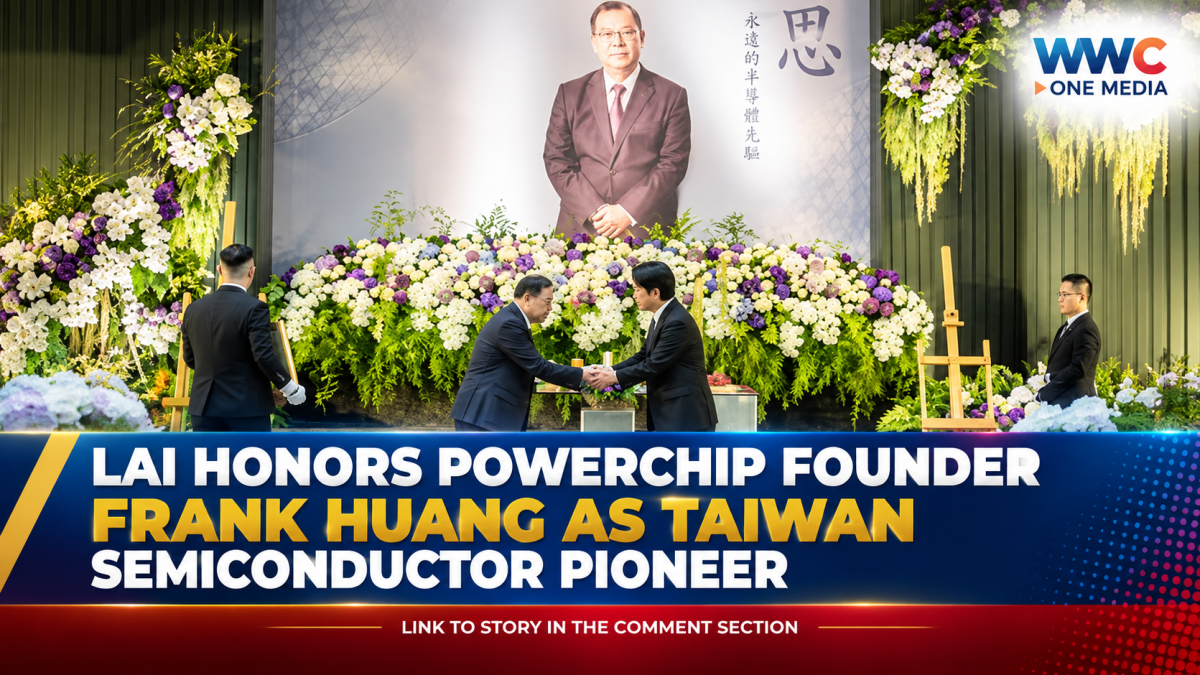
TAIPEI, Taiwan — President Lai Ching-te has honored the late Powerchip Semiconductor Manufacturing Corp. founder and chairman Frank Huang, recognizing the veteran technology executive for helping shape Taiwan’s semiconductor industry and promoting the development of chip talent.
Lai attended a memorial service for Huang on Saturday and presented a posthumous presidential commendation to Huang’s elder brother, Huang Chung-heng, who accepted the honor on behalf of the family. Huang died on July 31 at age 76.
From Medicine and Academia to Taiwan’s Chip Industry
Huang’s career was unusual even by the standards of Taiwan’s technology sector.
After earning a medical degree in the United States, he returned to Taiwan and entered academia before making a major career shift into business. At 38, he left teaching and founded Umax Computer in 1987.
Seven years later, in 1994, Huang established Powerchip Semiconductor in partnership with Japan’s Mitsubishi Electric, beginning a decades-long career in the semiconductor business.
President Lai described Huang as one of the pioneers of Taiwan’s semiconductor industry, particularly for his ability to keep the company moving through some of the sector’s most difficult periods.
Powerchip’s Dramatic Turnaround
Huang’s legacy was not built only during periods of growth.
Powerchip faced severe financial pressure following the collapse in DRAM prices and accumulated substantial debt. The company was eventually delisted from Taiwan’s over-the-counter market in 2012.
Rather than abandon the business, Huang led a restructuring effort that, according to Taiwan News citing company and industry information, resulted in roughly NT$120 billion in debt being repaid over eight years.
The company subsequently shifted its focus from DRAM manufacturing toward wafer foundry services. Powerchip Semiconductor Manufacturing Corp. eventually returned to Taiwan’s main board in 2021.
That turnaround became one of the defining chapters of Huang’s career and a major reason for the recognition he received after his death.
Beyond Powerchip: Building Taiwan’s Semiconductor Ecosystem
Huang’s influence extended beyond his own company.
He served in leadership positions at organizations including the Taipei Computer Association, Taiwan Semiconductor Industry Association and World Semiconductor Council, giving him a role in representing Taiwan’s technology sector both domestically and internationally.
He also pushed for greater investment in semiconductor education and research.
According to the Presidential Office account cited by Taiwan News, Huang personally approached then-President Tsai Ing-wen in 2021 to advocate the establishment of semiconductor research institutes and stronger efforts to develop technology talent.
That focus on talent is particularly significant as Taiwan continues to strengthen its position in the global semiconductor supply chain amid intense international demand for advanced chips.
A Legacy That Goes Beyond One Company
Huang’s death in July prompted tributes from Taiwan’s technology community, with Focus Taiwan reporting that the 76-year-old executive had spent decades helping develop the island’s semiconductor sector. Reuters separately reported that Huang died from cardiopulmonary failure.
His contributions also extended into education and culture. The presidential commendation recognized his work in international technology cooperation, semiconductor talent development and cultural activities. Huang had previously received the Ministry of Culture’s Wen-Hsieh Medal and an honorary Doctor of Engineering degree from National Yang Ming Chiao Tung University.
For Lai, however, Huang’s most important legacy may have been his persistence.
The president highlighted Huang’s belief that people should do their best, refuse to give up and continue working toward success. Lai also recalled Huang’s confidence that semiconductors would remain essential to the world’s future.
Why It Matters
Taiwan’s global semiconductor reputation is often associated with its largest chipmakers, but the industry was built over decades by a much broader network of entrepreneurs, engineers, researchers and manufacturers.
Huang’s story reflects that history: a medical graduate who moved into technology, founded a semiconductor company during a period of rapid industrial transformation, survived major financial challenges and later pushed for stronger semiconductor education.
His posthumous recognition therefore serves as more than a tribute to one businessman. It is also a reminder of the generations of industry leaders who helped turn Taiwan into one of the world’s most important semiconductor hubs.




Leave a Reply