
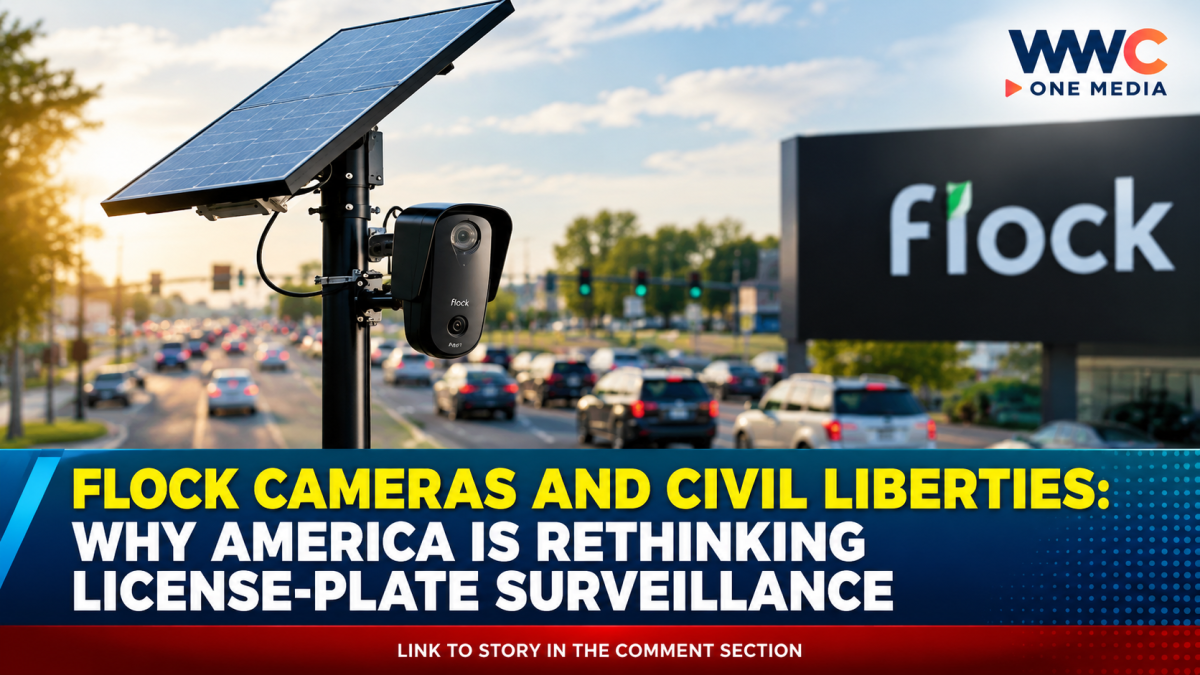
What if a camera could quietly record where your car goes—even when you are not suspected of committing a crime?
That question is at the center of a rapidly growing debate over Flock Safety cameras, a network of automated license-plate readers (ALPRs) that has expanded across communities in the United States.
Police departments describe the technology as a powerful investigative tool. Civil-liberties advocates see a very different risk: a system capable of creating detailed records of vehicle movements across public spaces.
The controversy is no longer confined to privacy activists. In 2026, the backlash has spread to local governments, lawmakers and voters, making Flock cameras an increasingly contentious issue in the broader debate over technology, policing and individual rights.
What are Flock cameras?
Flock Safety’s cameras are designed primarily as automated license-plate readers. They can capture images of passing vehicles and identify information such as a license plate, vehicle make, model, color and other visual characteristics.
That information can then become searchable by authorized users for investigations.
The technology’s appeal to law enforcement is straightforward. Police can use vehicle data to help investigate crimes such as vehicle thefts, shootings and other incidents, or locate missing people.
Flock says its technology helped authorities locate more than 10,000 missing people in 2025 and supported roughly 1 million criminal investigations that year. Those are company-reported figures, rather than an independent assessment of the system’s overall effectiveness.
Why civil-liberties groups are alarmed
The central concern is not simply whether one camera photographs a license plate.
It is what happens when thousands of cameras are connected into a searchable network.
The American Civil Liberties Union argues that widespread ALPR networks can enable authorities to reconstruct people’s movements without requiring that those individuals be suspected of a crime. The organization has described the growth of these systems as a potential form of mass surveillance.
Privacy advocates also question how long information should be retained, who can access it, when searches require justification and whether data can be shared across jurisdictions.
Those questions become particularly important because a vehicle’s movements can reveal highly sensitive patterns about a person’s life without the camera ever identifying the driver directly.
Misuse has intensified the controversy
One of the strongest arguments for tighter safeguards comes from incidents involving inappropriate access.
Recent reporting from San Jose described a police officer who was terminated after investigators determined that he improperly used the department’s Flock system to track a domestic-violence victim and provide her location to a relative. The incident has become another example of why critics argue that access controls and auditing cannot simply rely on individual officers acting responsibly.
Such cases do not establish that every Flock user misuses the technology. They do, however, highlight the potential consequences when powerful surveillance databases are accessed for unauthorized purposes.
The backlash is becoming bipartisan
The political reaction is especially notable because opposition to Flock cameras is coming from different parts of the political spectrum.
In August, Republican Sen. Josh Hawley launched a Senate inquiry into Flock Safety, raising questions about how the company collects, retains and disseminates surveillance data.
Meanwhile, privacy advocates and local activists have continued campaigning against the systems.
Texas and Florida lawmakers have also moved toward restrictions, while communities around the country have reconsidered or cancelled contracts.
That has transformed Flock cameras from a relatively obscure policing technology into a national political issue.
Some cities are already pulling back
The debate is producing concrete policy changes.
Englewood, Colorado, recently voted unanimously to terminate its Flock contract after using 12 ALPR cameras. The city also failed to reach agreement on replacing them with another provider, leaving officials to reconsider how vehicle surveillance should be handled.
In Tennessee, several governments have similarly moved in different directions, with some defending Flock technology while others have ended contracts amid concerns about privacy and surveillance.
And in El Paso, Texas, city officials are preparing to debate proposals that could remove roughly 150 Flock cameras and prevent new or extended agreements with Flock or similar surveillance providers.
The pattern suggests that the question is no longer simply whether ALPR technology works. Increasingly, communities are asking whether its benefits justify the privacy risks.
Flock says safety and privacy can coexist
Flock Safety disputes the idea that its technology is inherently incompatible with civil liberties.
The company says its systems are intended to help communities deter crime and investigate incidents while incorporating privacy protections. In August 2026, Flock announced additional governance measures and said its default data-retention period had been reduced to seven days, although individual customer policies and legal requirements can affect how information is handled.
The company also maintains that public safety and individual civil liberties do not have to be opposing goals.
That argument is central to the debate: the technology may provide investigators with information they would otherwise struggle to obtain, but safeguards have to determine who can access that information and under what circumstances.
The bigger question goes beyond Flock
Flock Safety is only one company operating in the broader ALPR and surveillance market.
Other systems can collect similar vehicle-location information, meaning that removing one vendor does not necessarily end the underlying privacy debate. The Salt Lake Tribune recently reported similar civil-liberties concerns involving another license-plate-reader system, with the ACLU warning about potential data sharing and surveillance.
That makes the Flock controversy part of a much larger question about how much surveillance society should accept in exchange for public safety.
Supporters argue that investigators need modern tools to respond to modern crime.
Critics counter that a society should not create a permanent record of ordinary people’s movements simply because the technology makes it possible.
The challenge for governments is finding the line between those two positions—and establishing rules strong enough to prevent a crime-fighting tool from becoming a system of routine population tracking.
As more cities reconsider their contracts and lawmakers examine the technology, the future of Flock cameras may ultimately depend less on what the cameras can see and more on what governments are legally and ethically allowed to do with what they see.




Leave a Reply